




Short Intro
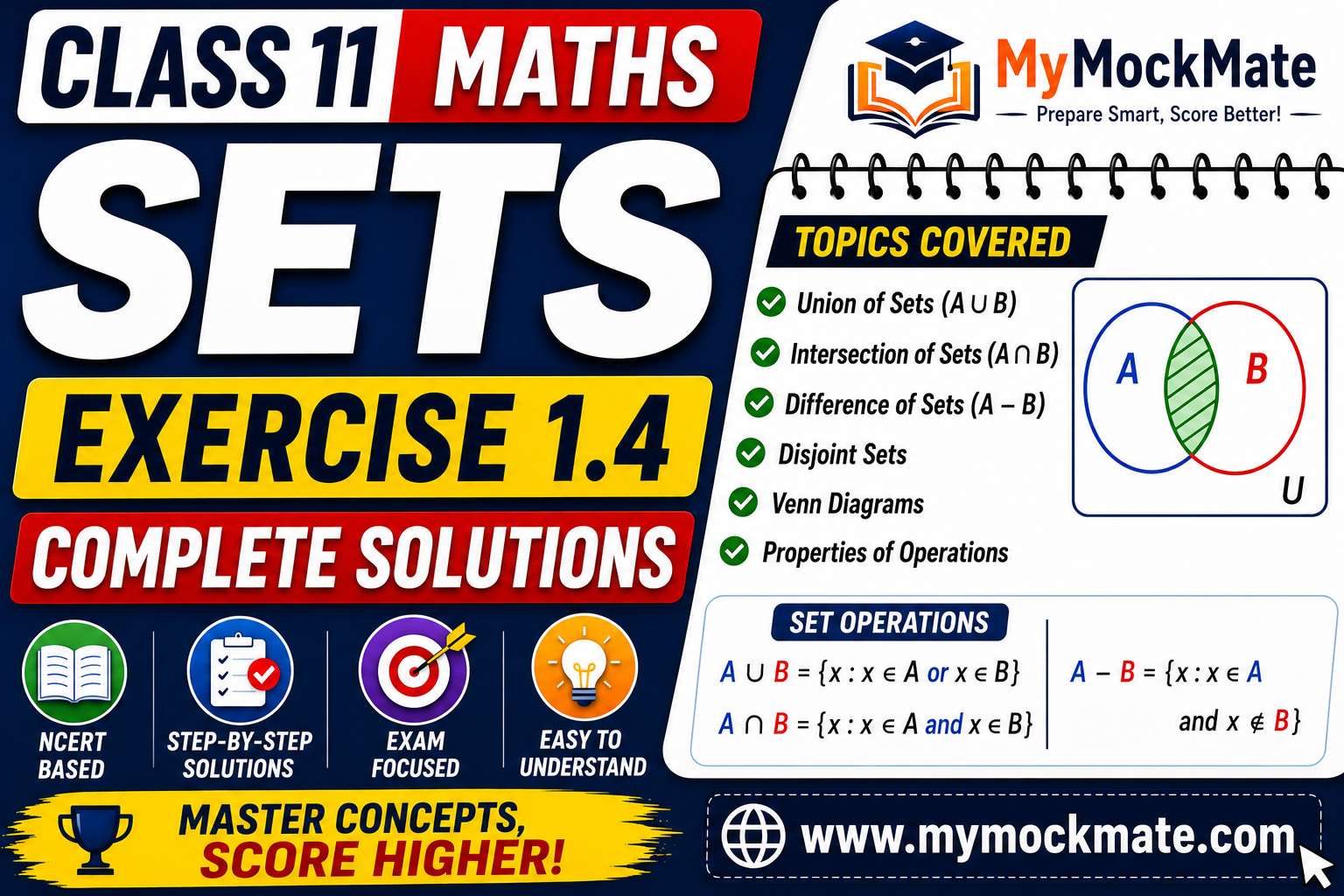
Class 11 Maths Chapter 1 “Sets” Exercise 1.4 focuses on Union, Intersection, Difference of Sets and Disjoint Sets. In this article, students will get complete NCERT solutions with step-by-step explanations in simple language for better exam preparation. These questions are very important for CBSE Board Exams, School Tests and Competitive Exams.
Quick Information Box
| Particular | Details |
|---|---|
| Class | 11 |
| Subject | Mathematics |
| Chapter | Sets |
| Exercise | 1.4 |
| Board | NCERT / CBSE |
| Main Topics | Union, Intersection, Difference of Sets |
| Difficulty Level | Easy to Moderate |
Concepts Used (Topics Covered)
- Union of Sets
- Intersection of Sets
- Difference of Sets
- Disjoint Sets
- Universal Set
- Venn Diagram Concepts
- Set Operations
According to the NCERT chapter, union means combining elements of both sets, while intersection means common elements.
Important Formulas
Union of Sets
Intersection of Sets
Difference of Sets
Disjoint Sets
Questions & Step-by-step Solutions
Question 1
Find the union of each of the following pairs of sets.
(i)
Given:
X = {1, 3, 5}
Y = {1, 2, 3}
Solution
Union means all distinct elements from both sets.
Therefore,
X ∪ Y = {1, 2, 3, 5}
(ii)
A = {a, e, i, o, u}
B = {a, b, c}

Solution
A ∪ B = {a, e, i, o, u, b, c}
(iii)
A = {Multiples of 3}
B = {Natural numbers less than 6}
Solution
A = {3, 6, 9, 12, …}
B = {1, 2, 3, 4, 5}
Therefore,
A ∪ B = {1, 2, 3, 4, 5, 6, 9, 12, …}
(iv)
A = {x : 1 < x ≤ 6}
B = {x : 6 < x < 10}
Solution
A = {2, 3, 4, 5, 6}
B = {7, 8, 9}
Therefore,
A ∪ B = {2, 3, 4, 5, 6, 7, 8, 9}
(v)
A = {1, 2, 3}
B = φ
Solution
Union of any set with null set is the set itself.
Therefore,
A ∪ B = {1, 2, 3}
Question 2
Let A = {a, b}, B = {a, b, c}. Is A ⊂ B ? What is A ∪ B ?
Solution
Every element of A is present in B.
Therefore,
A ⊂ B
Now,
A ∪ B = {a, b, c}
Question 3
If A and B are two sets such that A ⊂ B, then what is A ∪ B ?
Solution
If A is a subset of B, then all elements of A are already present in B.
Therefore,
A ∪ B = B
Question 4
Given:
A = {1, 2, 3, 4}
B = {3, 4, 5, 6}
C = {5, 6, 7, 8}
D = {7, 8, 9, 10}
(i) A ∪ B
= {1, 2, 3, 4, 5, 6}
(ii) A ∪ C
= {1, 2, 3, 4, 5, 6, 7, 8}
(iii) B ∪ C
= {3, 4, 5, 6, 7, 8}
(iv) B ∪ D
= {3, 4, 5, 6, 7, 8, 9, 10}
(v) A ∪ B ∪ C
= {1, 2, 3, 4, 5, 6, 7, 8}
(vi) A ∪ B ∪ D
= {1, 2, 3, 4, 5, 6, 7, 8, 9, 10}
(vii) B ∪ C ∪ D
= {3, 4, 5, 6, 7, 8, 9, 10}
Question 5
Find the intersection of each pair of sets of Question 1.
(i)
X ∩ Y = {1, 3}
(ii)
A ∩ B = {a}
(iii)
A ∩ B = {3}
(iv)
A ∩ B = φ
(v)
A ∩ φ = φ
Question 6
Given:
A = {3, 5, 7, 9, 11}
B = {7, 9, 11, 13}
C = {11, 13, 15}
D = {15, 17}
(i) A ∩ B
= {7, 9, 11}
(ii) B ∩ C
= {11, 13}
(iii) A ∩ C ∩ D
= φ
(iv) A ∩ C
= {11}
(v) B ∩ D
= φ
(vi) A ∩ (B ∪ C)
B ∪ C = {7, 9, 11, 13, 15}
Therefore,
A ∩ (B ∪ C) = {7, 9, 11}
(vii) A ∩ D
= φ
(viii) A ∩ (B ∪ D)
B ∪ D = {7, 9, 11, 13, 15, 17}
Therefore,
A ∩ (B ∪ D) = {7, 9, 11}
(ix)
(A ∩ B) ∩ (B ∪ C)
= {7, 9, 11}
(x)
(A ∪ D) ∩ (B ∪ C)
A ∪ D = {3, 5, 7, 9, 11, 15, 17}
B ∪ C = {7, 9, 11, 13, 15}
Therefore,
= {7, 9, 11, 15}
Question 7
A = Natural Numbers
B = Even Natural Numbers
C = Odd Natural Numbers
D = Prime Numbers
Answers
(i) A ∩ B = Even Natural Numbers
(ii) A ∩ C = Odd Natural Numbers
(iii) A ∩ D = Prime Numbers
(iv) B ∩ C = φ
(v) B ∩ D = {2}
(vi) C ∩ D = {3, 5, 7, 11, …}
Question 8
Which pairs are disjoint sets?
(i)
Common element = 4
Not disjoint
(ii)
Common element = e
Not disjoint
(iii)
Even integers and odd integers have no common element.
Therefore,
They are disjoint sets.
Question 9
Given:
A = {3, 6, 9, 12, 15, 18, 21}
B = {4, 8, 12, 16, 20}
C = {2, 4, 6, 8, 10, 12, 14, 16}
D = {5, 10, 15, 20}
Answers
(i) A – B = {3, 6, 9, 15, 18, 21}
(ii) A – C = {3, 9, 15, 18, 21}
(iii) A – D = {3, 6, 9, 12, 18, 21}
(iv) B – A = {4, 8, 16, 20}
(v) C – A = {2, 4, 8, 10, 14, 16}
(vi) D – A = {5, 10, 20}
(vii) B – C = {20}
(viii) B – D = {4, 8, 12, 16}
(ix) C – B = {2, 6, 10, 14}
(x) D – B = {5, 10, 15}
(xi) C – D = {2, 4, 6, 8, 12, 14, 16}
(xii) D – C = {5, 10, 15, 20}
Question 10
X = {a, b, c, d}
Y = {f, b, d, g}
(i)
X – Y = {a, c}
(ii)
Y – X = {f, g}
(iii)
X ∩ Y = {b, d}
Question 11
If R is set of real numbers and Q is set of rational numbers, then:
R – Q = Irrational Numbers
Question 12
State True or False.
(i)
False
Because 3 is common.
(ii)
False
Because a is common.
(iii)
True
No common element.
(iv)
True
No common element.
Common Mistakes
- Repeating elements while writing union.
- Forgetting common elements in intersection.
- Confusing A – B with B – A.
- Writing repeated elements in sets.
- Forgetting that φ union A = A.
Exam Tips
- Always write distinct elements only once.
- Use curly brackets properly.
- Learn formulas of union and intersection.
- Solve questions using Venn diagrams for better understanding.
- Practice difference of sets carefully.
Practice MCQs
1. If A = {1,2,3} and B = {3,4,5}, then A ∩ B is:
A) {1,2}
B) {3}
C) {4,5}
D) φ
Answer:
B) {3}
2. If A ⊂ B, then A ∪ B equals:
A) A
B) φ
C) B
D) None
Answer:
C) B
3. Two sets are disjoint if:
A) They are equal
B) They have common elements
C) Their intersection is φ
D) Their union is φ
Answer:
C) Their intersection is φ
FAQ Section
Q1. What is union of sets?
Union means combining all elements of both sets without repetition.
Q2. What is intersection of sets?
Intersection means common elements between two sets.
Q3. What are disjoint sets?
Sets having no common element are called disjoint sets.
Q4. What is null set?
A set having no element is called null set or empty set.
📘 Prepare Smarter with MyMockMate!
✅ Chapter-wise NCERT Solutions
✅ Important Notes & MCQs
✅ Online Mock Tests
✅ Instant Result & Analysis
✅ CBSE Board Preparation
Start learning now on MyMockMate