




Short Intro
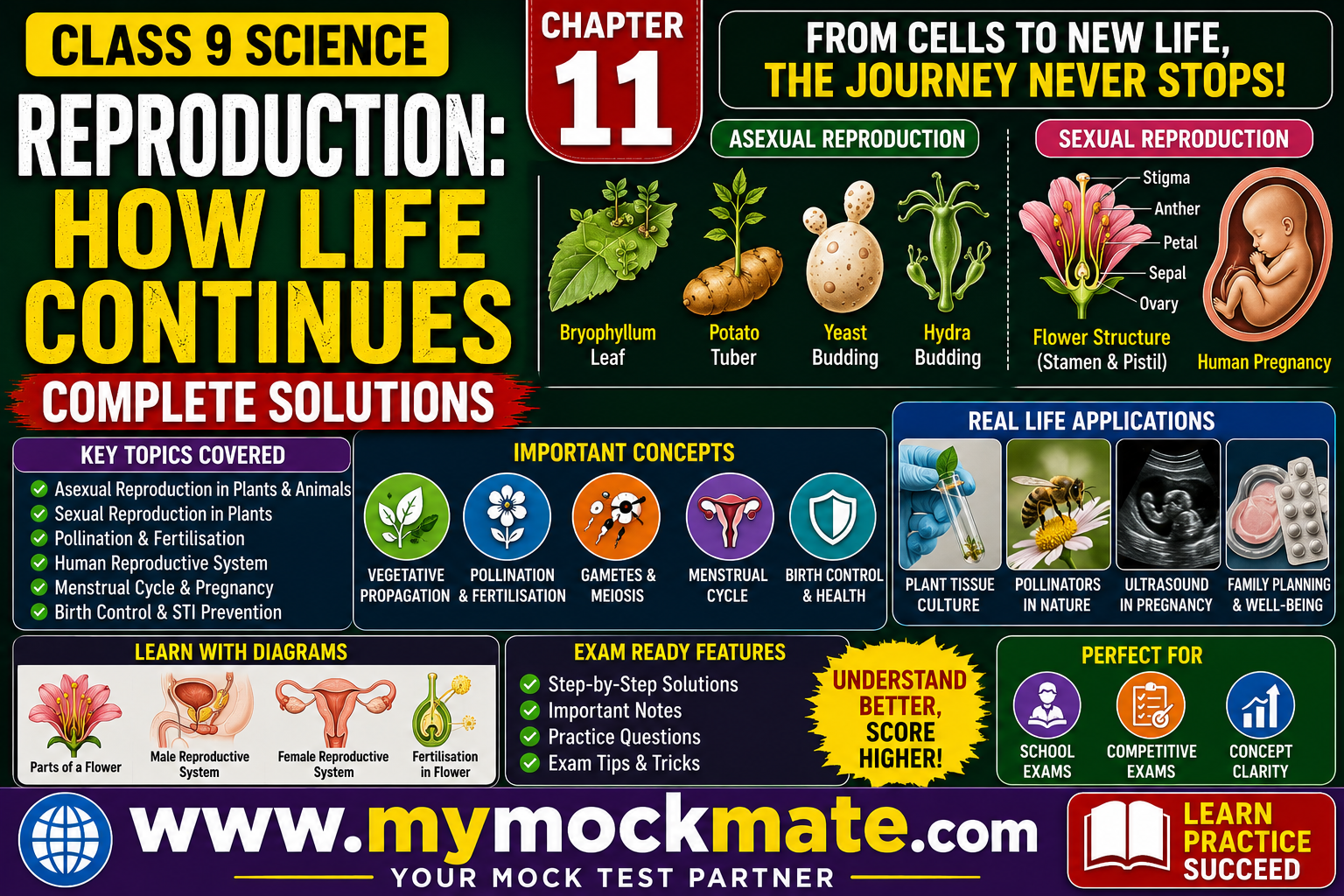
This chapter explains how living organisms reproduce and ensure continuity of life. Students learn about asexual and sexual reproduction in plants and animals, pollination, fertilisation, reproductive systems in humans, menstruation, pregnancy, and methods of birth control with detailed explanations and solved questions.
Quick Information Box
| Topic | Details |
|---|---|
| Chapter Name | Reproduction: How Life Continues |
| Class | Grade 9 |
| Subject | Science |
| Main Topics | Reproduction in Plants and Humans |
| Important Processes | Pollination, Fertilisation, Meiosis |
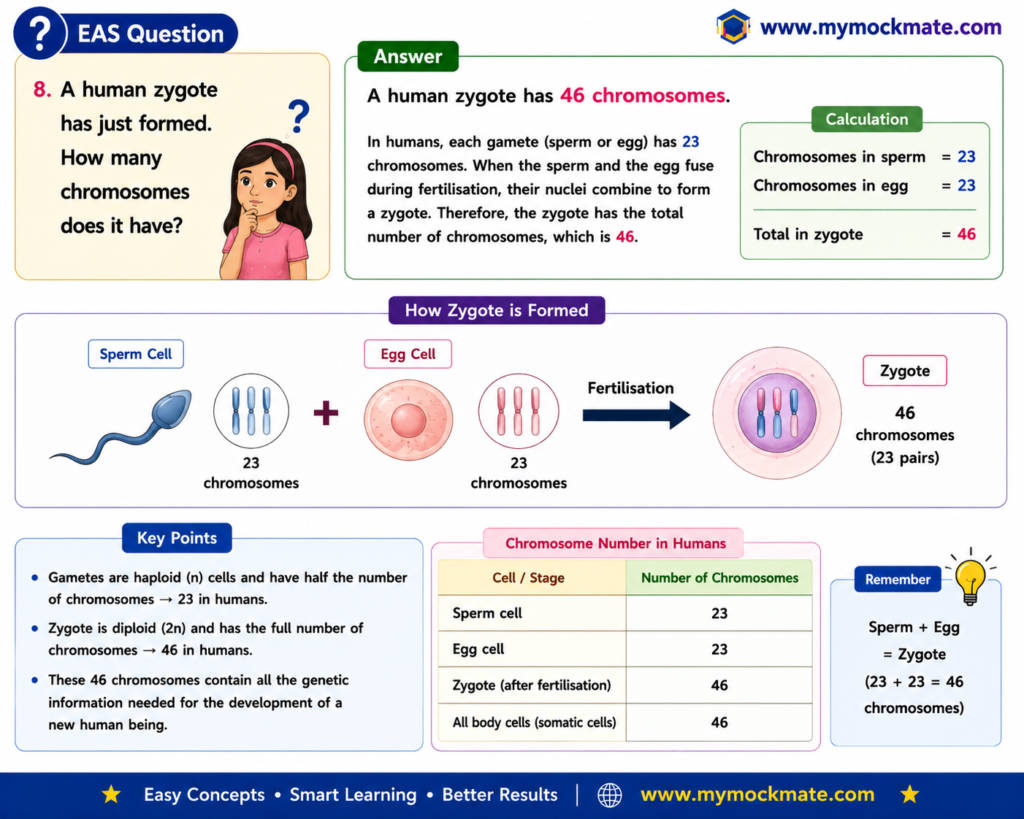
| Human Chromosomes | 46 |
| Gametes Chromosomes | 23 |
Concepts Used (Topics Covered)
- Asexual Reproduction
- Budding and Spore Formation
- Sexual Reproduction
- Meiosis and Gamete Formation
- Pollination and Fertilisation
- Self and Cross Pollination
- Flower Structure
- Reproduction in Animals
- Human Male Reproductive System
- Human Female Reproductive System
- Menstrual Cycle
- Pregnancy and Childbirth
- Contraceptive Methods
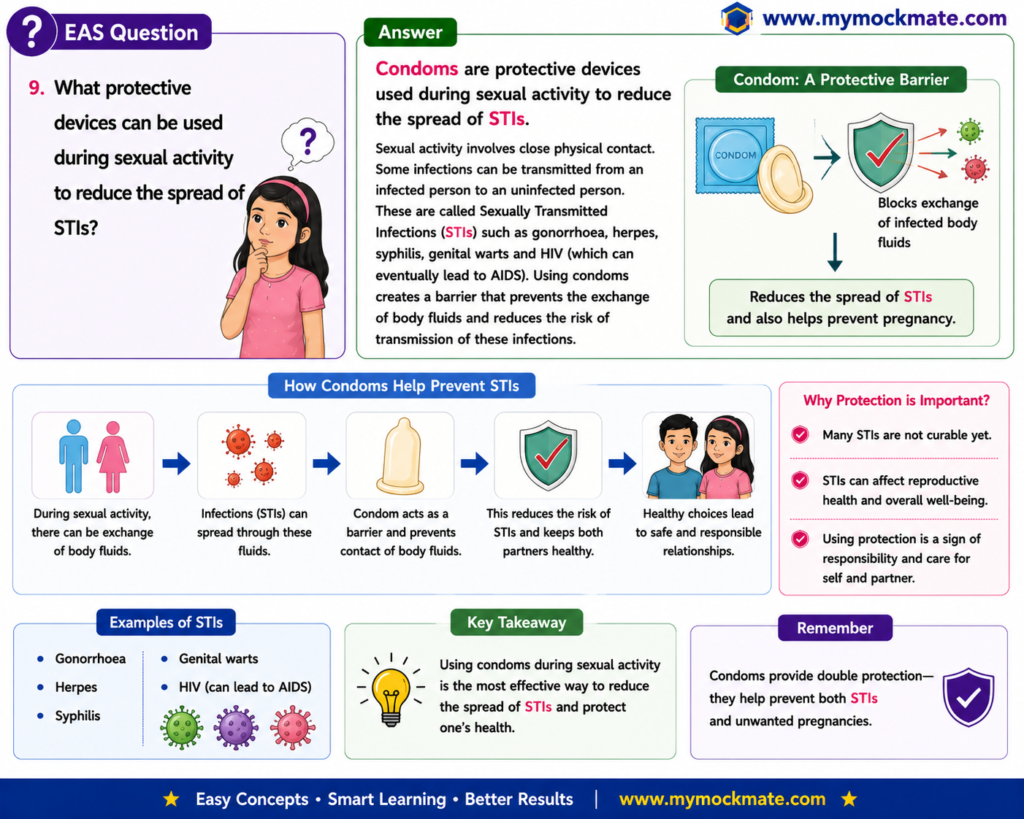
- Sexually Transmitted Infections (STIs)
Important Formulas
- Number of Chromosomes in Human Gametes
= 23 - Number of Chromosomes in Human Body Cells
= 46 - Fertilisation
Male Gamete + Female Gamete → Zygote - Menstrual Cycle Duration
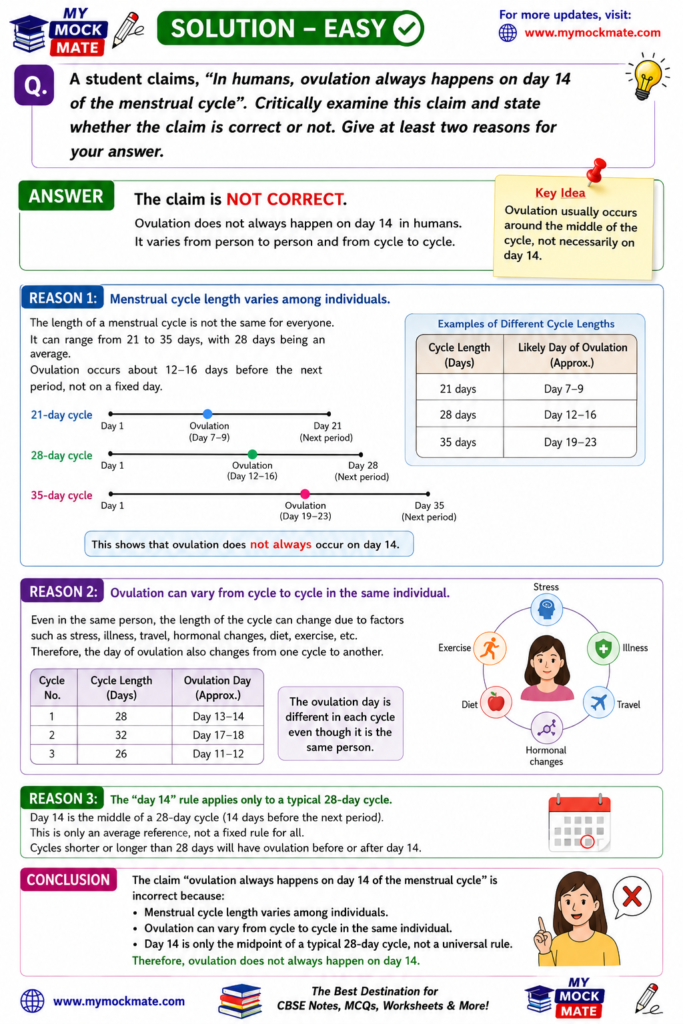
≈ 28 days - Ovulation
Occurs approximately on Day 14
Think It Over
- When does a farmer prefer asexual or sexual methods of reproduction for crops production?
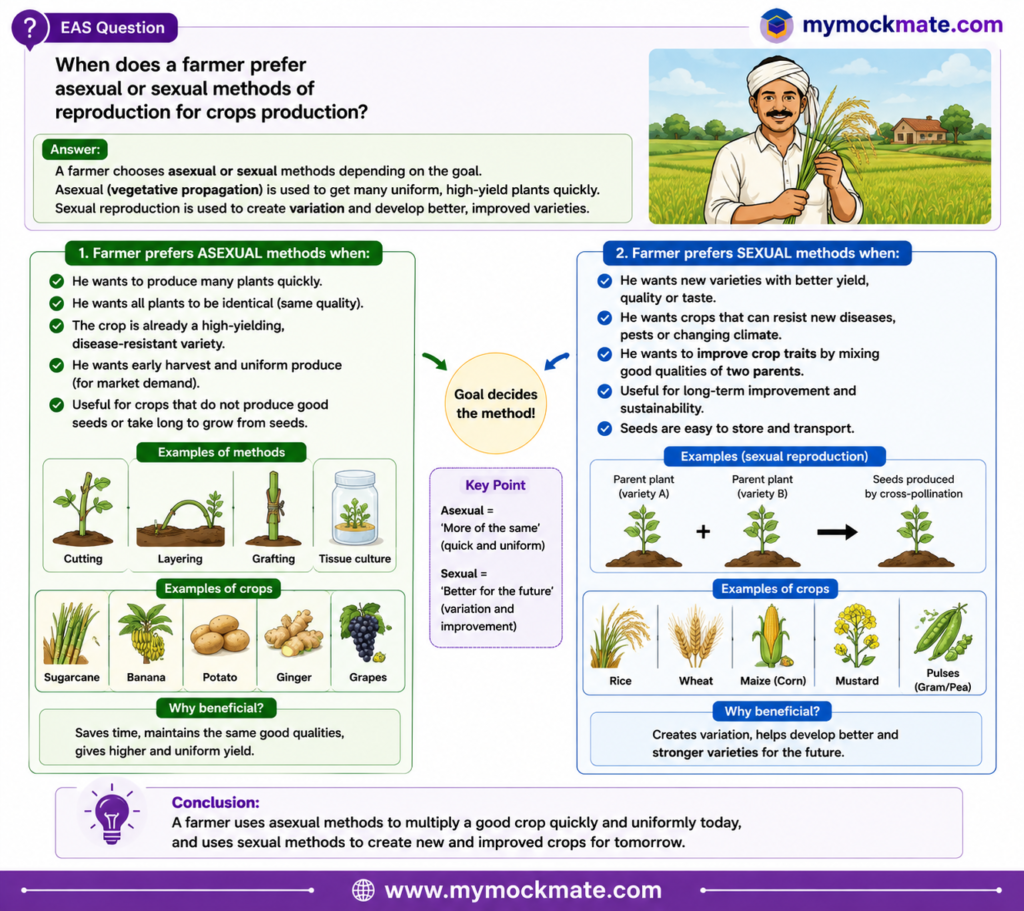
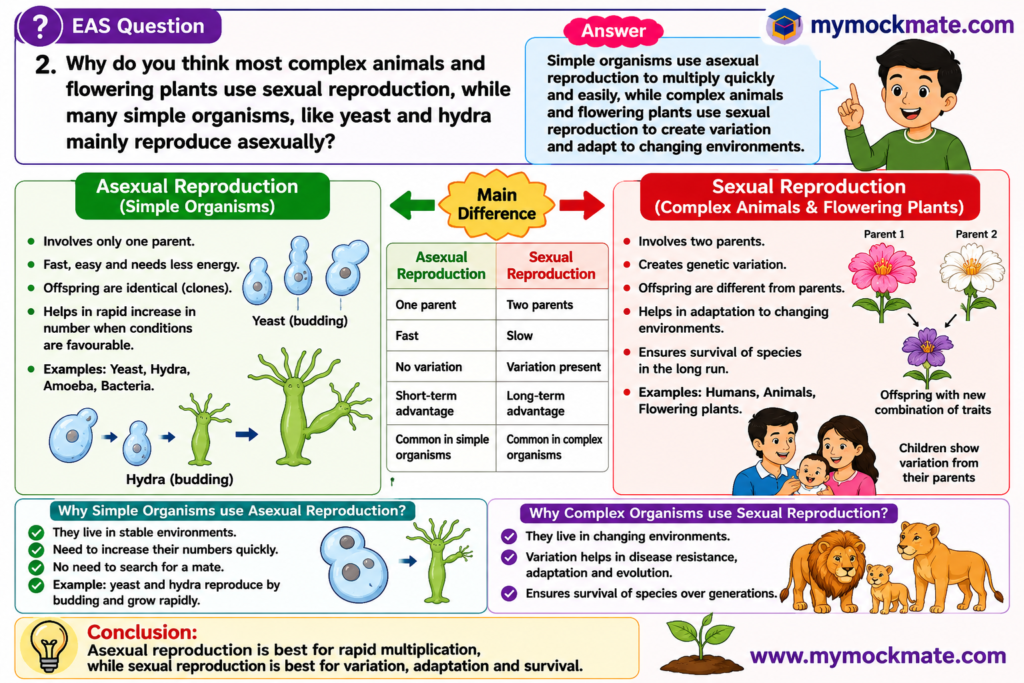
2. Why do you think most complex animals and flowering plants use sexual reproduction, while many simple organisms, like yeast and hydra mainly reproduce asexually?
Pause and Ponder
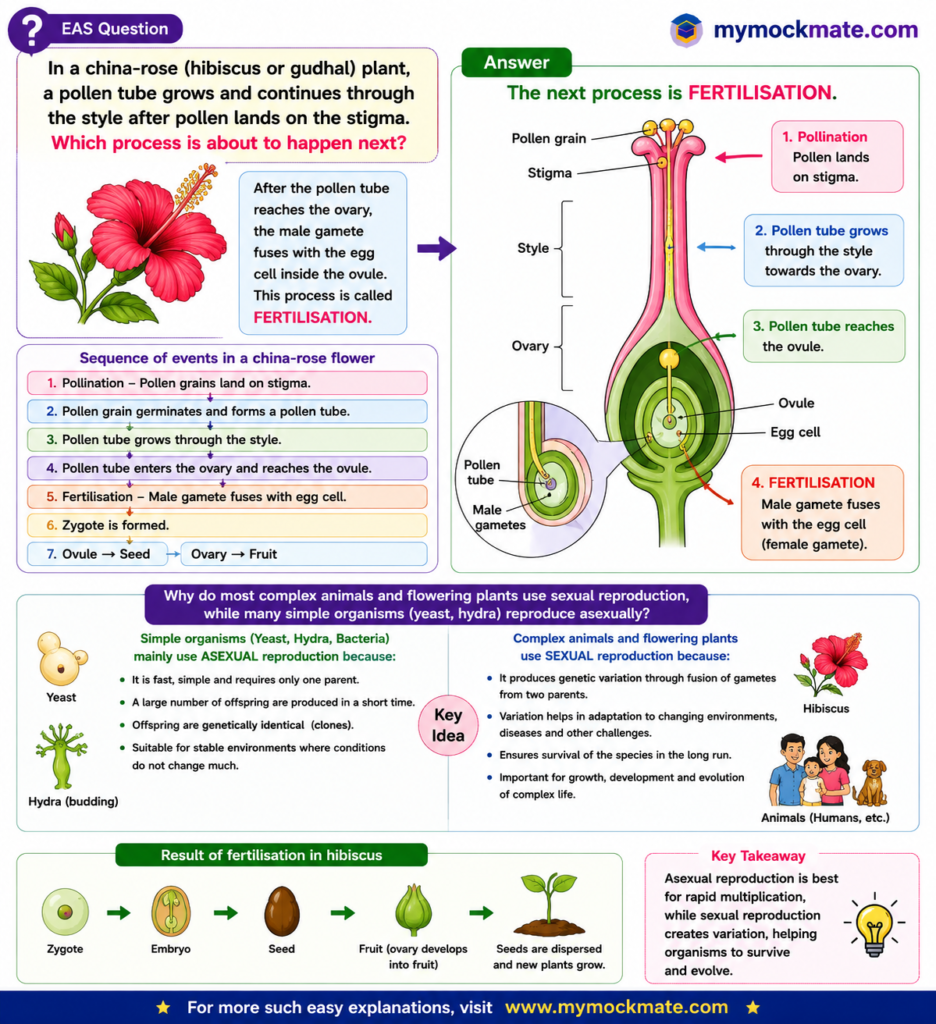
- In a china-rose (hibiscus or gudhal) plant, a pollen tube grows and continues through the style after pollen lands on the stigma. Which process is about to happen next?
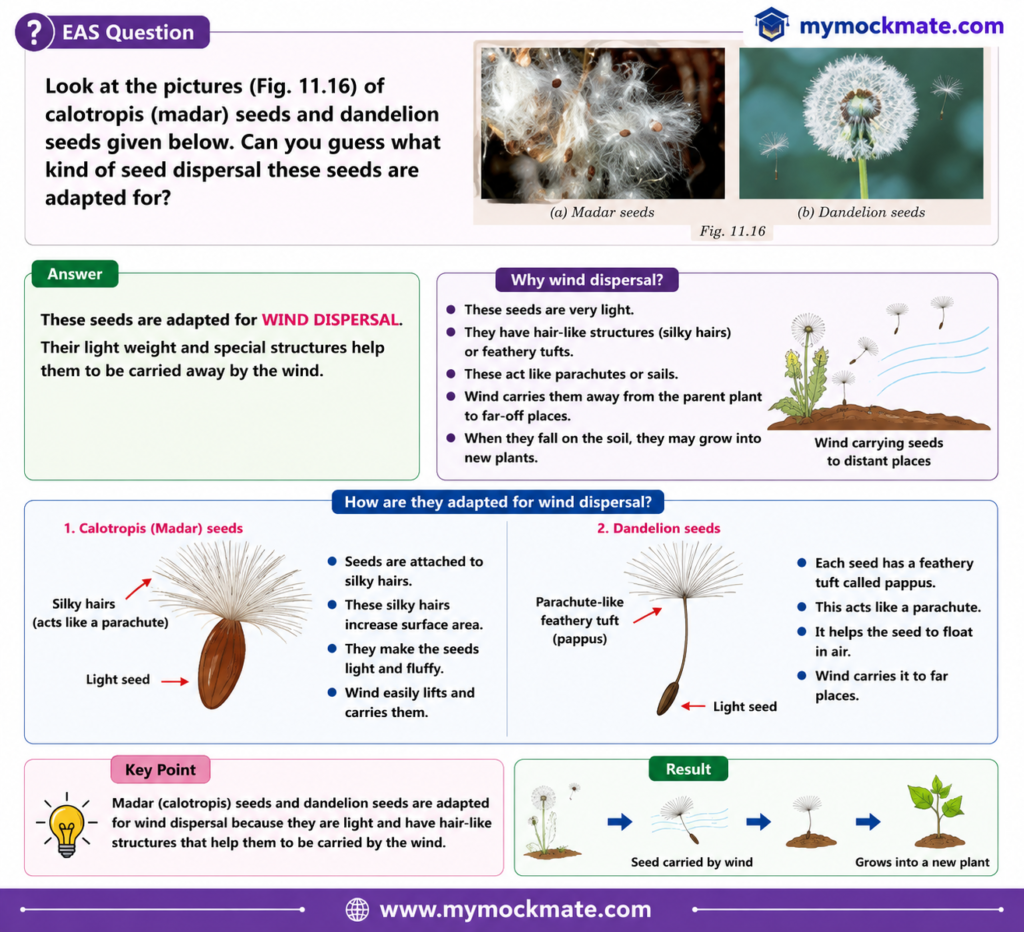
2. Look at the pictures (Fig. 11.16) of calotropis (madar) seeds and dandelion seeds given below. Can you guess what kind of seed dispersal these seeds are adapted for?
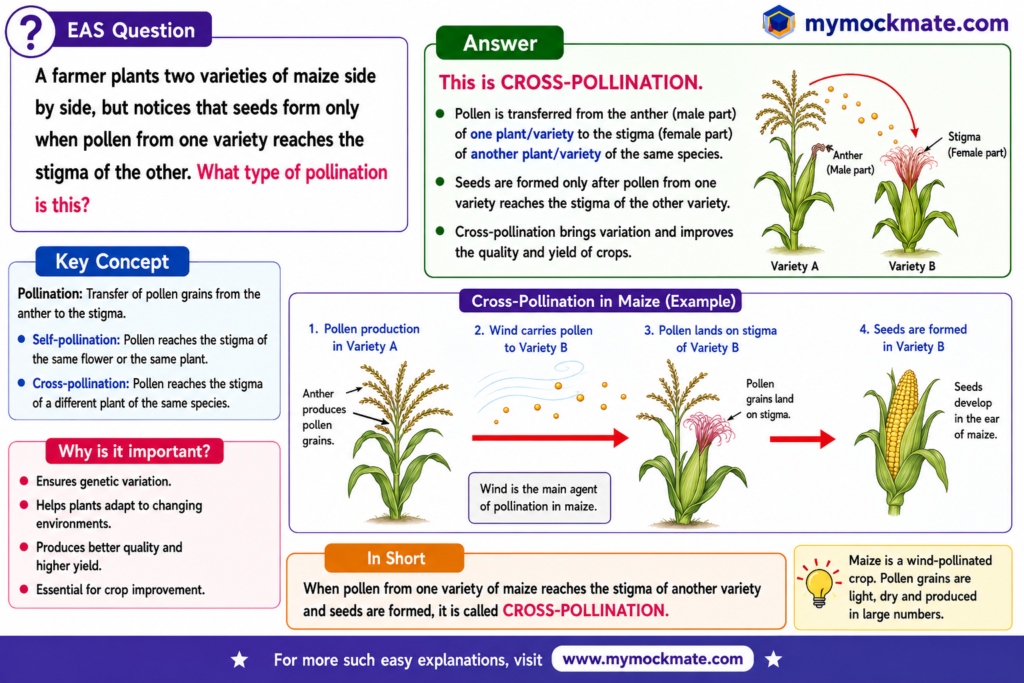
3. A farmer plants two varieties of maize side by side, but notices that seeds form only when pollen from one variety reaches the stigma of the other. What type of pollination is this? Questions & Step-by-step Solutions with Explanation
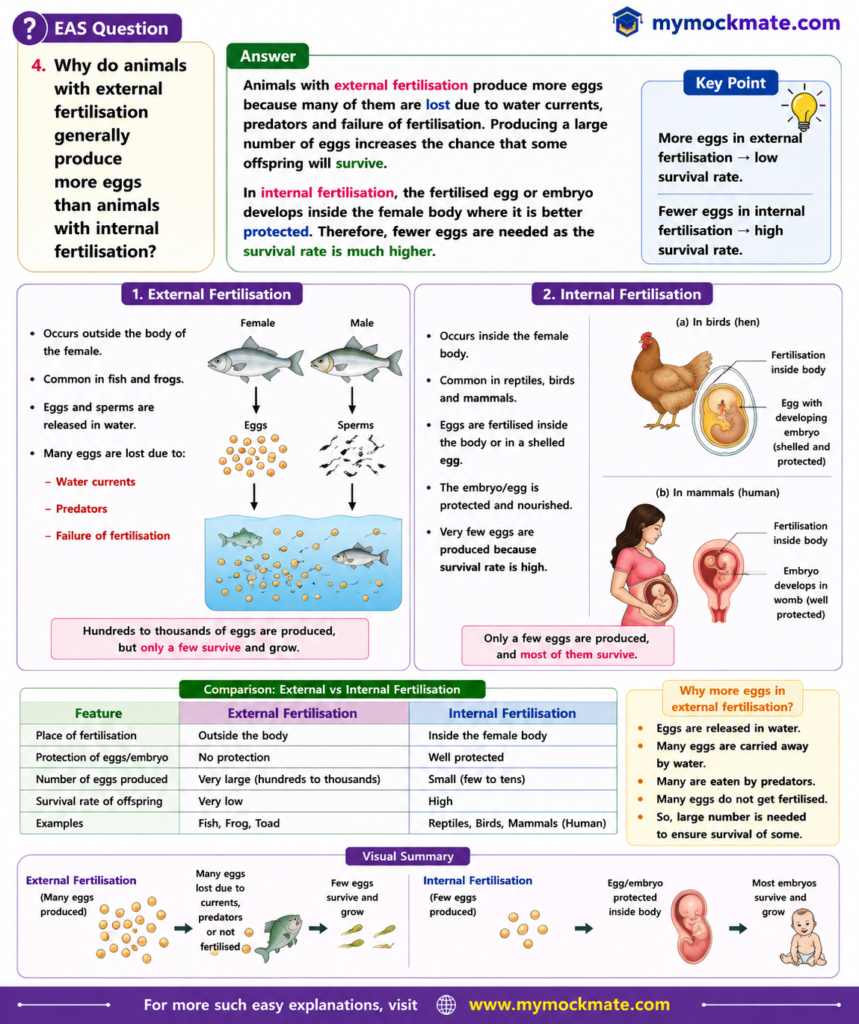
- Why do animals with external fertilisation generally produce more eggs than animals with internal fertilisation?
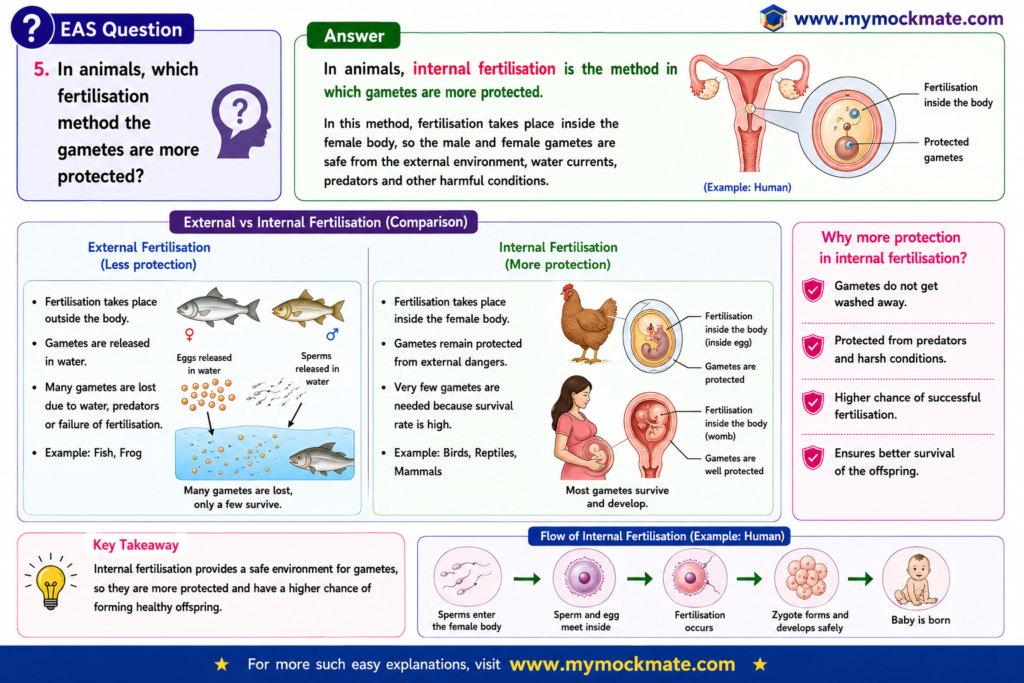
- In animals, which fertilisation method the gametes are more protected?
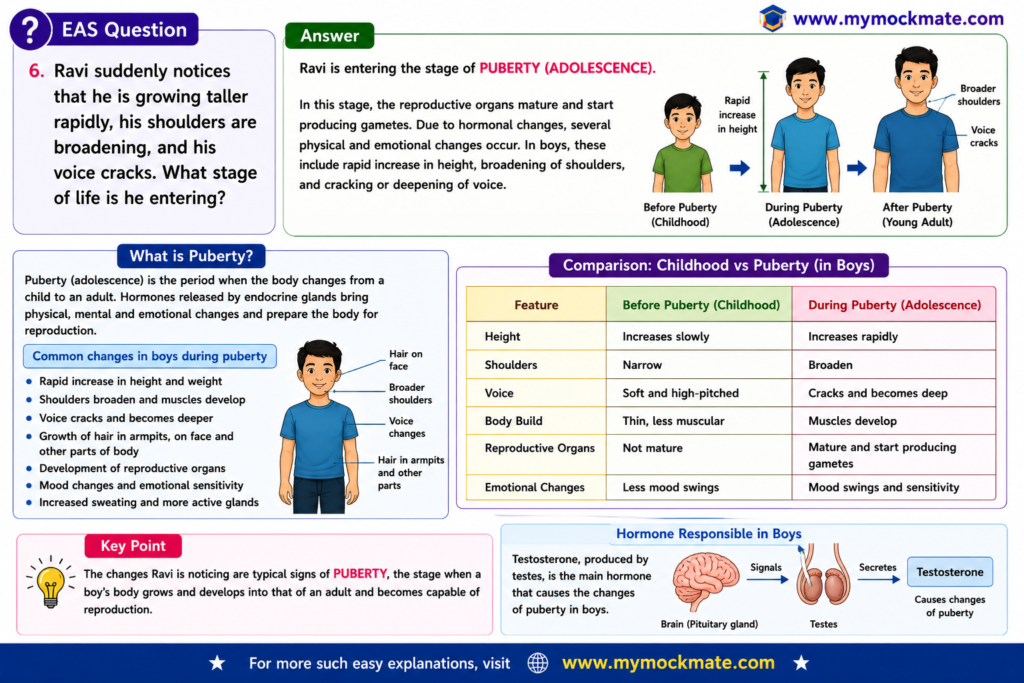
- Ravi suddenly notices that he is growing taller rapidly, his shoulders are broadening, and his voice cracks. What stage of life is he entering?
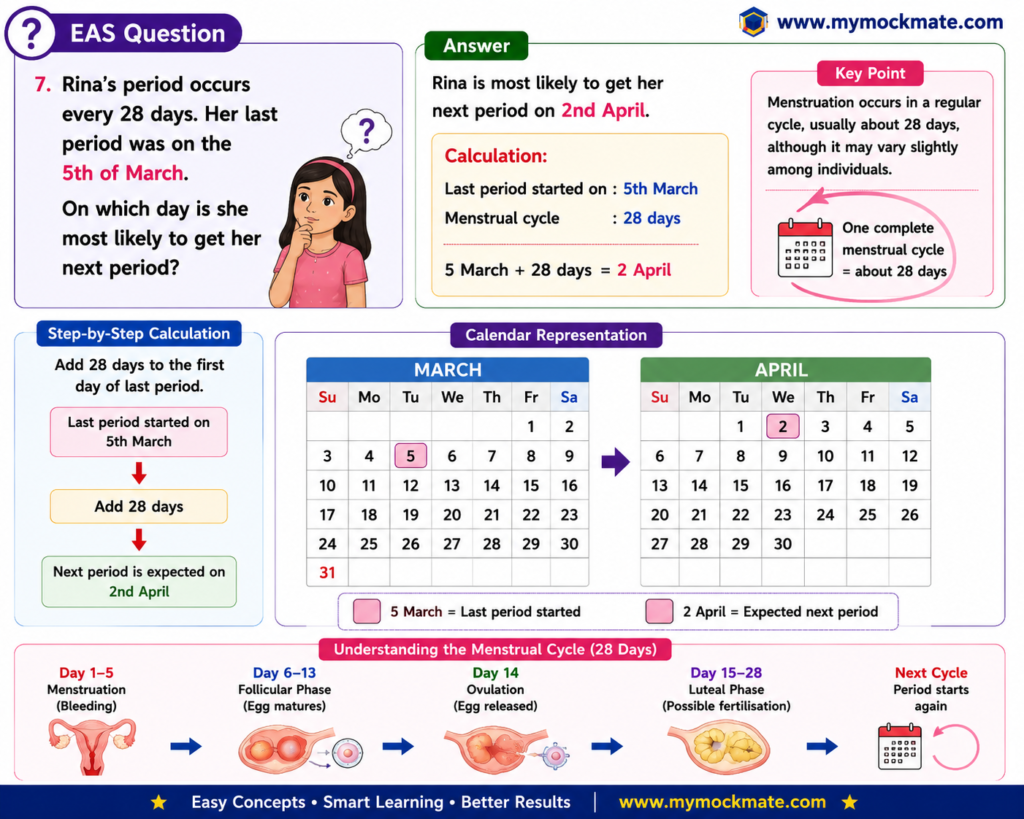
- Rina’s period occurs every 28 days. Her last period was on the 5th of March. On which day is she most likely to get her next period?
8. A human zygote has just formed. How many chromosomes does it have?
9. What protective devices can be used during sexual activity to reduce the spread of STIs?
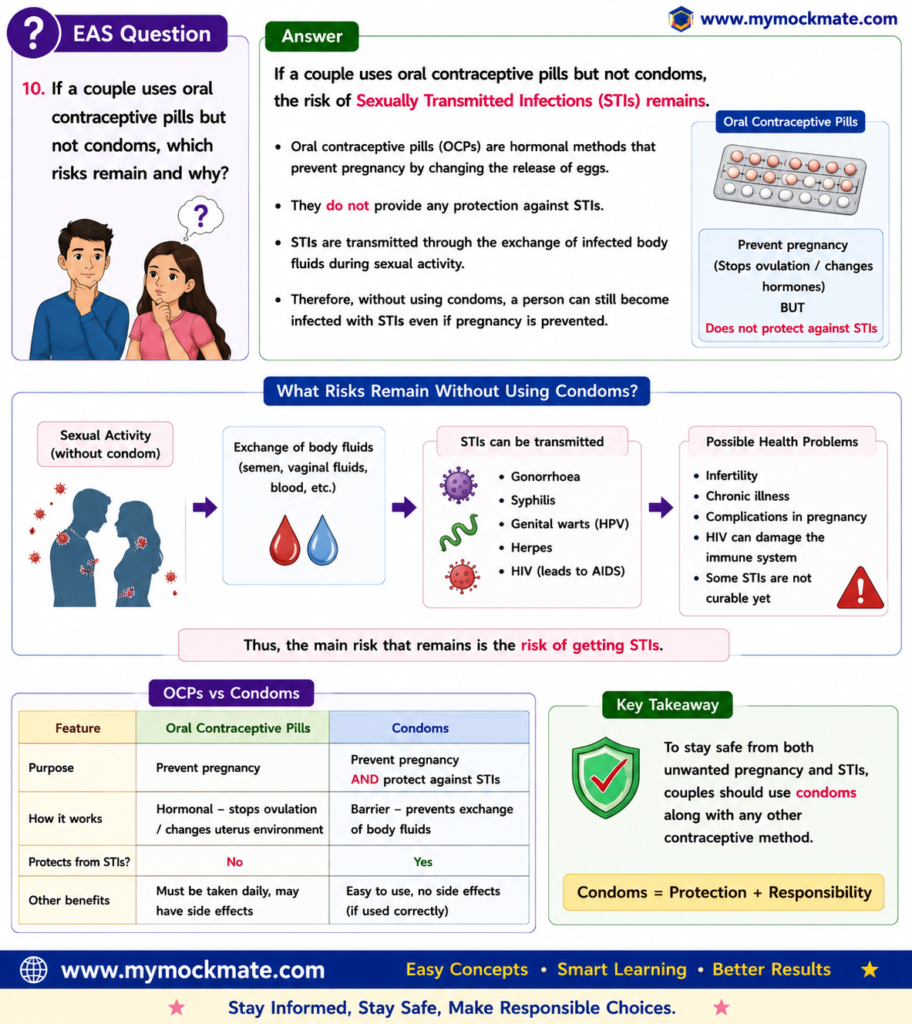
- If a couple uses oral contraceptive pills but not condoms, which risks remain and why?
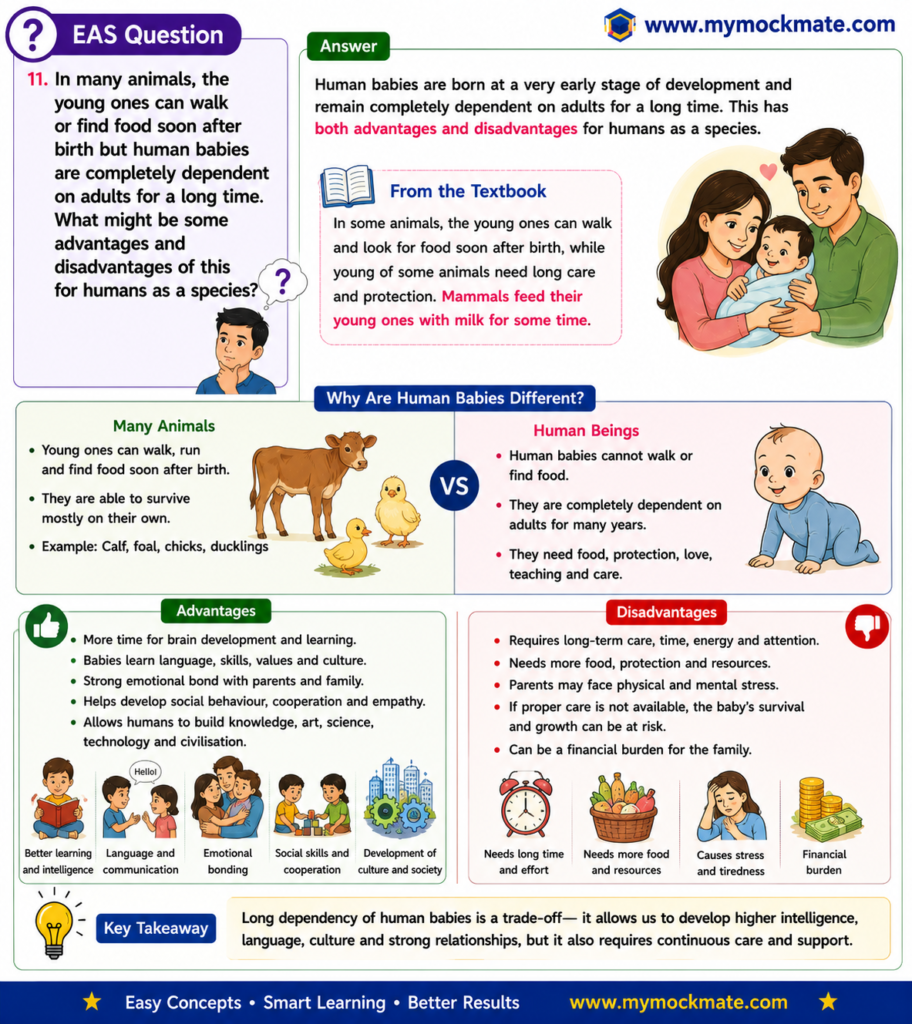
- In many animals, the young ones can walk or find food soon after birth but human babies are completely dependent on adults for a long time. What might be some advantages and disadvantages of this for humans as a species?
Revise, Reflect, Refine
Q1.
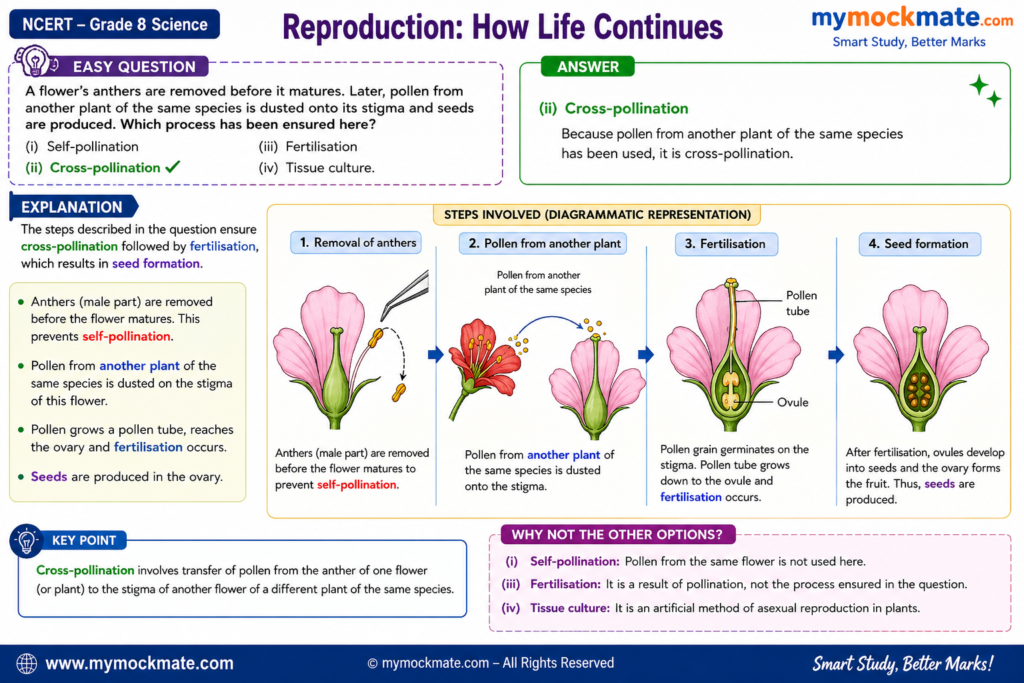
A flower’s anthers are removed before it matures. Later, pollen from another plant of the same species is dusted onto its stigma and seeds are produced. Which process has been ensured here?
(i) Self-pollination
(iii) Fertilisation
(ii) Cross-pollination
(iv) Tissue culture
Answer:
Cross-pollination
Q2.
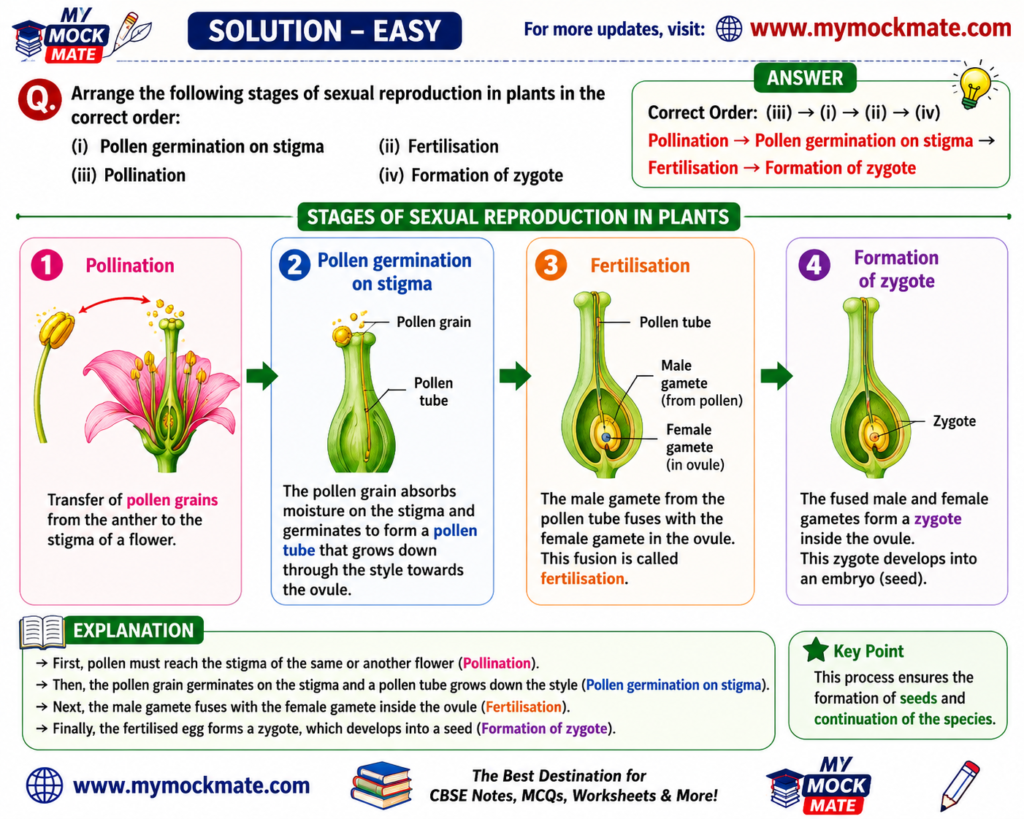
Arrange the following stages of sexual reproduction in plants in the correct order:
(i) Pollen germination on stigma
(ii) Fertilisation
(iii) Pollination
(iv) Formation of zygote
Q3. Assertion and Reason
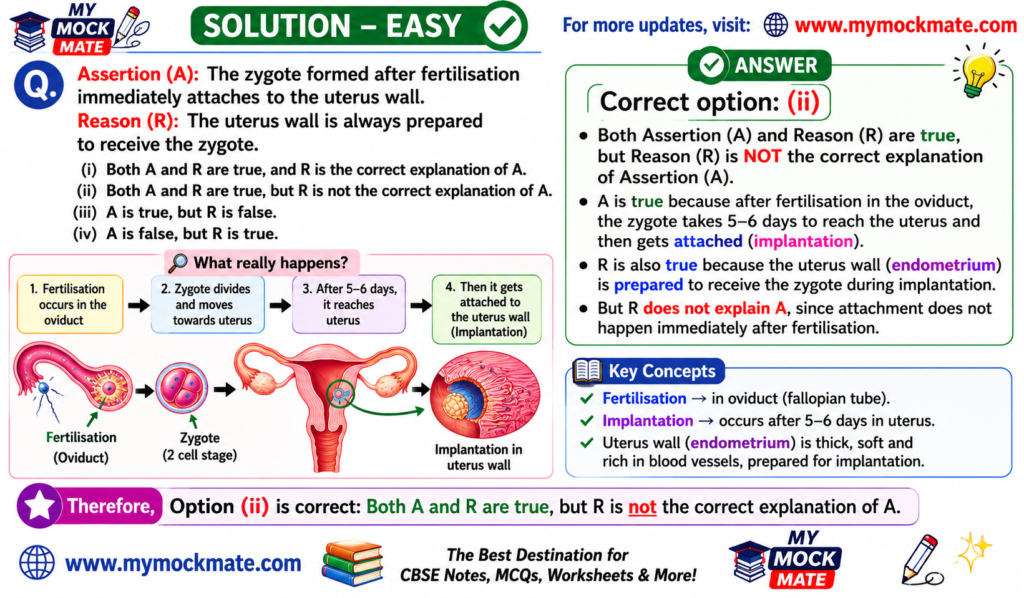
Assertion (A): The zygote formed after fertilisation immediately
attaches to the uterus wall.
Reason (R): The uterus wall is always prepared to receive the zygote.
(i) Both A and R are true, and R is the correct explanation of A.
(ii) Both A and R are true, but R is not the correct explanation of A.
(iii) A is true, but R is false.
(iv) A is false, but R is true.
Q4.
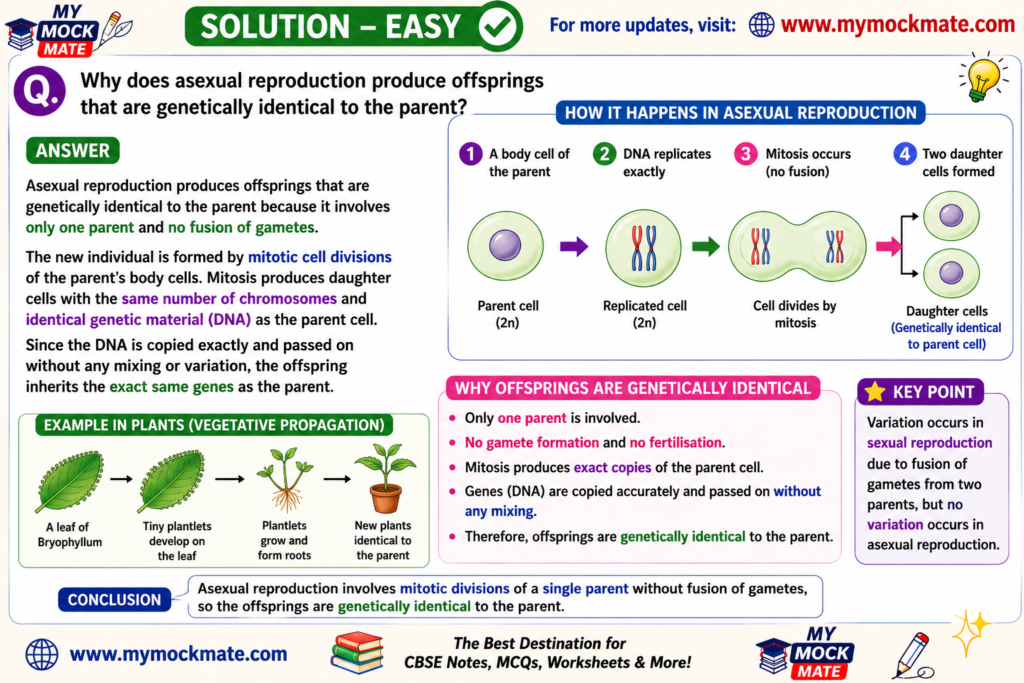
Why does asexual reproduction produce offsprings that are genetically
identical to the parent?
Q5.
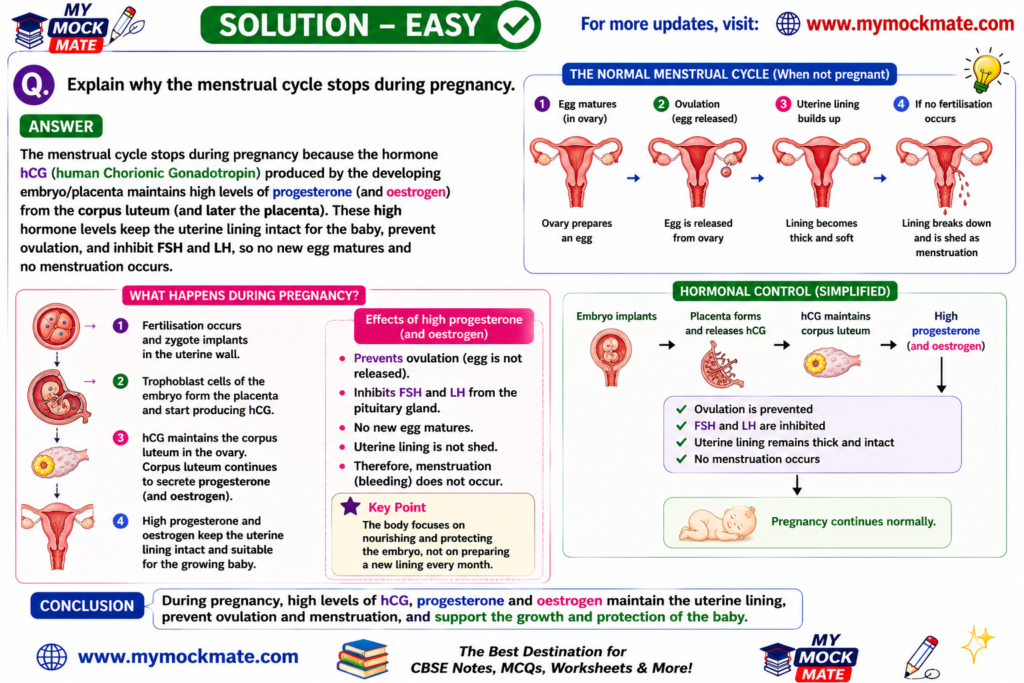
Explain why the menstrual cycle stops during pregnancy.
Q6.
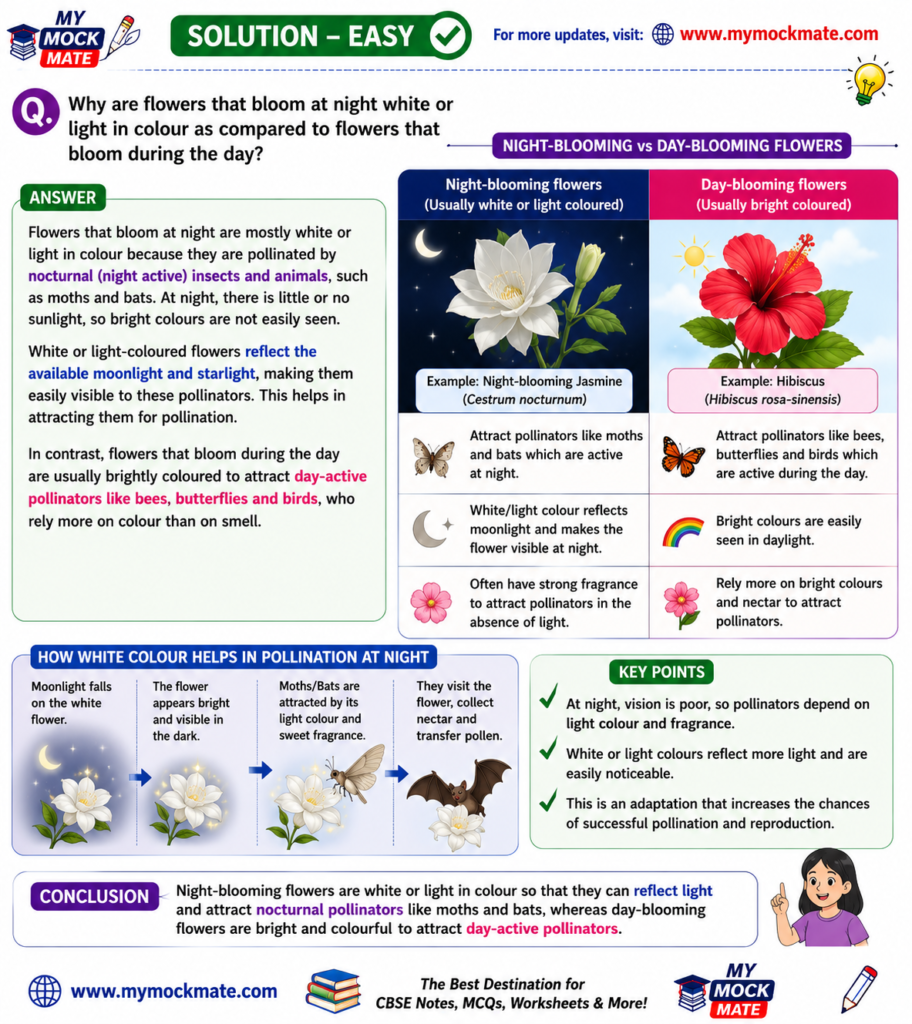
Why are flowers that bloom at night white or light in colour as compared to flowers that bloom during the day?
Q7.
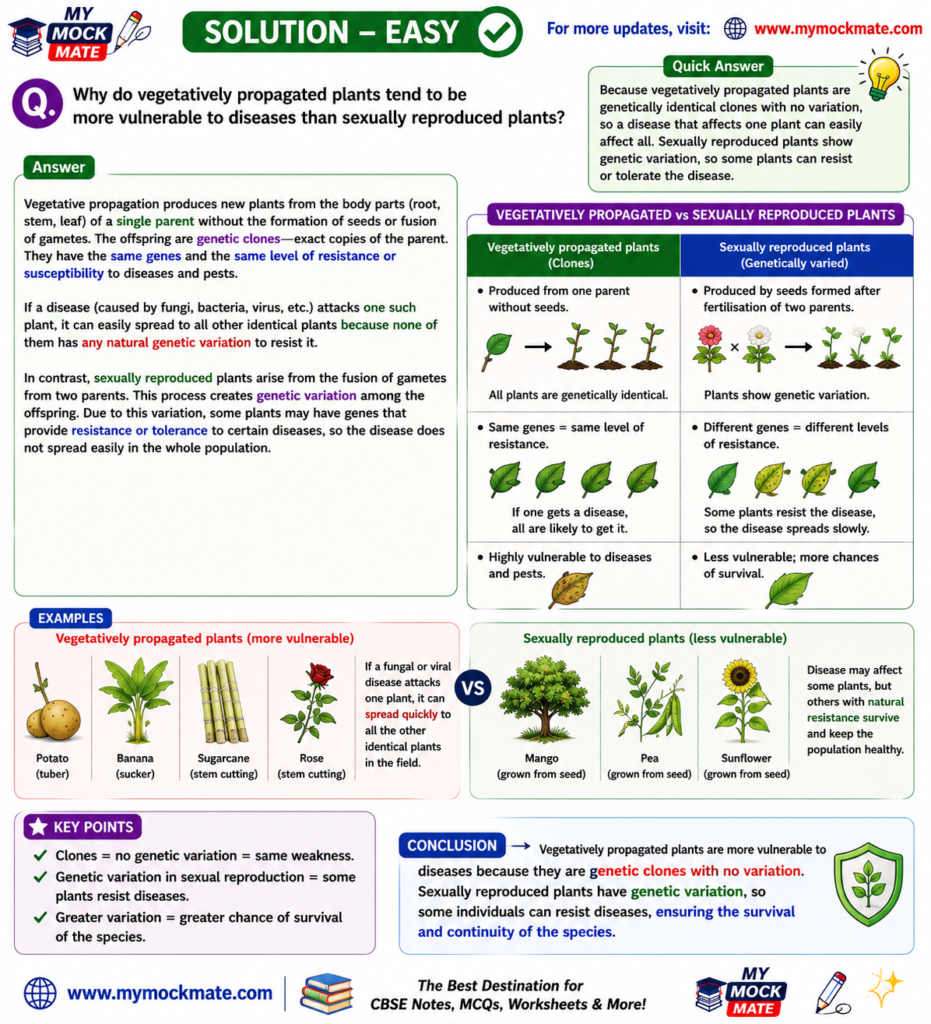
Why do vegetatively propagated plants tend to be more vulnerable to diseases than sexually reproduced plants?
Q8.
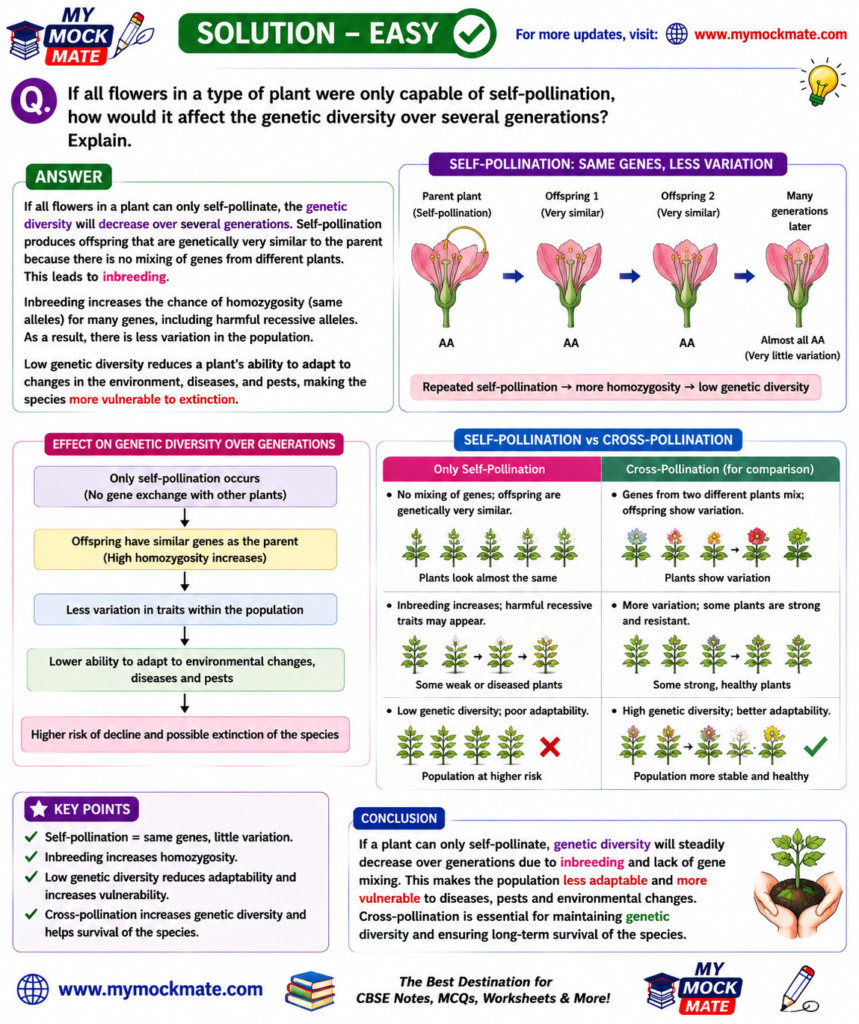
If all flowers in a type of plant were only capable of self-pollination, how would it affect the genetic diversity over several generations? Explain.
Q9.
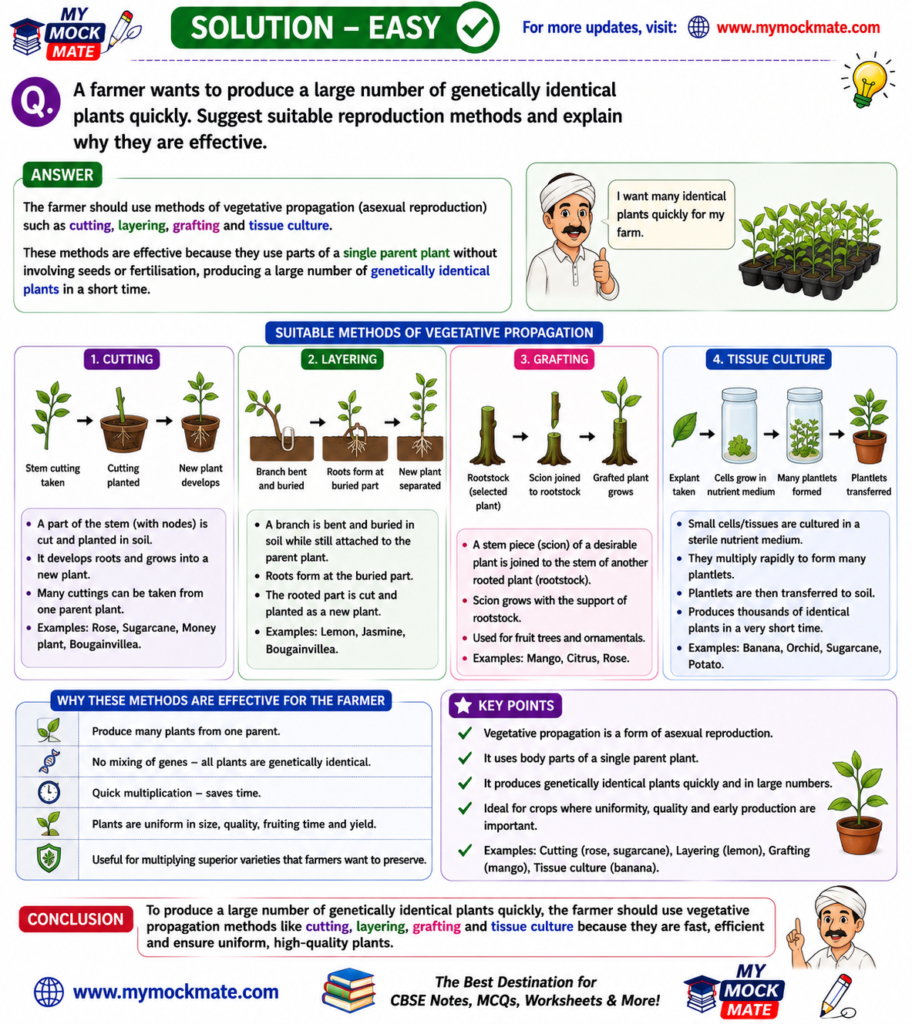
A farmer wants to produce a large number of genetically identical plants quickly. Suggest suitable reproduction methods and explain why they are effective.
Q10.
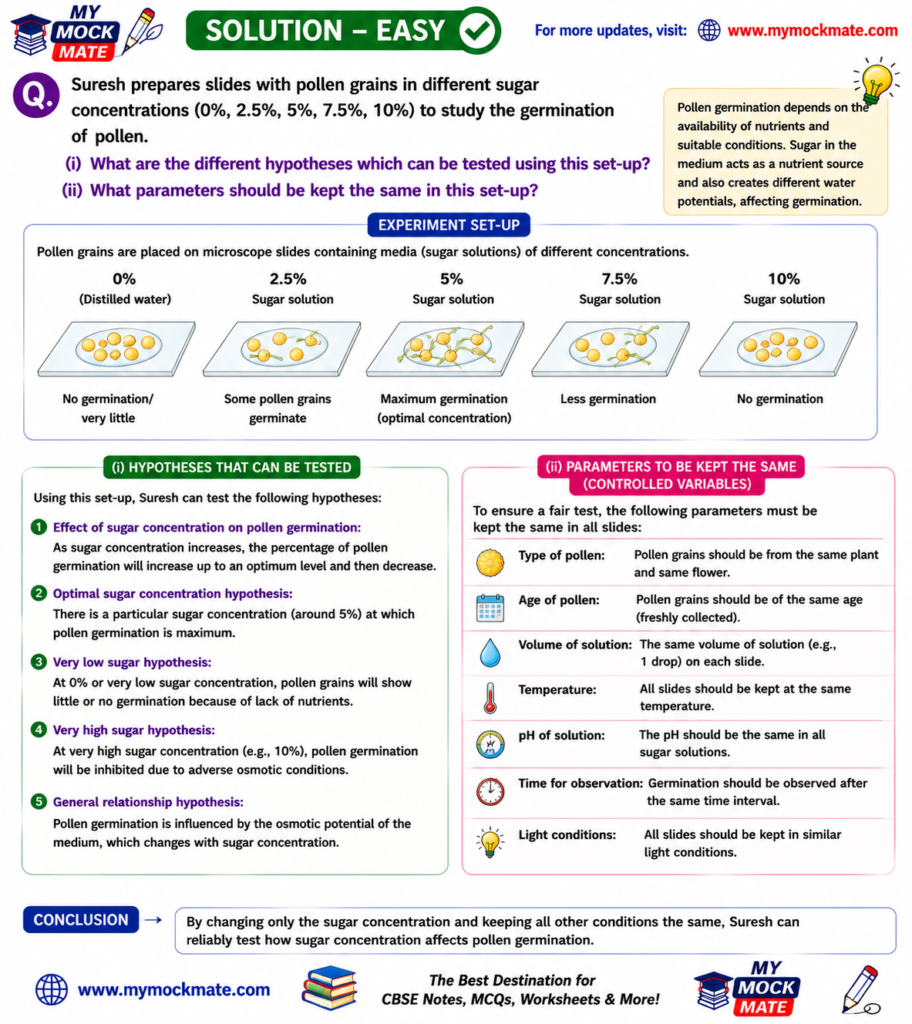
Suresh prepares slides with pollen grains in different sugar concentrations (0%, 2.5%, 5%, 7.5%, 10%) to study the germination of pollen.
(i) What are the different hypotheses which can be tested using this set-up?
(ii) What parameters should be kept the same in this set-up?
Q11.
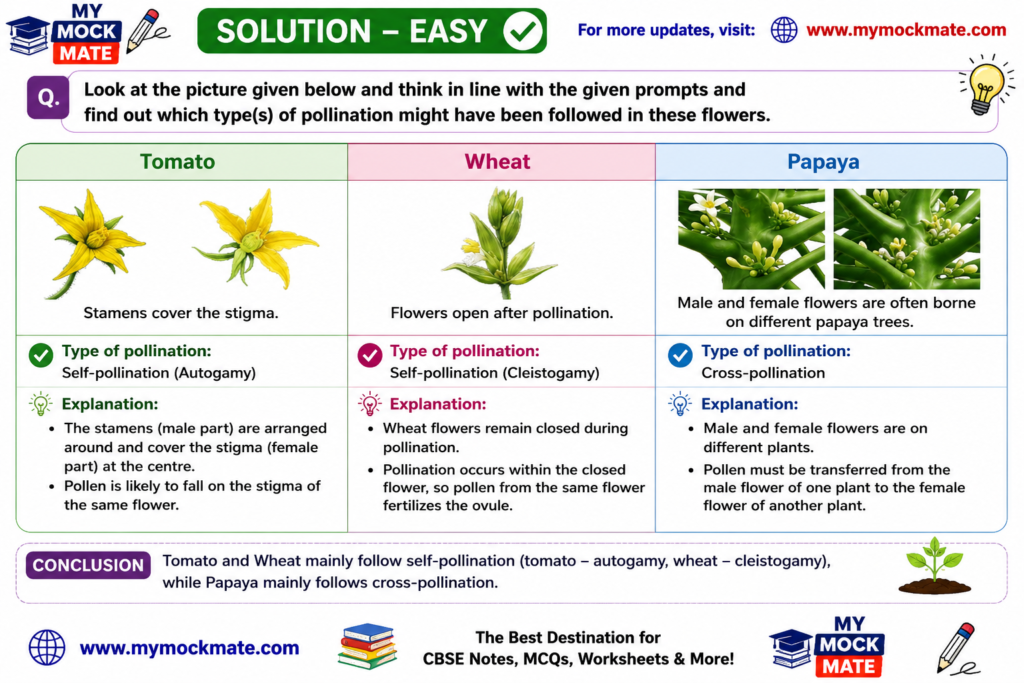
Look at the picture given below and think in line with the given prompts and find out which type(s) of pollination might have been followed in these flowers —
Q12. Apple Orchard Investigation
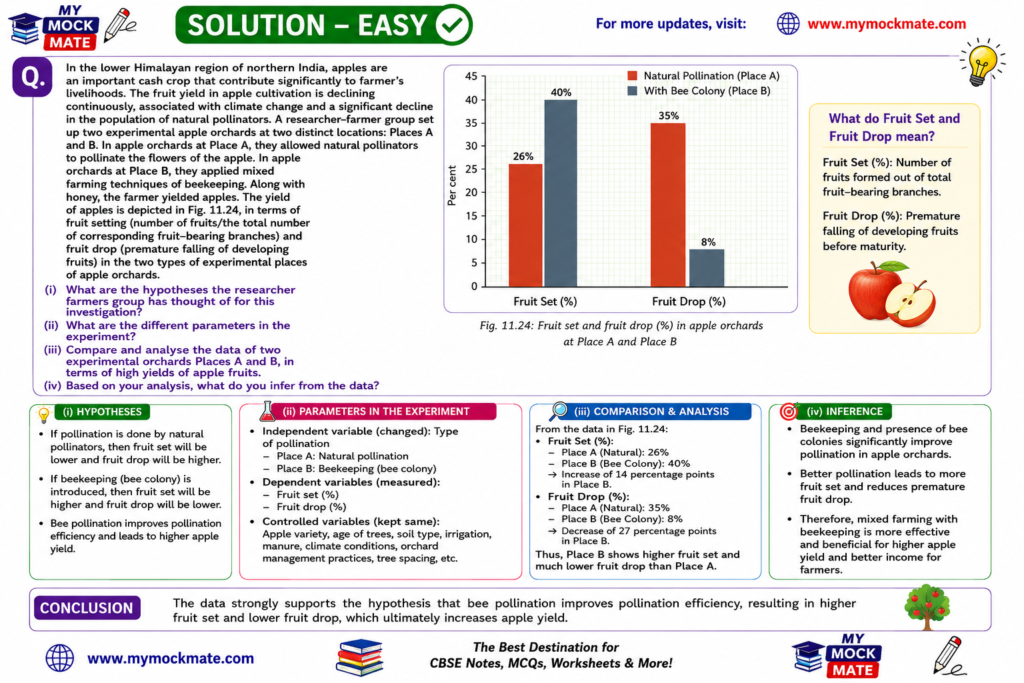
In the lower Himalayan region of northern India, apples are an important cash crop that contribute significantly to farmer’s livelihoods. The fruit yield in apple cultivation is declining continuously, associated with climate change and a significant decline in the population of natural pollinators. A researcher-farmer group set up two experimental apple orchards at two distinct locations: Places A and B. In apple orchards at Place A, they allowed natural pollinators to pollinate the flowers of the apple. In apple orchards at Place B, they applied mixed farming techniques of beekeeping. Along with honey, the farmer yielded apples. The yield of apples is depicted in Fig. 11.24, in terms of fruit setting (number of fruits/the total number of corresponding fruit-bearing branches) and fruit drop (premature falling of developing fruits) in the two types of experimental places of apple orchards.
(i) What are the hypotheses the researcher farmers group has thought of for this investigation?
(ii) What are the different parameters in the experiment?
(iii) Compare and analyse the data of two experimental orchards Places A and B, in terms of high yields of apple fruits.
(iv) Based on your analysis, what do you infer from the data?
Q13.
A student claims, “In humans, ovulation always happens on day 14 of the menstrual cycle”. Critically examine this claim and state whether the claim is correct or not. Give at least two reasons for your answer.
Common Mistakes
- Confusing pollination with fertilisation
- Mixing self-pollination and cross-pollination
- Forgetting functions of flower parts
- Confusing mitosis and meiosis
- Incorrect understanding of menstruation cycle
Exam Tips
- Draw labelled diagrams of flower and reproductive systems.
- Learn definitions carefully.
- Revise menstrual cycle stages regularly.
- Remember differences between sperm and egg.
- Practice assertion-reason questions.
Practice MCQs
1. Transfer of pollen to stigma is called:
A. Fertilisation
B. Pollination
C. Germination
D. Budding
Answer:
B. Pollination

2. Male reproductive part of flower:
A. Pistil
B. Ovary
C. Stamen
D. Ovule
Answer:
C. Stamen
3. Human gametes contain:
A. 46 chromosomes
B. 23 chromosomes
C. 92 chromosomes
D. 12 chromosomes
Answer:
B. 23 chromosomes
4. Fertilisation in frogs is generally:
A. Internal
B. External
C. Artificial
D. Vegetative
Answer:
B. External
5. Which method prevents STIs?
A. Copper-T
B. Oral pills
C. Condoms
D. Surgery
Answer:
C. Condoms
FAQ Section
Q1. What is reproduction?
It is the biological process through which organisms produce new individuals.
Q2. What is pollination?
Transfer of pollen grains from anther to stigma.
Q3. What is fertilisation?
Fusion of male and female gametes.
Q4. Why is meiosis important?
It reduces chromosome number to half in gametes.
Q5. What is menstruation?
Monthly shedding of uterine lining when fertilisation does not occur.
Boost your Science preparation with chapter-wise notes, detailed solutions, MCQs, quizzes, and mock tests only on www.mymockmate.com and score higher in your exams!