




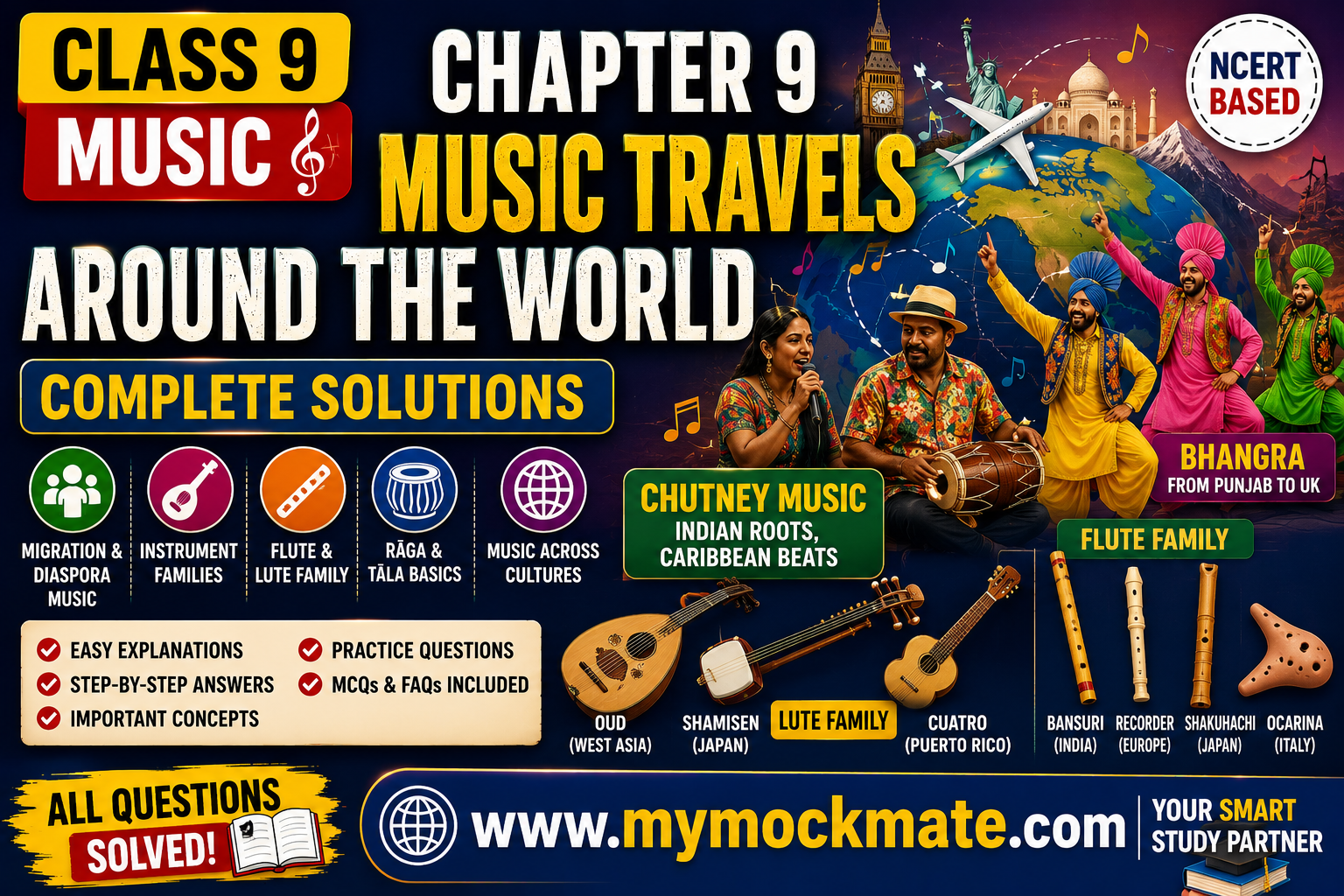

Short Intro
This chapter explores how music travels across countries and cultures through migration. Students learn about diaspora music, fusion genres, world musical instruments, flute and lute families, and the cultural importance of music during migration. These solutions provide easy explanations, MCQs, FAQs, exam tips, and detailed step-by-step answers for better understanding.
Quick Information Box
| Topic | Details |
|---|---|
| Chapter Name | Music Travels Around the World |
| Subject | Music |
| Class | 9 |
| Main Focus | Migration and Global Music Traditions |
| Important Concepts | Chutney Music, Bhangra, Instrument Families |
| Learning Goal | Understanding Cultural Exchange Through Music |
Concepts Used (Topics Covered)
- Music and Migration
- Diaspora Communities
- Chutney Music
- UK Bhangra
- Fusion Music
- Flamenco Tradition
- Families of Musical Instruments
- Lute Family
- Flute Family
- Veena Construction
- World Music Traditions
- Cultural Identity Through Music
- Folk and Hybrid Music Genres
Important Formulas / Key Terms
- Migration = Movement of people from one place to another
- Diaspora = Community settled outside its original homeland
- Fusion Music = Combination of multiple musical styles
- Tata = String instruments
- Suṣhira = Wind instruments
- Avanaddha = Percussion instruments
- Ghana = Solid instruments
Questions & Step-by-Step Solutions
Q1. Name two instruments that belong to the flute family and identify where they are from.
Solution
| Instrument | Region |
|---|---|
| Bansuri | India |
| Shakuhachi | Japan |
Explanation
Both are wind instruments belonging to the flute family but differ in playing style and sound quality.
Q2. Describe some features of Chutney music. (50 words)
Solution
Chutney music is a lively fusion genre created by Indian migrants in the Caribbean. It combines Bhojpuri folk songs, bhajans, and Indian instruments like dholak with Caribbean styles such as soca and calypso. Its lyrics mix Bhojpuri, Hindi, English, and Creole languages with energetic dance rhythms.
Explanation
Chutney music reflects cultural blending and the emotional connection of migrants with their homeland.
Q3. Give two examples of musical instruments and the materials used to make them.
Solution
| Instrument | Material Used |
|---|---|
| Bansuri | Bamboo |
| Ocarina | Clay/Ceramic |
Explanation
Different instruments are made from materials that affect their sound quality and resonance.
Q4. Match the following.
| Column A | Correct Match |
|---|---|
| i. Cuatro | d. Puerto Rico |
| ii. Sarod | a. India |
| iii. Shamisen | b. Japan |
| iv. Oud | c. West Asia |
Explanation
These instruments belong to different regions but are all members of the lute family.
Q5. Besides the standard classification into tata, suṣhira, avanaddha, and ghana, what are some other ways in which we can classify musical instruments?
Solution
Musical instruments can also be classified based on:
- Region or country of origin
- Musical genre
- Playing technique
- Material used
- Sound production method
- Cultural traditions
Explanation
Different classification systems help us understand instruments from historical and cultural perspectives.
Q6. Describe some characteristic features of instruments belonging to the lute family, and share some examples.
Solution
Characteristics of Lute Family Instruments
- Wide resonating body
- Long narrow neck
- Strings are plucked
- Different materials used for body construction
- Rich melodic sound
Examples
- Sarod (India)
- Oud (West Asia)
- Banjo (Europe)
- Shamisen (Japan)
- Cuatro (Puerto Rico)
Explanation
Though lute family instruments differ in design and culture, they share a similar structural pattern.
Q7. What purpose does music serve when people migrate?
Solution
Music helps migrants:
- Stay connected to their homeland.
- Preserve culture and traditions.
- Share emotions and memories.
- Build community relationships.
- Blend cultures and create new music styles.
Explanation
Music acts as emotional support and cultural identity for migrant communities.
Q8. Do you think the mixing of musical genres as a result of migration is beneficial? Justify your answer.
Solution
Yes, the mixing of musical genres is beneficial because:
- It creates innovative music styles.
- Different cultures learn from each other.
- Music becomes more diverse and creative.
- Fusion genres connect global audiences.
- Traditional music gains modern popularity.
Example
UK Bhangra combines Punjabi folk music with western pop and electronic sounds.
Explanation
Fusion music promotes creativity, cultural exchange, and unity.
Q9. Imagine you have migrated to another state in India, leaving your family behind. Write a few lines of a song describing your emotions.
Solution
“Far away from my home tonight,
I remember every smile and light.
Mother’s voice still echoes near,
In my heart, my family stays dear.”

Explanation
Migration songs often express loneliness, memories, and emotional attachment to home.
Q10. Listen to these instruments:
i. Violin (bowed)
ii. Guitar (plucked)
Can you explain the difference in their sounds?
Solution
| Violin | Guitar |
|---|---|
| Produces continuous smooth sound | Produces short plucked sound |
| Played using a bow | Played by plucking strings |
| Capable of long sustained notes | Sound fades more quickly |
| Emotional and expressive tone | Rhythmic and melodic tone |
Explanation
The playing technique changes the vibration style and sound quality of the instruments.
Common Mistakes
- Confusing lute and flute family instruments
- Forgetting examples of fusion music
- Writing incomplete explanations
- Ignoring the role of migration in music
- Mixing instrument regions incorrectly
Exam Tips
- Learn important examples of world instruments.
- Remember definitions of migration and diaspora.
- Use tables for comparison-based answers.
- Revise flute and lute family features carefully.
- Practice short descriptive answers regularly.
Practice MCQs
1. Chutney music developed mainly in:
A. Japan
B. Caribbean Islands
C. Europe
D. Africa
Answer:
B. Caribbean Islands
2. Which instrument belongs to Japan?
A. Sarod
B. Bansuri
C. Shamisen
D. Oud
Answer:
C. Shamisen
3. Which type of instrument is Bansuri?
A. Percussion
B. String
C. Wind
D. Solid
Answer:
C. Wind
4. UK Bhangra combines Punjabi music with:
A. Jazz only
B. Western styles like reggae and hip-hop
C. Opera
D. Classical dance only
Answer:
B. Western styles like reggae and hip-hop
5. Which material is commonly used for making a Bansuri?
A. Metal
B. Plastic
C. Bamboo
D. Glass
Answer:
C. Bamboo
FAQ Section
Q1. What is diaspora music?
Diaspora music is music created by communities living outside their original homeland.
Q2. What is fusion music?
Fusion music combines elements from different musical traditions and genres.
Q3. Why is music important during migration?
Music helps preserve identity, emotions, memories, and cultural traditions.
Q4. What are lute family instruments?
Lute family instruments are string instruments with a resonating body and long neck.
Q5. What is special about Chutney music?
Chutney music mixes Indian folk traditions with Caribbean musical styles.
For more chapter-wise solutions, MCQs, notes, music activities, and exam preparation materials, visit www.mymockmate.com and make your learning creative, musical, and exam-ready.