Introduction
Learning democracy is not just about memorising definitions—it is about understanding how democratic values shape our daily lives. This final part of Chapter 6 focuses on higher-order thinking, classroom activities, civic responsibility, and chapter revision. These answers encourage students to think critically, express their opinions confidently, and connect democratic principles with real-life situations.
Quick Glossary
| Term | Meaning |
|---|---|
| Civic Responsibility | Duties performed by citizens for society |
| Accountability | Responsibility for one’s actions |
| Participation | Taking part in decision-making |
| Democracy | Government by the people |
| Constitution | Supreme law of India |
| Good Governance | Transparent and accountable administration |
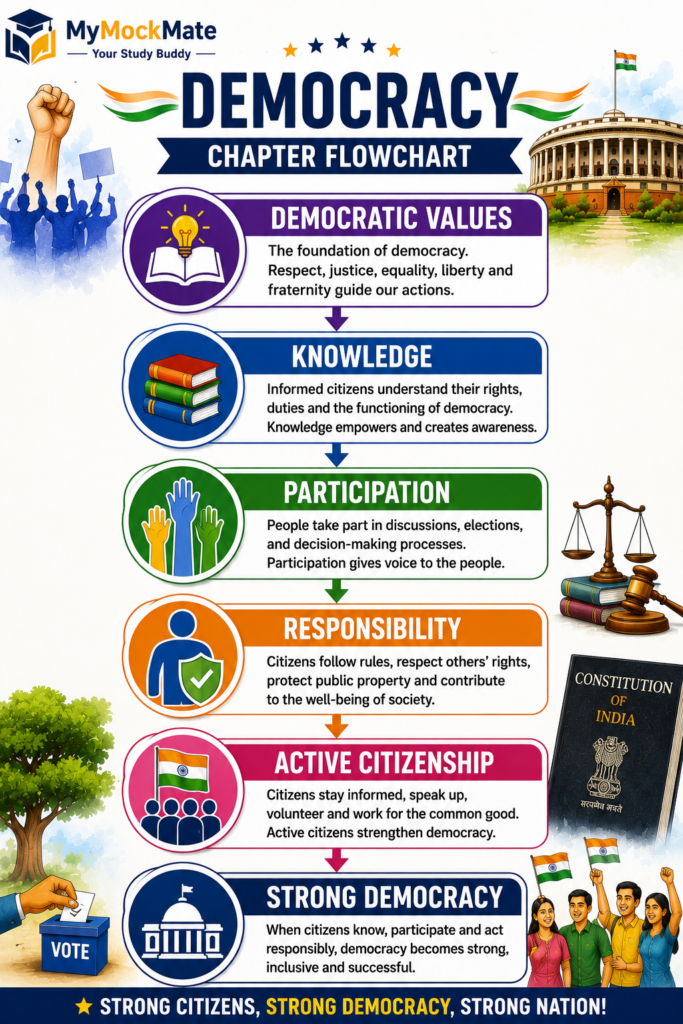
Chapter Flowchart
Think, Discuss & Act
Think
Question
How do your actions as a student contribute to your school community and to democracy in a larger context?
Answer
As a student, I contribute to democracy by:
- Respecting school rules.
- Participating in classroom discussions.
- Helping classmates.
- Protecting school property.
- Respecting different opinions.
- Solving problems peacefully.
- Being honest and responsible.
These habits prepare me to become a responsible citizen.
Real-Life Example
When students elect a class monitor through voting, they learn the importance of democracy, leadership, and responsibility.
Discuss
Question
Talk to your classmates about a social issue you care about. How can students make a difference?
Answer
One important issue is plastic pollution.
Students can:
- Organise awareness campaigns.
- Reduce plastic use.
- Conduct cleanliness drives.
- Encourage recycling.
- Plant trees.
- Spread awareness through social media.
Small actions create big changes.
Key Takeaway
Responsible students become responsible citizens.
Act
Question
Choose one civic responsibility you will perform this month.
Sample Answer
This month I will:
- Keep my surroundings clean.
- Respect public property.
- Help elderly people.
- Save electricity.
- Educate younger children about voting.
- Participate in community cleanliness drives.
Real-Life Example
Thousands of students across India participate in Swachh Bharat Abhiyan, helping keep their communities clean.
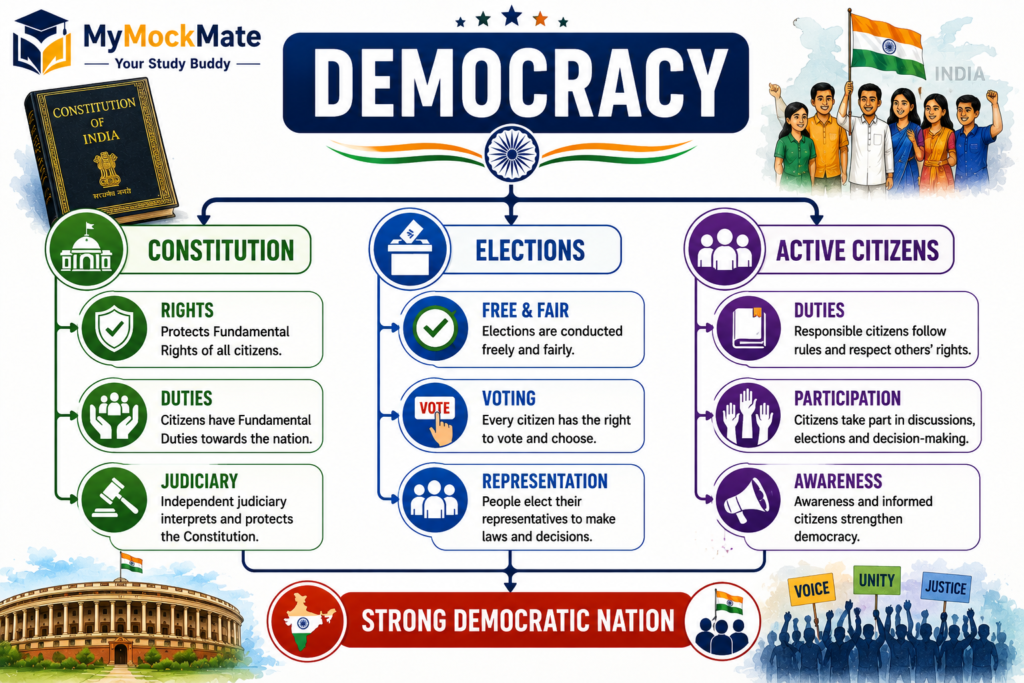
Chapter Mind Map
Final Revision Table
| Topic | Important Point |
|---|---|
| Democracy | Government by the people |
| Constitution | Protects Fundamental Rights |
| Elections | Free and Fair |
| Rule of Law | Everyone is equal before law |
| Local Government | Brings democracy closer to people |
| Citizens | Strengthen democracy through participation |
Chapter Quiz
Multiple Choice Questions
1.
Who conducts elections in India?
A. Parliament

B. Supreme Court
✅ C. Election Commission of India
D. President
2.
Which democratic value ensures equal treatment before law?
A. Liberty
B. Justice
✅ C. Rule of Law
D. Equality
3.
Which institution protects the Constitution?
A. Executive
B. Parliament
✅ C. Judiciary
D. Election Commission
True / False
- Democracy depends only on elections. False
- Active citizens strengthen democracy. True
- RTI promotes transparency. True
Assertion & Reason
Assertion
India is the world’s largest democracy.
Reason
It has over 96.8 crore registered voters.
Answer: Both Assertion and Reason are true, and the Reason correctly explains the Assertion.
HOTS Questions
1.
Can democracy survive without responsible citizens? Explain.
2.
How can technology strengthen democracy?
3.
Why is respecting different opinions important in democracy?
4.
How do Fundamental Duties support Fundamental Rights?
5.
Explain why democracy is considered a continuous process rather than just a form of government.
Common Mistakes Students Make
❌ Confusing democracy with only elections.
❌ Forgetting the importance of the Constitution.
❌ Ignoring Fundamental Duties.
❌ Writing answers without examples.
❌ Not mentioning democratic values.
Exam Tips
✅ Write answers using headings.
✅ Mention constitutional values.
✅ Use examples from daily life.
✅ Highlight important keywords.
✅ Draw simple flowcharts wherever possible.
Chapter Summary
- Democracy means government by the people.
- The Constitution safeguards citizens’ rights.
- Elections should be free and fair.
- Rule of Law protects equality.
- Local governments encourage participation.
- Transparency and accountability improve governance.
- Active citizens are the real strength of democracy.
- Democracy becomes stronger when citizens participate responsibly.
Frequently Asked Questions (FAQs)
Q1. Why is India called the world’s largest democracy?
Because it has the largest number of registered voters and conducts regular free and fair elections.
Q2. What is the Rule of Law?
It means everyone is equal before the law, and no one is above it.
Q3. Why is voting important?
Voting allows citizens to choose their representatives and participate in governance.
Q4. What is the role of the Constitution?
The Constitution protects Fundamental Rights, defines government powers, and upholds democratic values.
Q5. Why is citizen participation important?
Citizen participation makes governments accountable, transparent, and responsive to public needs.
Call To Action
🎯 Master NCERT with MyMockMate!
Strengthen your concepts with:
- ✅ Chapter-wise NCERT Solutions
- ✅ Mind Maps & Flowcharts
- ✅ Interactive Quizzes
- ✅ PYQs & HOTS Questions
- ✅ Mock Tests
- ✅ Revision Notes
- ✅ Exam Tips
Visit www.mymockmate.com and prepare smarter for your CBSE examinations.