




Introduction
Democracy becomes meaningful only when citizens actively participate in governance. In India, democracy is not limited to elections every five years. It extends to villages, towns, cities, schools, and communities through local self-government institutions and citizen participation. This part explains how democracy functions in everyday life, why local governments are important, and how active participation makes India the world’s largest living democracy.
Quick Glossary
| Term | Meaning |
|---|---|
| Gram Sabha | General assembly of all adult voters in a village |
| Gram Panchayat | Local government at the village level |
| Panchayati Raj | Three-tier rural local governance system |
| Municipality | Urban local government |
| Citizen Participation | People’s involvement in decision-making |
| Local Governance | Administration at village and city levels |
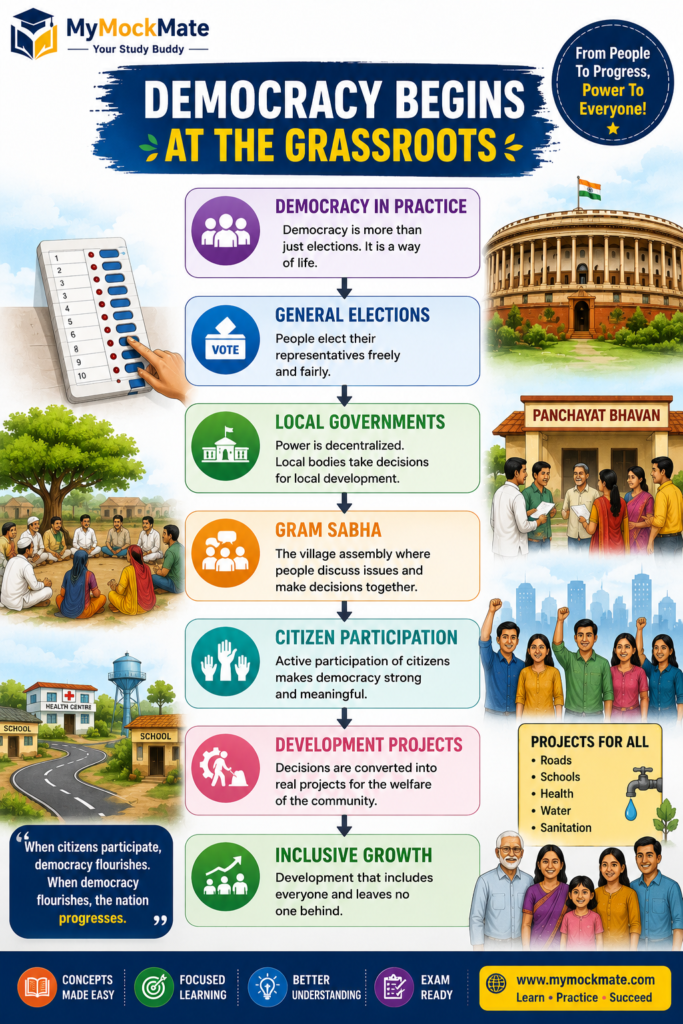
Chapter Flowchart
Question 11
NCERT Question
Why is India called the world’s largest democracy?
Answer
India is known as the world’s largest democracy because it has the highest number of voters and conducts free, fair, and regular elections on a massive scale.
Step-by-Step Explanation
1. Largest Electorate
India has over 96.8 crore registered voters, making it the largest democratic electorate in the world.
2. Regular Elections
General elections, state elections, and local body elections are conducted periodically under the supervision of the Election Commission of India.
3. Universal Adult Franchise
Every citizen aged 18 years or above has the right to vote regardless of caste, religion, gender, or economic status.
4. Diversity
India conducts elections across
- Mountains
- Forests
- Islands
- Deserts
- Cities
- Villages
ensuring equal voting opportunities for all citizens.
Real-Life Example
Special polling booths are established even in remote Himalayan villages where only a few voters live.
Exam Tip
Always mention
Universal Adult Franchise
and
Election Commission of India
Key Takeaway
India’s democracy is the largest because every eligible citizen gets an equal opportunity to participate in governance.
Question 12
NCERT Question
How does citizen participation strengthen democracy?

Answer
Citizen participation is the foundation of democracy.
People strengthen democracy by taking part in governance instead of remaining passive observers.
Ways Citizens Participate
- Voting in elections
- Attending Gram Sabha meetings
- Participating in public discussions
- Reporting corruption
- Paying taxes
- Protecting public property
- Following Fundamental Duties
Importance
Citizen participation
- improves transparency,
- makes governments accountable,
- strengthens democracy,
- promotes social justice.
Real-Life Example
Residents attending Gram Sabha meetings help decide village development projects such as roads, drinking water, schools, and sanitation.
Key Takeaway
Democracy succeeds when citizens actively participate in public life.
Question 13
NCERT Question
Explain the role of Panchayati Raj Institutions in strengthening democracy.
Answer
Panchayati Raj Institutions bring democracy closer to the people.
They allow citizens to participate directly in local administration.
Three Levels
Gram Panchayat
Village level
Panchayat Samiti
Block level
Zila Parishad
District level
Functions
- Rural development
- Water supply
- Sanitation
- Roads
- Education
- Healthcare
- Welfare schemes
Importance
- Decentralisation
- Local decision-making
- People’s participation
- Better governance
- Inclusive development
Real-Life Example
Villagers collectively decide how government funds should be used for building roads or schools.
Exam Tip
Remember
Panchayati Raj = Grassroots Democracy
Key Takeaway
Local governments make democracy more participatory and effective.
Question 14
NCERT Question
What lessons do the case studies of Gram Panchayats teach us about democracy?
Answer
The chapter describes successful Gram Panchayats where citizens actively participated in development activities.
Lessons Learned
- Active citizen participation improves governance.
- Women play an important leadership role.
- Transparency builds public trust.
- Inclusive development benefits everyone.
- Local democracy solves local problems effectively.
Benefits
- Better education
- Clean villages
- Improved sanitation
- Women’s empowerment
- Community development
Real-Life Example
A Gram Panchayat organising regular Gram Sabha meetings ensures that every villager gets an opportunity to express opinions before development decisions are taken.
Key Takeaway
Strong villages create a strong democracy.
Question 15
NCERT Question
Why is local self-government important in a democracy?
Answer
Local self-government enables people to solve local problems through democratic participation.
Instead of depending only on higher governments, local bodies make quick and effective decisions.
Importance
- Better public services
- Faster implementation
- Local planning
- Greater accountability
- People’s participation
- Rural development
Institutions
- Gram Panchayat
- Municipality
- Municipal Corporation
Real-Life Example
Municipal Corporations manage
- roads,
- street lighting,
- parks,
- waste management,
- water supply,
with the help of elected representatives.
Exam Tip
Use the keyword
Decentralisation of Power
Key Takeaway
Local self-government makes democracy stronger by bringing decision-making closer to the people.
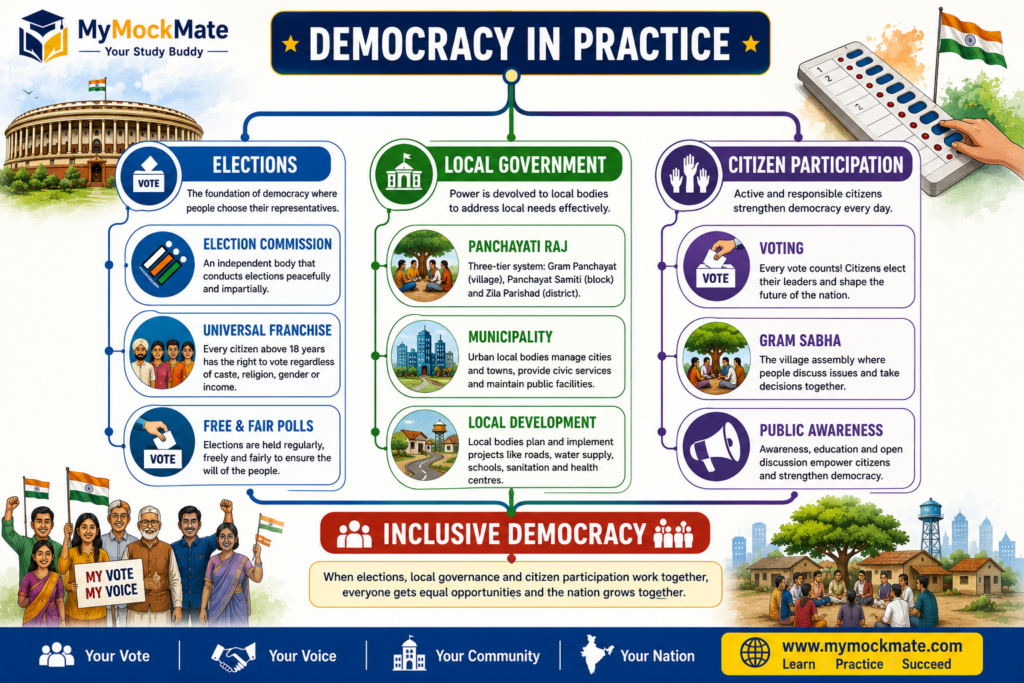
Mind Map
Revision Table
| Topic | Quick Revision |
|---|---|
| World’s Largest Democracy | Over 96.8 crore voters |
| Citizen Participation | Voting, Gram Sabha, Awareness |
| Panchayati Raj | Grassroots Democracy |
| Local Government | Village & Urban Administration |
| Decentralisation | Power shared with local bodies |
| Democracy in Practice | Active public participation |
Chapter Quiz
MCQs
1. Which institution conducts elections in India?
A. Supreme Court
✅ B. Election Commission of India
C. Parliament
D. President
2. Gram Panchayat functions at
A. National Level
B. State Level
✅ C. Village Level
D. International Level
True / False
- Every adult citizen has the right to vote. ✅
- Panchayati Raj exists only in cities. ❌
Match the Following
| Column A | Column B |
|---|---|
| Gram Sabha | Village Assembly |
| Municipality | Urban Local Government |
| Panchayat | Rural Administration |
| Citizen | Democracy |
Assertion–Reason
Assertion: Local self-government strengthens democracy.
Reason: It allows citizens to participate directly in local governance.
Answer: Both Assertion and Reason are true, and the Reason correctly explains the Assertion.
Explore complete NCERT Solutions, interactive quizzes, chapter-wise revision notes, PYQs, mock tests, and smart learning resources exclusively on www.mymockmate.com. Learn concepts, practice regularly, and excel in your CBSE examinations with confidence.