



Quick Revision
1. Meaning of Election
An election is a democratic process through which citizens choose their representatives by voting. Elections allow people to participate in government formation and hold elected representatives accountable.
2. Direct and Indirect Elections
Direct election: Citizens directly vote for their representatives.
Examples:
- Lok Sabha elections
- Vidhan Sabha elections
- Panchayat and municipal elections
Indirect election: Citizens elect representatives who then elect another public official.
Examples:
- Election of the President
- Election of the Vice-President
- Election of Rajya Sabha members
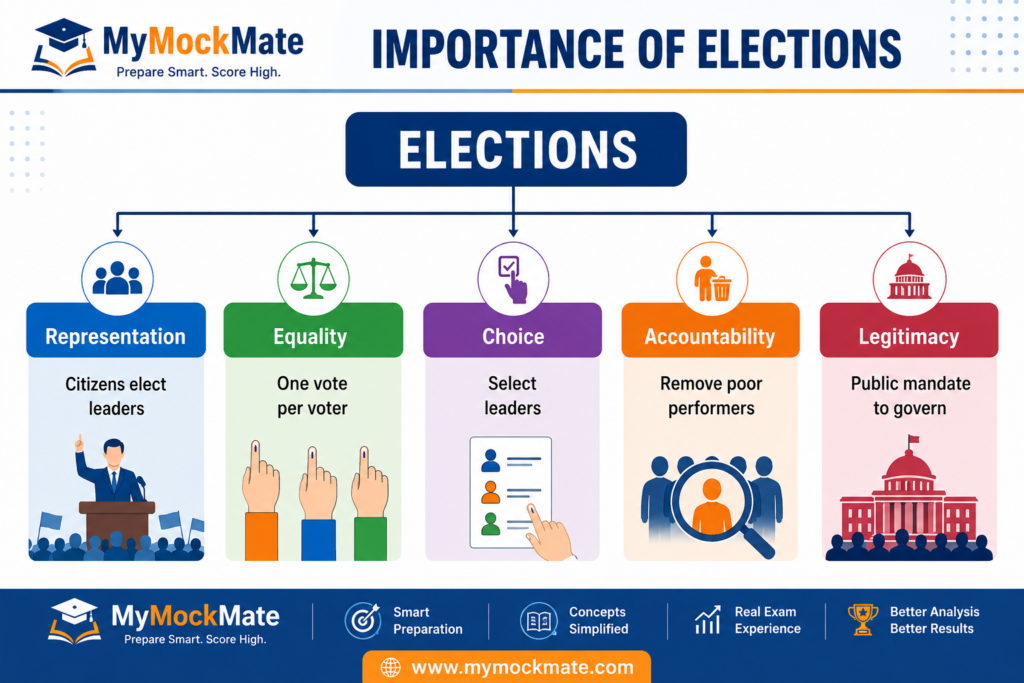
3. Importance of Elections
Elections promote:
- Representation
- Equality
- Accountability
- Legitimacy
- Participation
- Peaceful transfer of power
4. First-Past-the-Post System
Under the First-Past-the-Post or FPTP system:
- The country is divided into constituencies.
- Each constituency elects one representative.
- Voters select one candidate.
- The candidate receiving the highest number of votes wins.
- The winner does not necessarily need more than 50% of the votes.
India uses FPTP for elections to the Lok Sabha and Vidhan Sabhas.
5. Proportional Representation
In proportional representation, seats are distributed according to the proportion of votes received by parties or candidates.
It is used in India for elections such as:
- Rajya Sabha elections
- Presidential elections
- Vice-Presidential elections
- Vidhan Parishad elections
6. Election Commission of India
The Election Commission of India is an autonomous, permanent constitutional body responsible for supervising, directing and controlling elections.
It was established on 25 January 1950. Articles 324 to 329 of the Constitution deal with elections and the Election Commission.
7. Major Election Laws
Representation of the People Act, 1950
It mainly deals with:
- Allocation of seats
- Delimitation of constituencies
- Preparation of electoral rolls
- Revision of electoral rolls
- Voter eligibility
Representation of the People Act, 1951
It deals with:
- Conduct of elections
- Candidate nominations
- Election campaigns
- Voting procedures
- Electoral offences
- Corrupt practices
- Election disputes
8. Political Parties
Political parties:

- Organise public opinion
- Select candidates
- Prepare manifestos
- Contest elections
- Form governments
- Implement policies
- Act as the opposition
- Ensure accountability
9. Challenges to Free and Fair Elections
Major challenges include:
- Money power
- Intimidation and violence
- Fake news
- Misinformation
- Hate speech
- Misuse of government resources
- Bribing voters
- Appeals based on religion or caste
- Paid news
- Low voter awareness
- Accessibility barriers
Important Facts
- Elections to the Lok Sabha, Vidhan Sabha and local bodies are generally direct elections.
- The President, Vice-President and Rajya Sabha members are elected indirectly.
- The normal term of the Lok Sabha and Vidhan Sabha is five years unless dissolved earlier.
- The scientific study of elections is called psephology.
- India follows the FPTP system for Lok Sabha and Vidhan Sabha elections.
- Proportional representation through the single transferable vote is used in several indirect elections.
- The quota under the single transferable vote system is generally calculated as:
- Article 82 provides for the establishment of a Delimitation Commission.
- India has had Delimitation Commissions in 1952, 1963, 1973 and 2002.
- National Voters’ Day is celebrated on 25 January.
- The ECI prepares and revises electoral rolls.
- The cVIGIL application allows citizens to report election misconduct and Model Code of Conduct violations.
- The Saksham application assists persons with disabilities.
- ETPBS stands for Electronically Transmitted Postal Ballot System.
- VVPAT stands for Voter Verifiable Paper Audit Trail.
- India has a multi-party political system.
- The Anti-Defection Law was introduced through the 52nd Constitutional Amendment Act, 1985.
- A national party must satisfy at least one of the recognition conditions prescribed by the Election Commission.
- A registered political party that does not meet the conditions for national or state recognition is called a Registered Unrecognised Political Party.
- Free elections must be inclusive, impartial, transparent and trustworthy.
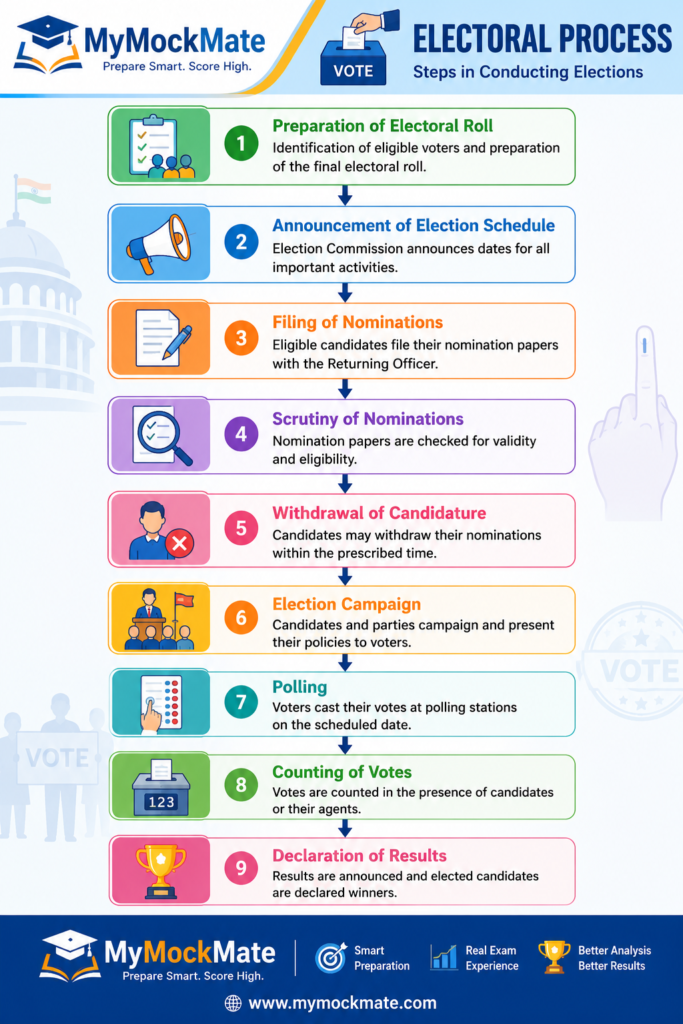
Electoral Process Flowchart
Importance of Elections
Electoral Systems
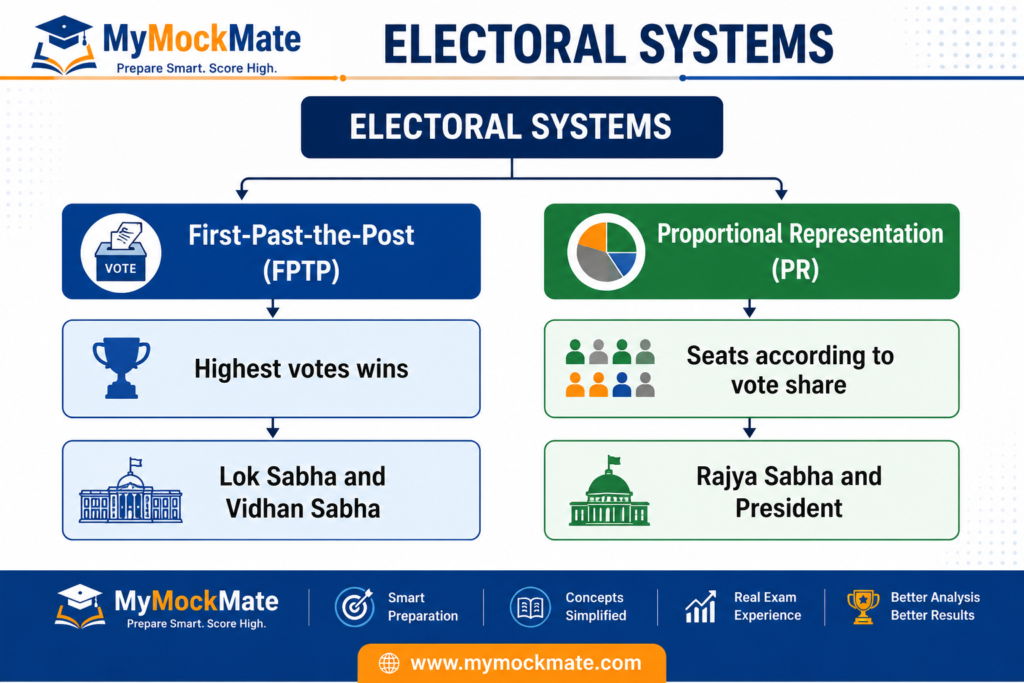
The electoral-system comparison explains how FPTP selects the highest-polling candidate, while proportional representation distributes seats according to vote share.
Questions and Step-by-Step Solutions
Question 1
What reforms have been introduced by the Election Commission of India to make voting more inclusive for the following groups?
(a) People with Disabilities
Solution
The Election Commission has introduced several facilities for persons with disabilities.
Step 1: Accessible registration
The Saksham App provides customised assistance for:
- Voter registration
- Locating polling stations
- Requesting electoral assistance
- Obtaining information about accessible facilities
Step 2: Accessible polling stations
Polling stations are provided with:
- Ramps
- Wheelchairs
- Volunteers
- Accessible entrances
- Priority voting facilities
- Clear signs and instructions
Step 3: Accessible voting equipment
EVMs may contain Braille markings so that visually impaired voters can vote more independently.
Step 4: Home-voting facility
Persons with benchmark disabilities may be provided a postal-ballot or home-voting facility according to the applicable election rules.
Conclusion
These measures allow voters with disabilities to exercise their right without unnecessary physical, informational or technological barriers. The chapter specifically highlights Saksham, EVMs with Braille, wheelchairs and home-voting initiatives.
(b) Service Voters
Solution
Service voters may be posted far away from their registered constituencies.
Step 1: They are entered in the electoral roll as service voters.
Step 2: They may use a postal ballot instead of appearing personally at the polling station.
Step 3: Under ETPBS, the postal ballot is transmitted electronically to the eligible service voter.
Step 4: The voter marks the ballot and returns it through the prescribed postal procedure.
ETPBS therefore enables eligible service voters to participate even when they are serving outside their constituencies.
(c) Senior Citizens—60 Years and Above, and 80 Years and Above
Solution
The Election Commission provides assistance according to the needs and applicable rules.
Senior citizens aged 60 years and above
They may receive:
- Priority in polling queues
- Seating and drinking-water facilities
- Wheelchairs where required
- Assistance from polling officials or volunteers
- Accessible polling-station arrangements
Very senior citizens
Eligible elderly voters may be allowed to vote through a postal ballot from home under the notified election rules.
The chapter notes that voting from home was extended nationally during the 2024 General Elections to eligible senior citizens above the prescribed age and to persons with benchmark disabilities.
Conclusion
The purpose is to ensure that age, illness or reduced mobility does not prevent citizens from voting.
(d) Prisoners
Solution
A person confined in prison generally cannot vote while in lawful custody, even when the person has not yet been convicted.
However:
- The person’s name may continue to remain on the electoral roll, subject to electoral rules.
- A person released from custody may vote if otherwise eligible.
- A person kept in preventive detention is treated differently.
Therefore, ordinary prisoners do not receive a polling or postal-ballot facility while confined in prison.
(e) Persons in Preventive Detention
Solution
A person in preventive detention is detained to prevent a possible future act rather than as punishment after conviction.
Such eligible persons may vote through a postal ballot.
Steps:
- The authority identifies eligible detainees.
- A postal ballot is supplied through the prescribed procedure.
- The voter marks the choice secretly.
- The ballot is returned to the Returning Officer before the deadline.
Thus, the voting right of a person under preventive detention is protected through postal voting.
Question 2
What are the various functions of the Election Commission of India? Which function is the most important for conducting free and fair elections? Explain.
Solution
The Election Commission performs the following major functions.
1. Preparing Electoral Rolls
It prepares, revises and corrects the list of eligible voters.
2. Announcing the Election Schedule
It fixes dates for:
- Nomination
- Scrutiny
- Withdrawal
- Polling
- Counting
- Declaration of results
3. Registering Political Parties
It registers political parties and classifies them according to prescribed conditions.
4. Allocating Election Symbols
It assigns reserved symbols to recognised parties and resolves symbol-related disputes.
5. Supervising Candidate Nominations
It ensures that nomination papers are accepted, examined and processed under the law.
6. Enforcing the Model Code of Conduct
It monitors the conduct of:
- Political parties
- Candidates
- Ministers
- Campaigners
- Government authorities
7. Regulating Election Campaigns
It monitors campaign expenditure, rallies, publicity and the use of government resources.
8. Making Security Arrangements
It coordinates with civil authorities and security forces to prevent violence, intimidation and booth capturing.
9. Conducting Polling
It arranges:
- Polling stations
- EVMs and VVPATs
- Polling personnel
- Voter assistance
- Election materials
10. Counting Votes and Declaring Results
It supervises counting and ensures that results are declared correctly and transparently.
11. Promoting Inclusive Elections
It provides special arrangements for:
- Persons with disabilities
- Elderly voters
- Service voters
- Voters in remote areas
- Vulnerable communities
12. Settling Certain Election-Related Disputes
It acts in a quasi-judicial capacity in matters such as party recognition and symbol disputes.
The chapter describes the ECI’s work as including electoral-roll revision, nominations, campaign regulation, security coordination, counting and dispute resolution.
Most Important Function
The most important function is ensuring the independence, fairness and impartiality of the entire electoral process.
This is broader than any single technical task.
Reasoning:
- A correct electoral roll is meaningless if voters are intimidated.
- Peaceful polling is insufficient if votes are counted dishonestly.
- Candidate choice becomes unfair if government resources are misused.
- Election results lose legitimacy if rules are applied selectively.
- Therefore, impartial supervision connects all other functions.
Conclusion
Every ECI function is important, but its independent supervision and enforcement of fair rules are central to free and fair elections.
Question 3
“Elections are the soul of democracy.” Do you agree? Why or why not?
Solution
Yes, I agree that elections are the soul of democracy.
Step 1: Elections provide representation
Citizens cannot personally make every national or state-level decision. They therefore elect representatives to act on their behalf.
Step 2: Elections create accountability
Representatives know that they must face voters again. This encourages them to respond to public needs.
Step 3: Elections provide political equality
Every eligible citizen has one vote of equal value, regardless of wealth, caste, language, gender or social status.
Step 4: Elections offer choice
Citizens can compare candidates, parties, programmes and policies.
Step 5: Elections permit peaceful change
A non-performing government can be removed without violence or revolution.
Step 6: Elections provide legitimacy
A government formed through a lawful and fair electoral process receives the people’s mandate.
Step 7: Elections encourage participation
Campaigns and public debates encourage citizens to discuss issues and participate in public life.
Important Qualification
Merely holding elections is not enough. Elections must also be:
- Regular
- Competitive
- Inclusive
- Impartial
- Transparent
- Free from intimidation
- Based on genuine choice
Conclusion
Elections are the soul of democracy because they transform the consent of citizens into representative government.
Question 4
Explain at least three differences between national and state or regional political parties.
Solution
| Basis | National Party | State/Regional Party |
|---|---|---|
| Area of influence | Operates across several states | Mainly influential in one state or region |
| Issues | Focuses on national and international matters | Gives greater attention to regional and state-level concerns |
| Recognition | Must meet national-party criteria | Must meet state-party criteria in a particular state |
| Organisation | Usually has units in many states | Organisation is usually concentrated in a limited region |
| Electoral presence | Contests elections across several states | Mainly contests elections in its state or region |
| Government role | May form or lead the Union Government | Often forms a state government or influences coalition politics |
| Symbol | Reserved symbol generally available nationally | Reserved symbol mainly linked to its recognised state status |
Recognition Difference
A party can receive national recognition by satisfying one of the prescribed national-level conditions, such as:
- Receiving the required vote share in multiple states along with Lok Sabha seats
- Winning the required percentage of Lok Sabha seats from multiple states
- Being recognised as a state party in at least four states
A state party satisfies prescribed electoral-performance conditions within a particular state.
Conclusion
National parties seek a wider national mandate, whereas regional parties mainly represent the needs, identities and interests of particular states or regions.
Question 5
Why should you vote? Arrange the following reasons in descending order and explain your choice.
- Opportunity to choose my representative
- Makes me a responsible person
- Opportunity to change a non-performing representative
- Strengthens democracy
Suggested Descending Order
- Strengthens democracy
- Opportunity to choose my representative
- Opportunity to change a non-performing representative
- Makes me a responsible person
Explanation
1. Strengthens Democracy
Voting provides legitimacy to democratic institutions. High and informed participation makes the government more representative.
2. Opportunity to Choose My Representative
Voting allows citizens to select the candidate they believe can represent their interests honestly and effectively.
3. Opportunity to Change a Non-Performing Representative
Citizens can peacefully remove a representative who has failed to fulfil responsibilities.
4. Makes Me a Responsible Person
Voting is not only a right but also a civic responsibility. It shows concern for the community and the country.
Conclusion
All four reasons are important. The order may differ from one student to another, provided the reasons are logical and democratic.
Question 6
What is the Special Intensive Revision initiative of the ECI? Explain its objectives and necessity.
Solution
Special Intensive Revision, or SIR, is a detailed exercise undertaken by the Election Commission to verify, update and correct electoral rolls.
Step 1: Collection and Verification
Election officials verify voter information through records, forms and field-level checking.
Step 2: Addition of Eligible Citizens
Names of eligible citizens are added, especially:
- Citizens who have recently turned 18
- People whose names were omitted
- Citizens who have moved into the constituency
Step 3: Correction of Entries
Incorrect details such as name, age, address or photograph may be corrected.
Step 4: Removal of Ineligible Entries
Names may be deleted because of:
- Death
- Permanent shifting
- Duplicate registration
- Loss of eligibility
- Permanent untraceability after due process
Step 5: Claims and Objections
Citizens are given an opportunity to:
- Claim inclusion
- Request correction
- Object to an incorrect entry
Objectives
The objectives of SIR are:
- To include every eligible voter.
- To remove duplicate or invalid entries.
- To correct outdated information.
- To improve the accuracy of electoral rolls.
- To prevent impersonation and electoral fraud.
- To strengthen confidence in election administration.
The chapter explains that SIR is used to ensure that no eligible voter is left out and no ineligible person is included.
Necessity
An inaccurate electoral roll can:
- Deny eligible people the right to vote
- Permit duplicate voting
- Cause confusion at polling stations
- Reduce public trust
- Affect the fairness of an election
Conclusion
SIR is necessary because a reliable electoral roll is the foundation of a free and fair election.
Question 7
Match the political party with its election symbol.
Solution
| Political Party | Election Symbol |
|---|---|
| Aam Aadmi Party | Broom |
| Bharatiya Janata Party | Lotus |
| Bahujan Samaj Party | Elephant |
| Communist Party of India (Marxist) | Hammer, Sickle and Star |
| Indian National Congress | Hand |
| National People’s Party | Book |
Memory Trick
- AAP — Broom: linked with cleaning public life
- BJP — Lotus: the party’s familiar lotus symbol
- BSP — Elephant: represents organised strength
- CPI(M) — Hammer, Sickle and Star: associated with workers and farmers
- INC — Hand: a raised open hand
- NPP — Book: represents learning and knowledge
Question 8: Case Study
Ishani, a first-time voter, visits a polling station with her mother and disabled brother. The station has police protection, a wheelchair and volunteers. Ishani votes despite not carrying her Voter ID or Aadhaar card, sees a VVPAT slip, and later learns that her 89-year-old grandmother voted from home.
(a) What initiatives were taken by the ECI to enable the voters to cast their votes?
Solution
The following initiatives are mentioned in the case:
- Online voter registration
Ishani registered through the ECI’s online portal. - Security arrangements
Police personnel guarded the polling station. - Wheelchair facility
A wheelchair was made available to her disabled brother. - Volunteer assistance
Volunteers guided voters to the polling booth. - Accessible polling station
Arrangements enabled a person with a disability to vote. - Alternative identity documents
Ishani could establish her identity using another approved document. - VVPAT facility
She could see the printed confirmation of her vote. - Home voting for an eligible senior citizen
Her 89-year-old grandmother voted from home.
These measures demonstrate the principle of “No Voter to Be Left Behind.”
(b) Which other valid document might Ishani have carried?
Solution
She may have carried any identity document approved by the Election Commission for that election, such as:
- Passport
- Driving licence
- PAN card
- Government service identity card
- Passbook with photograph issued by a bank or post office
- Pension document with photograph
- Health insurance smart card
- MNREGA job card
- Another officially notified photo identity document
Important Condition
Her name must appear in the electoral roll. An identity card proves identity, but it does not replace the requirement of being enrolled as a voter.
(c) Cite examples of Model Code of Conduct violations from the passage.
Solution
Possible violations include:
- Unauthorised wall writing
- Posters pasted on public or private property without permission
- Campaigning too close to polling day or during the silence period
- Large campaign gatherings without proper permission
- Use of prohibited slogans or disorderly campaigning
- Distribution of pamphlets in violation of local or election rules
The exact classification would depend on whether permission had been obtained and whether the activities took place during the legally restricted campaign period.
(d) Give a suitable title to the passage.
Answer
“Ishani’s First Voting Experience: Inclusive Elections in Action”
Other suitable titles:
- “No Voter Left Behind”
- “A First-Time Voter at the Polling Station”
- “Accessible and Inclusive Voting”
(e) How do police and army personnel cast their votes?
Solution
Police and armed-forces personnel may be unable to vote at their ordinary polling stations because of election or service duties.
They can use facilities such as:
- Postal ballot
- ETPBS, where applicable
- Election Duty Certificate
- Facilitation centres
- Special voting arrangements notified for election-duty personnel
General Procedure
- The voter is registered under the relevant category.
- The election authority verifies eligibility.
- A ballot or authorised voting facility is provided.
- The voter marks the vote secretly.
- The ballot is returned or deposited within the prescribed time.
Thus, public-duty responsibilities do not automatically deprive eligible service personnel of participation.
Question 9
A chart describes three countries:
- Country A: Written Constitution, periodic elections, voting rights and a multi-party or two-party system
- Country B: Written Constitution, periodic elections, voting rights but only one political party
- Country C: Monarchy, no voting rights and no political party
(a) What is the difference between voting rights in a multi-party system and in a single-party system?
Solution
In a multi-party system:
- Voters choose from different parties and candidates.
- Parties offer competing programmes and policies.
- The opposition can question the government.
- Voters can replace the ruling party.
- Elections provide meaningful political choice.
In a single-party system:
- Voters have little or no alternative political choice.
- Candidates may belong to the same party.
- Opposition is absent or restricted.
- Citizens may vote, but cannot freely change the ruling party.
- Elections may not provide genuine competition.
Conclusion
The right to vote becomes fully democratic only when it is accompanied by real choice, political competition and freedom of expression.
(b) In which country would you like to live and why?
Answer
I would prefer to live in Country A.
Reasons
- It has a written Constitution.
- It holds periodic elections.
- Citizens have voting rights.
- Multiple parties provide meaningful alternatives.
- People can peacefully change the government.
- The opposition can hold the government accountable.
- Political freedom is more important than material prosperity alone.
Although Countries B and C may have a higher standard of living, economic development without genuine political freedom does not provide full democratic citizenship.
Question 10
What are the challenges to conducting free and fair elections?
Solution
Conducting elections in a large and diverse country is a complex task. The major challenges are as follows.
1. Money Power
Wealthy candidates may spend excessive amounts on:
- Advertisements
- Transport
- Campaign workers
- Gifts or inducements
- Paid publicity
This creates an unequal contest.
2. Bribery and Inducements
Offering cash, gifts, alcohol or other benefits in exchange for votes is a corrupt practice.
3. Muscle Power and Intimidation
Voters or rival candidates may be threatened or prevented from participating freely.
4. Electoral Violence
Clashes, vandalism and attacks can disturb polling and create fear.
5. Fake News and Misinformation
False claims can spread rapidly through social media and mislead voters.
6. Hate Speech
Appeals based on religion, caste, race, community or language can divide society and distort voter choice.
7. Misuse of Government Machinery
Ruling parties may attempt to use:
- Government vehicles
- Officials
- Public funds
- Official publicity
- State institutions
for electoral advantage.
8. Paid News
Political advertisements may be presented as independent news reporting.
9. Voter Suppression
Some voters may face:
- Incorrect deletion from the electoral roll
- Accessibility barriers
- Threats
- Misleading information
- Deliberately long delays
10. Impersonation and Bogus Voting
One person may attempt to vote in another voter’s name.
11. Booth Capturing or Poll Disruption
Organised groups may attempt to take control of polling stations or interfere with voting.
12. Inaccurate Electoral Rolls
Missing names, duplicate entries and outdated addresses can affect participation.
13. Low Political Awareness
Some voters may select candidates based on rumours, narrow identities or inducements rather than policies and performance.
14. Difficult Geography
Remote villages, mountains, forests and islands make the movement of personnel and voting equipment difficult.
15. Cyber and Technological Challenges
Election systems may face:
- False digital content
- Hacking attempts
- Misleading artificial media
- Organised online propaganda
The chapter identifies misinformation, fake news and intimidation among the practical challenges faced during elections.
Measures to Address These Challenges
The Election Commission uses:
- Model Code of Conduct
- Security forces
- Election observers
- Expenditure monitoring
- cVIGIL
- VVPAT
- Voter education
- Accessible polling arrangements
- Re-polling where necessary
- Legal action under election laws
Conclusion
Free and fair elections require cooperation among the ECI, political parties, candidates, media, civil society and voters.
Question 11: On the Stage
Conduct a school election for Head Girl, Head Boy and Sports Captain by assigning different election roles.
Suggested Role-Play Solution
Stage 1: Announcement
Election Commissioner
- Announces the school election.
- Prepares the complete schedule.
- Frames campaign rules.
- Ensures equal opportunity.
- Supervises the entire process.
Sample announcement:
“The school elections for Head Girl, Head Boy and Sports Captain will be conducted on Friday. All candidates must follow the campaign code. Bribery, threats, personal attacks and damage to school property are prohibited.”
Stage 2: Nomination
Returning Officer
- Issues nomination forms.
- Receives completed forms.
- Checks eligibility.
- Scrutinises nominations.
- Publishes the final list of candidates.
Eligibility may include:
- Required attendance
- Good disciplinary record
- Prescribed academic standard
- Support from a fixed number of students
Stage 3: Campaigning
Candidate
- Presents a manifesto.
- Explains plans and priorities.
- Answers questions respectfully.
- Avoids false promises and personal attacks.
Campaigner
- Distributes authorised campaign material.
- Organises speeches and discussions.
- Encourages peaceful participation.
- Does not offer gifts or threaten voters.
Sample manifesto points:
- Student suggestion box
- Improved sports activities
- Clean-campus campaign
- Peer-support programme
- Better library access
Stage 4: Polling Arrangements
Polling Officer
- Checks the voter list.
- Verifies voter identity.
- Issues the ballot.
- Marks participation.
- Maintains secrecy.
- Assists voters requiring help.
Police or Security Personnel
- Maintains order outside the polling room.
- Prevents campaigning near the booth.
- Stops intimidation.
- Protects ballot material.
- Intervenes only when necessary.
Polling Agent
- Represents a candidate at the polling station.
- Observes the process.
- Reports irregularities.
- Does not interfere with voters.
Stage 5: Voting
- The voter enters the polling room.
- Identity is checked.
- The voter’s name is marked on the roll.
- A ballot paper is issued.
- The voter marks the choice in secret.
- The ballot is deposited in the sealed box.
- The voter leaves the polling area.
Stage 6: Counting
- The ballot box is opened before authorised representatives.
- Invalid ballots are separated.
- Valid votes are counted.
- Candidate-wise totals are recorded.
- A recount may occur if justified.
- The Returning Officer declares the result.
Stage 7: Media Reporting
Journalist
- Reports facts accurately.
- Interviews candidates and voters.
- Avoids favouring any candidate.
- Does not publish rumours.
- Explains voter turnout and results.
Sample report:
“The school election was conducted peacefully with strong student participation. Accessible voting arrangements and secret ballots ensured fairness. The winning candidates thanked voters and promised to work with both supporters and opponents.”
The role-play should demonstrate free, fair and transparent elections, as required in the chapter activity.
HOTS Questions
HOTS 1
A candidate receives only 38% of the votes but wins the election. How is this possible?
Answer
This is possible under the FPTP system.
Suppose:
- Candidate A: 38%
- Candidate B: 34%
- Candidate C: 28%
Candidate A has not received an absolute majority, but has received more votes than every other candidate. Therefore, Candidate A wins.
HOTS 2
Can a country be called democratic merely because it conducts elections?
Answer
No. Elections alone do not guarantee democracy.
A democratic election must include:
- Genuine political choice
- Universal adult franchise
- Secret voting
- Independent election administration
- Freedom of speech and association
- Accurate counting
- Periodic elections
- Peaceful transfer of power
An election without competition or freedom may only create an appearance of democracy.
HOTS 3
Why is an accurate electoral roll as important as the voting machine?
Answer
A voting machine records votes only after voters are permitted to vote. If an eligible citizen’s name is missing from the roll, the person may be unable to vote even when the voting machine functions perfectly.
Therefore:
- The electoral roll decides who may vote.
- The voting machine records how eligible voters vote.
Both are essential.
HOTS 4
Why can a high standard of living not replace political freedom?
Answer
A high standard of living provides material comfort, but political freedom gives citizens:
- Dignity
- Participation
- Choice
- Accountability
- Protection from arbitrary rule
- Power to change the government
Economic prosperity without freedom may leave citizens unable to question unjust decisions.
HOTS 5
Why does bribing voters weaken equality even when everyone has one vote?
Answer
Formal equality means every voter has one vote. However, bribery distorts free choice.
Poor or vulnerable voters may face greater pressure to accept inducements. Therefore, money power creates unequal influence even when the numerical value of votes remains equal.
HOTS 6
Should social-media companies have responsibilities during elections?
Answer
Yes. They should:
- Remove unlawful content
- Identify paid political advertisements
- Act against coordinated misinformation
- Protect users’ data
- Label manipulated media
- Cooperate with lawful election authorities
- Preserve freedom of expression while controlling clear abuse
However, regulation must be transparent so that it does not become political censorship.
HOTS 7
Why should an opposition party be respected after losing an election?
Answer
The opposition:
- Represents citizens who did not vote for the ruling party
- Questions government decisions
- Examines proposed laws
- Exposes mistakes
- Offers alternative policies
- Prevents concentration of power
Democracy requires both a government and an effective opposition.
HOTS 8
How can delimitation improve political equality?
Answer
If constituencies have extremely unequal populations, one representative may speak for far more citizens than another.
Delimitation redraws boundaries to make the population-to-seat ratio more equal. It supports the democratic principle that each vote should have approximately equal political weight.
Worksheet
Section A: Multiple-Choice Questions
1. Which body conducts elections to the Lok Sabha?
A. Parliament
B. Supreme Court
C. Election Commission of India
D. Union Cabinet
Answer: C. Election Commission of India
2. Which system is used for Lok Sabha elections?
A. Proportional representation
B. First-Past-the-Post
C. Monarchical nomination
D. Two-round voting everywhere
Answer: B. First-Past-the-Post
3. The scientific study of elections is called:
A. Sociology
B. Psephology
C. Archaeology
D. Demography
Answer: B. Psephology
4. ETPBS is mainly designed for:
A. Political parties
B. Service voters
C. Journalists
D. Election observers
Answer: B. Service voters
5. Which application helps report election-code violations?
A. Saksham
B. Suvidha
C. cVIGIL
D. Sugam
Answer: C. cVIGIL
6. The Anti-Defection Law was introduced in:
A. 1950
B. 1951
C. 1985
D. 2002
Answer: C. 1985
7. Which Act mainly concerns electoral rolls and delimitation?
A. Representation of the People Act, 1950
B. Representation of the People Act, 1951
C. Indian Penal Code only
D. Anti-Defection Act
Answer: A. Representation of the People Act, 1950
8. The candidate with the highest number of votes wins under:
A. Proportional representation
B. FPTP
C. Nomination
D. Preventive voting
Answer: B. FPTP
9. VVPAT allows voters to:
A. Register a political party
B. Verify that their vote was recorded for the selected candidate
C. Vote twice
D. Change constituency immediately
Answer: B
10. Which institution allocates election symbols?
A. Finance Commission
B. Election Commission of India
C. Planning Commission
D. Public Service Commission
Answer: B. Election Commission of India
Section B: Fill in the Blanks
- The normal term of the Lok Sabha is five years.
- The Election Commission was established on 25 January 1950.
- The process of redrawing constituency boundaries is called delimitation.
- India has a multi-party system.
- ETPBS stands for Electronically Transmitted Postal Ballot System.
- The list of eligible voters is called the electoral roll.
- Elections to the Rajya Sabha use proportional representation.
- The election symbol of the BJP is the lotus.
- The election symbol of the INC is the hand.
- A person elected on one party’s ticket who later abandons that party may be said to have committed defection.
Section C: True or False
- Every election with voting is automatically democratic.
False - A candidate must always obtain more than 50% of votes to win under FPTP.
False - The Election Commission prepares electoral rolls.
True - Political parties do not play any role in forming public opinion.
False - Proportional representation allocates seats according to vote share.
True - Bribing voters is an electoral offence.
True - The opposition has no role after an election.
False - cVIGIL can be used to report electoral misconduct.
True
Section D: Very Short-Answer Questions
1. What is an electoral roll?
An electoral roll is the official list of eligible voters in a constituency.
2. What is a constituency?
A constituency is a defined geographical area whose voters elect a representative.
3. What is a manifesto?
A manifesto is a document containing a political party’s policies, programmes and promises.
4. What is defection?
Defection is the act of an elected representative abandoning or acting against the political party on whose ticket the person was elected.
5. What is a secret ballot?
It is a voting method in which no one can know or forcefully discover the voter’s choice.
Section E: Short-Answer Questions
1. State two advantages of FPTP.
- It is simple for voters to understand.
- It creates a direct link between a constituency and its representative.
2. State two limitations of FPTP.
- A winner may receive less than half the total votes.
- A party’s seat share may differ considerably from its vote share.
3. Why are election symbols important?
They help voters identify parties and candidates, particularly where literacy levels or language differences may create difficulty.
4. Why is secrecy of voting important?
It protects voters from fear, pressure, retaliation and bribery, allowing them to vote according to their own judgment.
5. Why are periodic elections necessary?
They renew the public mandate and allow citizens to retain or replace their representatives.
Section F: Long-Answer Practice
- Explain the complete role of the Election Commission in conducting elections.
- Compare FPTP with proportional representation.
- Discuss the importance of political parties in a democracy.
- Explain how technology makes Indian elections more inclusive and transparent.
- Discuss the major challenges to free and fair elections and suggest remedies.
FAQ
1. Why are elections necessary?
Elections enable citizens to choose representatives, change governments peacefully and hold leaders accountable.
2. What is the difference between direct and indirect elections?
In a direct election, citizens directly elect the office-holder or representative. In an indirect election, elected representatives choose the office-holder.
3. Why does India use FPTP?
It is comparatively simple, produces constituency-based representatives and is practical for direct elections in a large country.
4. Can a candidate win without receiving 50% of the votes?
Yes. Under FPTP, the candidate receiving more votes than every other candidate wins.
5. What is the role of the Election Commission?
It prepares electoral rolls, announces schedules, supervises nominations, enforces election rules, conducts polling, counts votes and declares results.
6. What is SIR?
Special Intensive Revision is a detailed verification and correction of electoral rolls.
7. What is delimitation?
Delimitation is the process of determining the number and territorial boundaries of electoral constituencies.
8. What is the Model Code of Conduct?
It is a set of behavioural guidelines for political parties, candidates and governments during an election period.
9. What is VVPAT?
VVPAT is a system that briefly displays a paper confirmation showing the candidate for whom the vote has been recorded.
10. What is ETPBS?
ETPBS is a system that electronically transmits postal ballots to eligible service voters.
11. What is the purpose of the Saksham App?
It provides voter-registration and polling assistance to persons with disabilities.
12. Can a person vote without a voter ID card?
A voter may be permitted to vote using another identity document approved by the Election Commission, provided the voter’s name appears in the electoral roll.
13. Can prisoners vote in India?
People confined in prison or lawful police custody generally cannot vote while in custody. Eligible persons under preventive detention may use a postal ballot.
14. Why are political parties necessary?
They provide candidates, policies, political choices, government formation and organised opposition.
15. What is defection?
Defection occurs when an elected member abandons the party on whose ticket the member was elected or violates the party direction in circumstances covered by the Anti-Defection Law.
16. What makes an election free and fair?
An election is free and fair when voters have genuine choice, can vote without fear, rules are applied impartially, votes are counted accurately and results reflect the voters’ decision.
17. Why is voter awareness important?
Aware voters are less likely to be influenced by rumours, hate speech, bribery or false promises and are more likely to evaluate candidates on policies and performance.
18. What is the role of the opposition?
The opposition questions the government, examines laws, represents alternative views and ensures accountability.
19. Why should young citizens register immediately after turning 18?
Registration allows them to exercise their constitutional voting right and participate in choosing their representatives.
20. What is the main message of the chapter?
Elections become meaningful only when they are regular, inclusive, competitive, transparent and conducted by impartial institutions under the rule of law. The chapter’s complete exercise contains questions on inclusive voting, ECI functions, SIR, political-party symbols, the voter case study, democratic choice and election challenges.