




Short Introduction
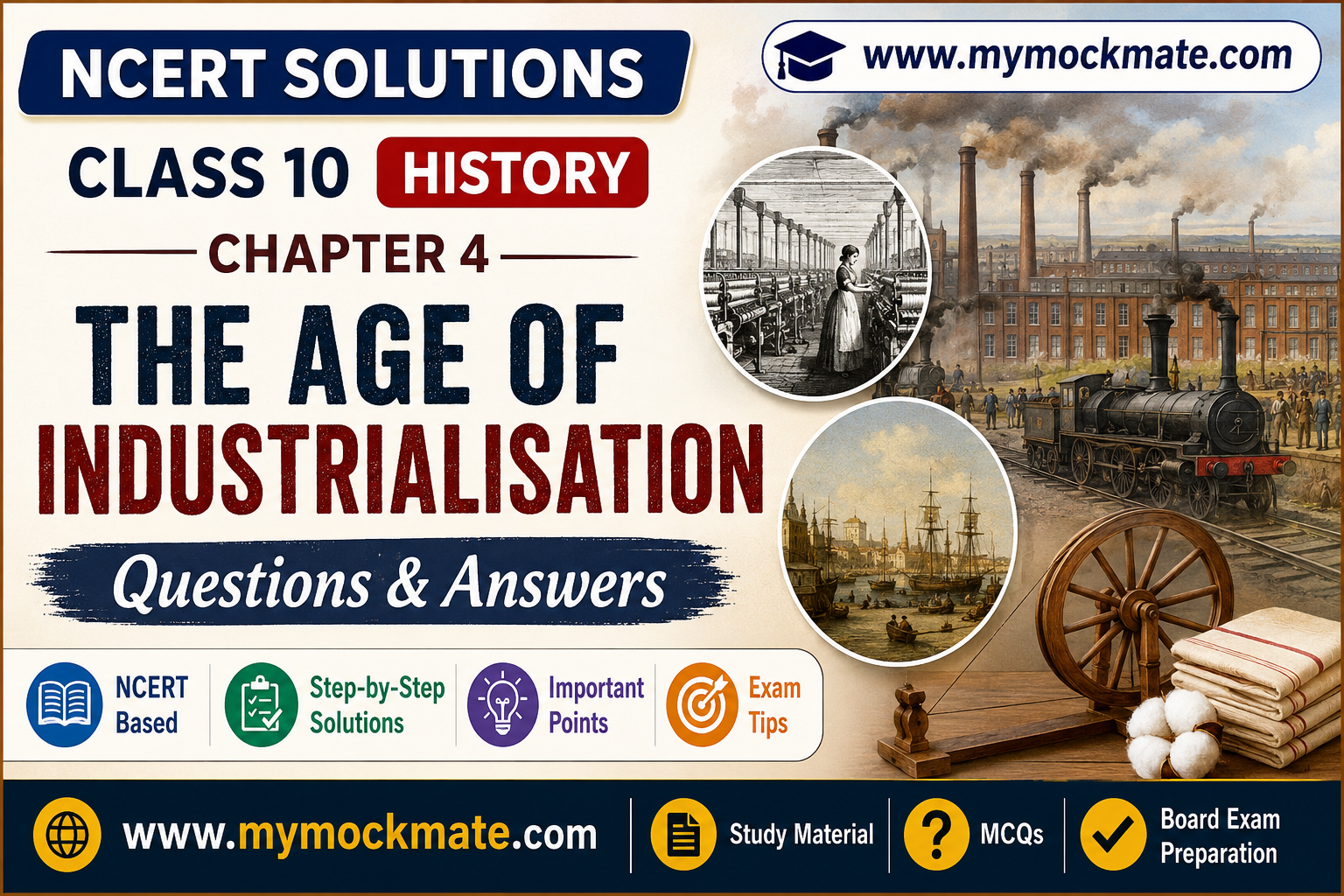
The chapter “The Age of Industrialisation” explains how industrialisation began in Britain and later spread to India. It discusses proto-industrialisation, factory production, the impact of machines on workers, the decline of Indian textiles under colonial rule, and the growth of industries in India. The chapter highlights both the opportunities and challenges created by industrial development.
Quick Information Box
| Particular | Details |
|---|---|
| Class | 10 |
| Subject | History |
| Book | India and the Contemporary World – II |
| Chapter Number | 4 |
| Chapter Name | The Age of Industrialisation |
| Board | CBSE |
| Important Topics | Proto-industrialisation, Factories, Indian Textiles, Industrial Growth |
| Exam Weightage | High |
Concepts Used (Topics Covered)
- Proto-Industrialisation
- Industrial Revolution
- Factory System
- Cotton Industry in Britain
- Hand Labour and Steam Power
- Indian Textile Industry
- East India Company and Weavers
- Manchester Goods in India
- Growth of Factories in India
- Swadeshi Movement
- Small-Scale Industries
- Advertisement and Consumer Markets
Important Formulas
History chapter mein mathematical formulas nahi hote. Important terms yaad rakhein:
- Proto-Industrialisation
- Gomastha
- Spinning Jenny
- Fly Shuttle
- Industrialisation
- Swadeshi Movement
- Managing Agency
NCERT Exercise Solutions
Write in Brief
Q1(a). Why did women workers in Britain attack the Spinning Jenny?
Answer:
Women workers attacked the Spinning Jenny because:
Step 1:
The Spinning Jenny increased production with fewer workers.
Step 2:
Women hand spinners feared losing their jobs.
Step 3:
The machine reduced the demand for manual labour.
Conclusion:
Women believed that the machine threatened their livelihood, so they protested and attacked it.
Q1(b). Why did merchants from towns in Europe begin employing peasants and artisans in villages during the seventeenth century?
Answer:
Step 1:
Demand for goods increased in international markets.
Step 2:
Trade guilds in towns restricted production expansion.
Step 3:
Peasants needed additional income because agriculture alone was insufficient.
Step 4:
Merchants supplied raw materials and advances to rural producers.
Conclusion:
Merchants shifted production to villages where labour was available and restrictions were fewer.
Q1(c). Why did the port of Surat decline by the end of the eighteenth century?
Answer:
Step 1:
European trading companies gained political and economic power.
Step 2:
Trade shifted from Surat to Bombay and Calcutta.
Step 3:
European companies controlled trade through new ports.

Step 4:
Credit networks and local merchants became weak.
Conclusion:
Surat declined because colonial trade policies favoured new British-controlled ports.
Q1(d). Why did the East India Company appoint gomasthas to supervise weavers?
Answer:
Step 1:
The Company wanted direct control over weavers.
Step 2:
Gomasthas supervised production and checked cloth quality.
Step 3:
They collected supplies and prevented weavers from selling to other buyers.
Step 4:
This ensured regular supply at lower prices.
Conclusion:
Gomasthas helped the Company maintain monopoly control over textile production.
Q2. Write True or False
(a) At the end of the nineteenth century, 80% of the total workforce in Europe was employed in technologically advanced industrial sectors.
Answer: False
Explanation: Less than 20% worked in technologically advanced sectors.
(b) The international market for fine textiles was dominated by India till the eighteenth century.
Answer: True
Explanation: Indian cotton and silk textiles were famous worldwide.
(c) The American Civil War resulted in the reduction of cotton exports from India.
Answer: False
Explanation: Cotton exports from India increased during the American Civil War.
(d) The introduction of the fly shuttle enabled handloom workers to improve productivity.
Answer: True
Explanation: It increased speed and efficiency of weaving.
Q3. Explain what is meant by Proto-Industrialisation.
Answer:
Proto-industrialisation refers to the phase before factories became common.
Explanation:
- Production was organised by merchants.
- Goods were produced in rural households.
- Peasants and artisans worked for international markets.
- Factory production had not yet started on a large scale.
Conclusion:
Proto-industrialisation was the early stage of industrial development before the rise of factories.
Discuss
Q1. Why did some industrialists in nineteenth-century Europe prefer hand labour over machines?
Answer:
- Labour was cheap and easily available.
- Machines required large investment.
- Machines often broke down.
- Handmade products were preferred by wealthy customers.
- Seasonal industries required temporary labour.
Therefore, many industrialists found hand labour more economical than machines.
Q2. How did the East India Company procure regular supplies of cotton and silk textiles from Indian weavers?
Answer:
- It appointed gomasthas.
- It provided advances to weavers.
- It prevented weavers from selling to other buyers.
- It monitored production and quality.
This system ensured a steady supply of textiles.
Q3. Why did industrial production in India increase during the First World War?
Answer:
Step 1:
British factories became busy producing war materials.
Step 2:
Imports from Britain declined.
Step 3:
Indian industries received large orders.
Step 4:
Factories produced uniforms, tents, bags, boots and other war supplies.
Conclusion:
Industrial production expanded rapidly due to increased demand during the war.
Q4. Encyclopaedia Note on Britain and the History of Cotton
Britain’s cotton industry played a major role in the Industrial Revolution. Technological innovations such as the Spinning Jenny and power looms increased production. Cotton mills became symbols of industrial progress. Britain imported raw cotton from colonies and exported finished goods worldwide. The expansion of railways and factories further strengthened industrial growth. Cotton became the leading sector of Britain’s industrial economy during the nineteenth century.
Common Mistakes
- Confusing Proto-Industrialisation with Industrial Revolution.
- Writing Gomastha as a trader instead of Company agent.
- Forgetting the impact of Manchester goods on Indian weavers.
- Mixing handloom industry with factory industry.
- Incorrectly stating that machines immediately replaced hand labour.
Exam Tips
- Learn definitions of Proto-Industrialisation, Gomastha, Fly Shuttle and Spinning Jenny.
- Remember causes of decline of Indian textiles.
- Revise effects of the American Civil War.
- Prepare short notes on Indian entrepreneurs.
- Practice 3-mark and 5-mark answers regularly.
Practice MCQs
1. Who invented the Spinning Jenny?
A. James Watt
B. Richard Arkwright
C. James Hargreaves
D. Mathew Boulton
Answer: C. James Hargreaves
2. What was a Gomastha?
A. Factory Owner
B. Company Agent
C. Merchant Banker
D. Weaver
Answer: B. Company Agent
3. Which city became famous as a finishing centre for cloth?
A. Manchester
B. Liverpool
C. London
D. Birmingham
Answer: C. London
4. Which movement encouraged the boycott of foreign cloth?
A. Non-Cooperation Movement
B. Swadeshi Movement
C. Quit India Movement
D. Civil Disobedience Movement
Answer: B. Swadeshi Movement
5. What is Proto-Industrialisation?
A. Factory Production
B. Household Production Before Factories
C. Steam Production
D. Railway Industry
Answer: B. Household Production Before Factories
FAQ Section
Q1. What is the main theme of The Age of Industrialisation?
The chapter explains industrial development in Britain and India and its impact on society and economy.
Q2. Who were Gomasthas?
They were agents appointed by the East India Company to supervise weavers.
Q3. What is Proto-Industrialisation?
It is the stage of industrial production before factory-based manufacturing.
Q4. Why were Indian weavers affected by Manchester goods?
Machine-made British goods were cheaper and flooded Indian markets.
Q5. What was the role of the Swadeshi Movement?
It encouraged people to buy Indian-made goods and boycott foreign products.
CTA (Call To Action)
Found these NCERT Class 10 History Chapter 4 solutions helpful?
Explore more chapter-wise NCERT solutions, CBSE notes, MCQs, previous year questions and board exam study material on www.mymockmate.com. Stay updated with the latest educational resources and improve your exam preparation today!