




Short Intro
Chemical Reactions and Equations is the first chapter of Class 10 Science. This chapter explains chemical reactions, balancing chemical equations, types of reactions, oxidation, reduction, corrosion, and rancidity. These NCERT solutions provide step-by-step explanations for all important questions and help students prepare effectively for board examinations.
Quick Information Box
| Particular | Details |
|---|---|
| Chapter Name | Chemical Reactions and Equations |
| Class | 10 |
| Subject | Science |
| Board | CBSE/State Boards |
| Important Topics | Balancing Equations, Oxidation, Reduction, Types of Reactions |
| Exam Weightage | High |
Concepts Used (Topics Covered)
• Chemical Reactions
• Chemical Equations
• Balanced Chemical Equations
• Combination Reactions
• Decomposition Reactions
• Displacement Reactions
• Double Displacement Reactions
• Oxidation and Reduction
• Corrosion
• Rancidity
Important Formulas
- Law of Conservation of Mass
Total mass of reactants = Total mass of products - Combination Reaction
A + B → AB - Decomposition Reaction
AB → A + B - Displacement Reaction
A + BC → AC + B - Double Displacement Reaction
AB + CD → AD + CB
Question 1
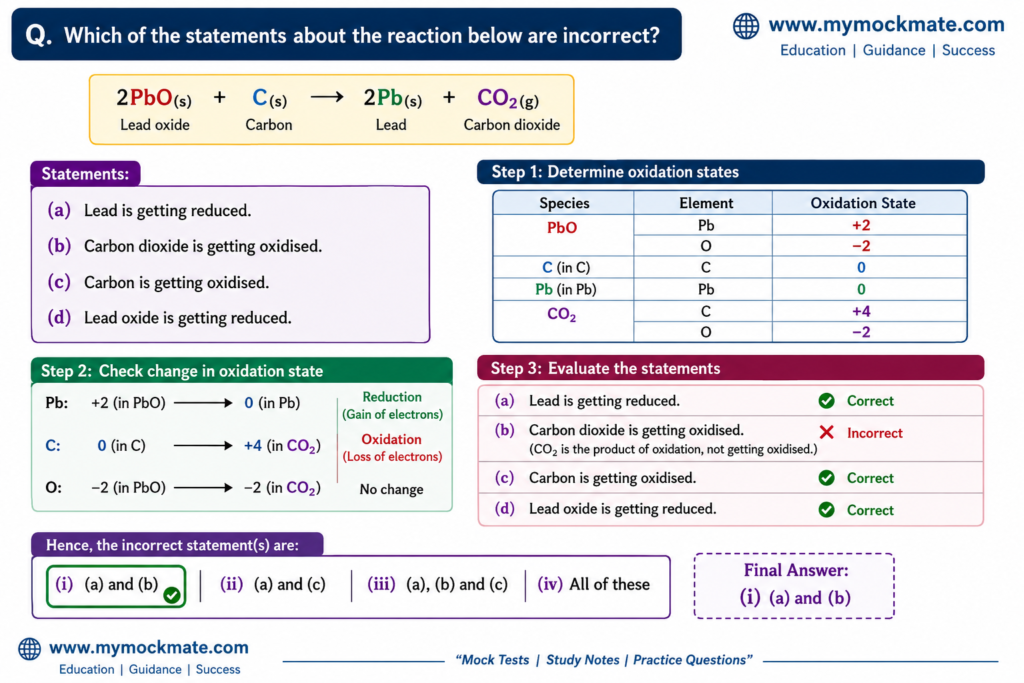
Which statements are incorrect?
2PbO + C → 2Pb + CO₂
Solution
Question 2
Fe₂O₃ + 2Al → Al₂O₃ + 2Fe
Solution
Aluminium displaces iron from iron oxide.
Answer
(d) Displacement Reaction
Question 3
What happens when dilute hydrochloric acid is added to iron filings?
Solution
Iron reacts with HCl to form iron chloride and hydrogen gas.
Fe + 2HCl → FeCl₂ + H₂
Answer
(a) Hydrogen gas and iron chloride are produced.
Question 4
What is a balanced chemical equation? Why should chemical equations be balanced?
Solution
A balanced chemical equation has an equal number of atoms of each element on both sides.
Chemical equations are balanced because of the Law of Conservation of Mass.
Answer
A balanced chemical equation contains equal numbers of atoms of every element on both sides. It is balanced to satisfy the law of conservation of mass.

Question 5
Translate and balance the equations.
(a)
Hydrogen + Nitrogen → Ammonia
N₂ + 3H₂ → 2NH₃
(b)
Hydrogen sulphide + Oxygen → Water + Sulphur dioxide
2H₂S + 3O₂ → 2H₂O + 2SO₂
(c)
Barium chloride + Aluminium sulphate → Aluminium chloride + Barium sulphate
3BaCl₂ + Al₂(SO₄)₃ → 2AlCl₃ + 3BaSO₄
(d)
Potassium + Water → Potassium hydroxide + Hydrogen
2K + 2H₂O → 2KOH + H₂
Question 6
Balance the following equations.
(a)
2HNO₃ + Ca(OH)₂ → Ca(NO₃)₂ + 2H₂O
(b)
2NaOH + H₂SO₄ → Na₂SO₄ + 2H₂O
(c)
NaCl + AgNO₃ → AgCl + NaNO₃
(d)
BaCl₂ + H₂SO₄ → BaSO₄ + 2HCl
Question 7
(a)
Ca(OH)₂ + CO₂ → CaCO₃ + H₂O
(b)
Zn + 2AgNO₃ → Zn(NO₃)₂ + 2Ag
(c)
2Al + 3CuCl₂ → 2AlCl₃ + 3Cu
(d)
BaCl₂ + K₂SO₄ → BaSO₄ + 2KCl
Question 8
(a)
2KBr + BaI₂ → 2KI + BaBr₂
Type: Double Displacement
(b)
ZnCO₃ → ZnO + CO₂
Type: Decomposition
(c)
H₂ + Cl₂ → 2HCl
Type: Combination
(d)
Mg + 2HCl → MgCl₂ + H₂
Type: Displacement
Question 9
What are exothermic and endothermic reactions?
Solution
Exothermic reactions release heat.
Example:
CH₄ + 2O₂ → CO₂ + 2H₂O + Heat
Endothermic reactions absorb heat.
Example:
CaCO₃ → CaO + CO₂
Question 10
Why is respiration exothermic?
Solution
During respiration, glucose reacts with oxygen and releases energy.
C₆H₁₂O₆ + 6O₂ → 6CO₂ + 6H₂O + Energy
Hence respiration is exothermic.
Question 11
Why are decomposition reactions opposite to combination reactions?
Solution
Combination:
A + B → AB
Decomposition:
AB → A + B
Combination forms one product while decomposition breaks one compound into simpler substances.
Question 12
Examples of decomposition reactions
Heat:
CaCO₃ → CaO + CO₂
Light:
2AgCl → 2Ag + Cl₂
Electricity:
2H₂O → 2H₂ + O₂
Question 13
Difference between displacement and double displacement reactions
Displacement:
One element replaces another.
Zn + CuSO₄ → ZnSO₄ + Cu
Double displacement:
Exchange of ions occurs.
Na₂SO₄ + BaCl₂ → BaSO₄ + 2NaCl
Question 14
Silver recovery reaction
Cu + 2AgNO₃ → Cu(NO₃)₂ + 2Ag
Question 15
Precipitation Reaction
A reaction producing an insoluble solid is called a precipitation reaction.
Example:
Na₂SO₄ + BaCl₂ → BaSO₄↓ + 2NaCl
Question 16
(a) Oxidation
Addition of oxygen or removal of hydrogen.
Examples:
2Cu + O₂ → 2CuO
C + O₂ → CO₂
(b) Reduction
Removal of oxygen or addition of hydrogen.
Examples:
CuO + H₂ → Cu + H₂O
ZnO + C → Zn + CO
Question 17
A shiny brown element becomes black on heating.
Answer
Element: Copper
Black Compound: Copper Oxide (CuO)
Question 18
Why is paint applied on iron articles?
Solution
Paint prevents contact of iron with air and moisture and protects it from rusting.
Question 19
Why are food items flushed with nitrogen?
Solution
Nitrogen prevents oxidation of oils and fats and avoids rancidity.
Question 20
(a) Corrosion
Gradual destruction of metals by air and moisture.
Example:
Rusting of iron.
(b) Rancidity
Oxidation of fats and oils causing bad smell and taste.
Example:
Spoilage of chips and fried foods.
Common Mistakes
• Forgetting to balance equations.
• Confusing oxidation with reduction.
• Mixing displacement and double displacement reactions.
• Ignoring state symbols.
• Writing incorrect chemical formulae.
Exam Tips
• Learn all reaction types with examples.
• Practice balancing equations daily.
• Remember oxidation and reduction definitions.
• Revise important NCERT reactions.
• Focus on board-exam frequently asked questions.
Practice MCQs
- Rusting of iron is an example of:
A. Combination
B. Corrosion
C. Neutralization
D. Sublimation
Answer: B
- Which reaction releases heat?
A. Endothermic
B. Decomposition
C. Exothermic
D. Electrolysis
Answer: C
- Whitewashing uses:
A. CaO
B. Ca(OH)₂
C. CaCO₃
D. MgO
Answer: B
- Silver chloride decomposes in:
A. Heat
B. Water
C. Sunlight
D. Steam
Answer: C
- Zn + CuSO₄ → ZnSO₄ + Cu is:
A. Combination
B. Displacement
C. Reduction
D. Neutralization
Answer: B
FAQ Section
Q1. What is a chemical reaction?
A. A process in which new substances are formed from reactants.
Q2. Why are chemical equations balanced?
A. To satisfy the law of conservation of mass.
Q3. What is oxidation?
A. Gain of oxygen or loss of hydrogen.
Q4. What is reduction?
A. Loss of oxygen or gain of hydrogen.
Q5. What causes rusting?
A. Reaction of iron with oxygen and moisture.
CTA (Call To Action)
Found these NCERT Class 10 Science Chapter 1 solutions helpful? Explore more chapter-wise solutions, MCQs, notes, and previous-year questions on www.mymockmate.com to boost your exam preparation.