




Short Introduction
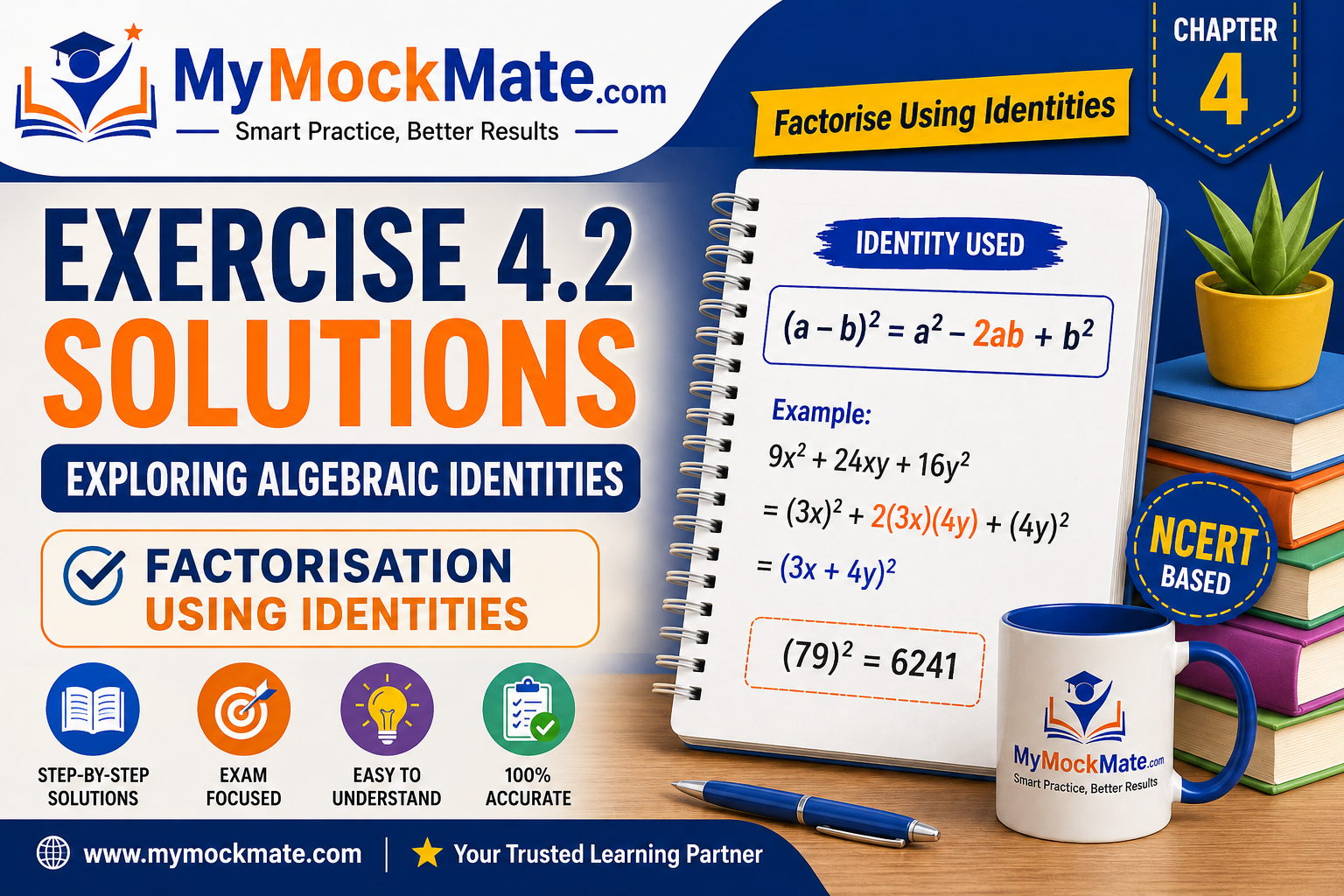
Exercise 4.2 focuses on factorisation using algebraic identities. Students learn how to recognize perfect square trinomials and convert them into factors using the identities:
(a + b)² = a² + 2ab + b²
(a − b)² = a² − 2ab + b²
These techniques simplify algebraic expressions and help solve mathematical problems quickly.
Quick Information Box
| Particular | Details |
|---|---|
| Chapter | Exploring Algebraic Identities |
| Exercise | 4.2 |
| Topic | Factorisation Using Identities |
| Class | 9 |
| Difficulty Level | Moderate |
| Main Identities | (a+b)² and (a−b)² |
Concepts Used (Topics Covered)
✅ Perfect Square Trinomials
✅ Factorisation by Identities
✅ Common Factor Method
✅ Expansion Verification
✅ Numerical Calculation using (a−b)²
Important Formulas
Identity 1
(a + b)² = a² + 2ab + b²
Identity 2
(a − b)² = a² − 2ab + b²
Factorisation Forms
a² + 2ab + b² = (a + b)²
a² − 2ab + b² = (a − b)²
Question 1
Factor Completely
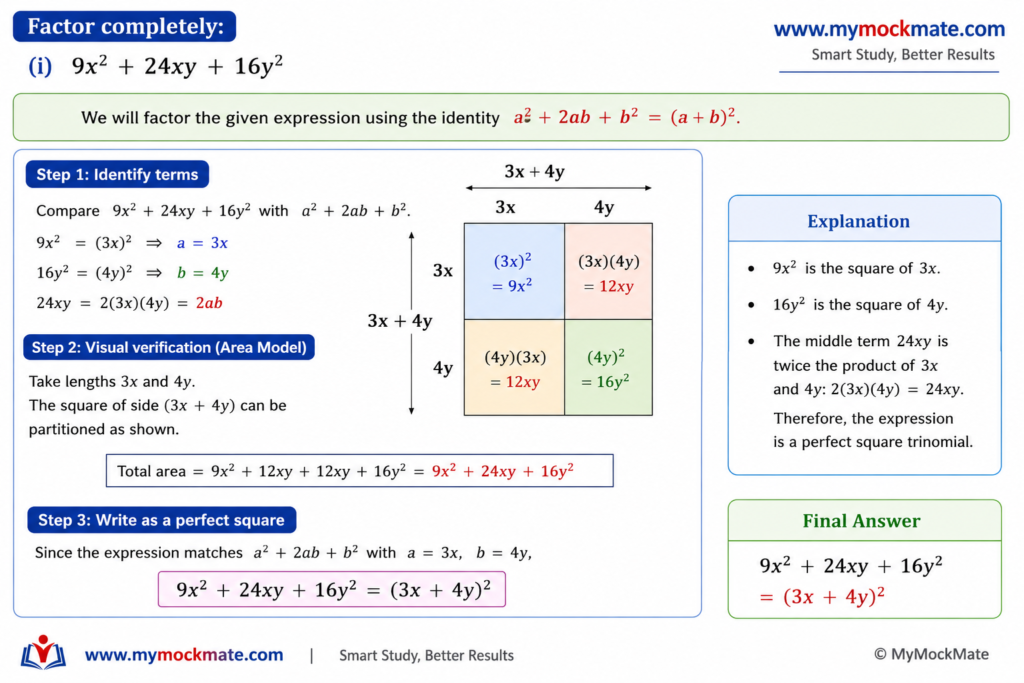
(i) 9x² + 24xy + 16y²
Solution
Answer
(3x + 4y)²
(ii) 4s² + 20st + 25t²
Solution
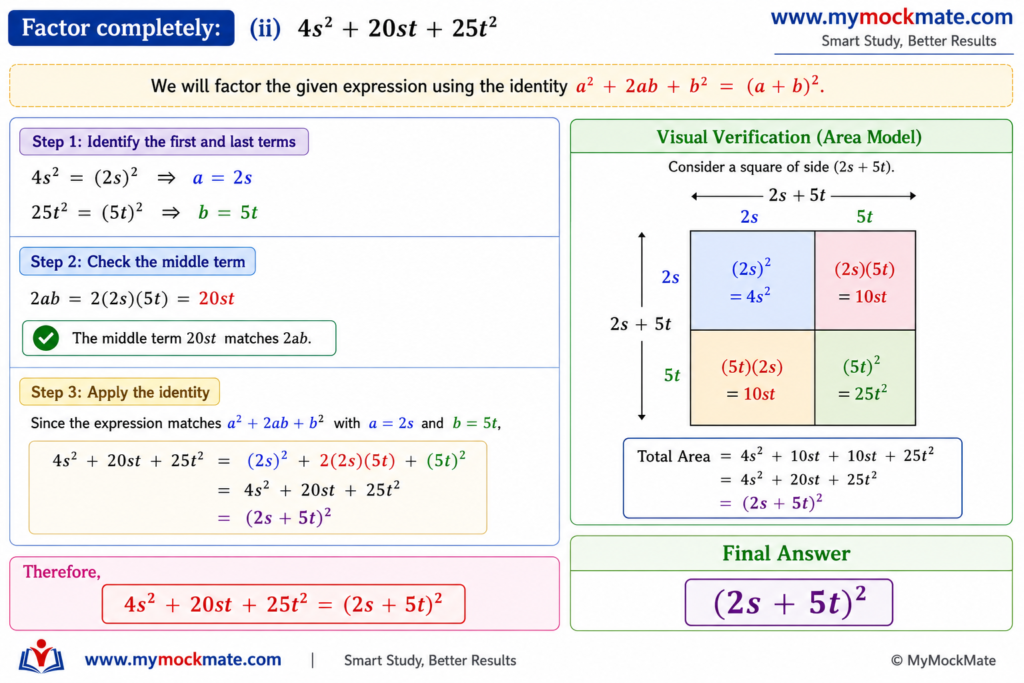
Answer
(2s + 5t)²
(iii) 49x² + 28xy + 4y²
Solution
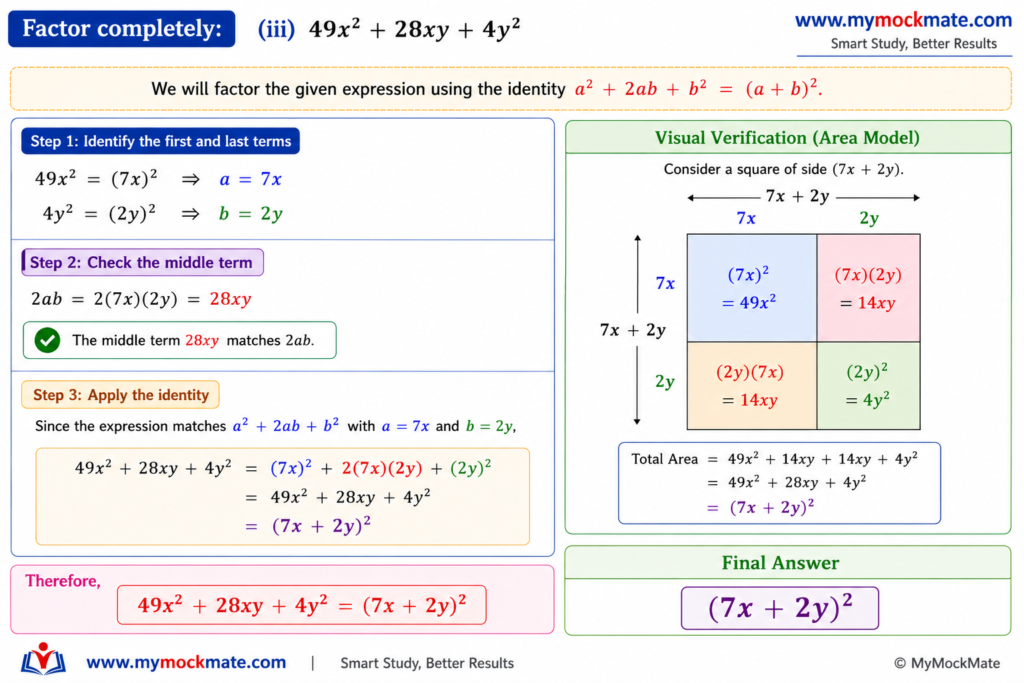
Answer
(7x + 2y)²
(iv) 64p² + (32/3)pq + (4/9)q²
Solution
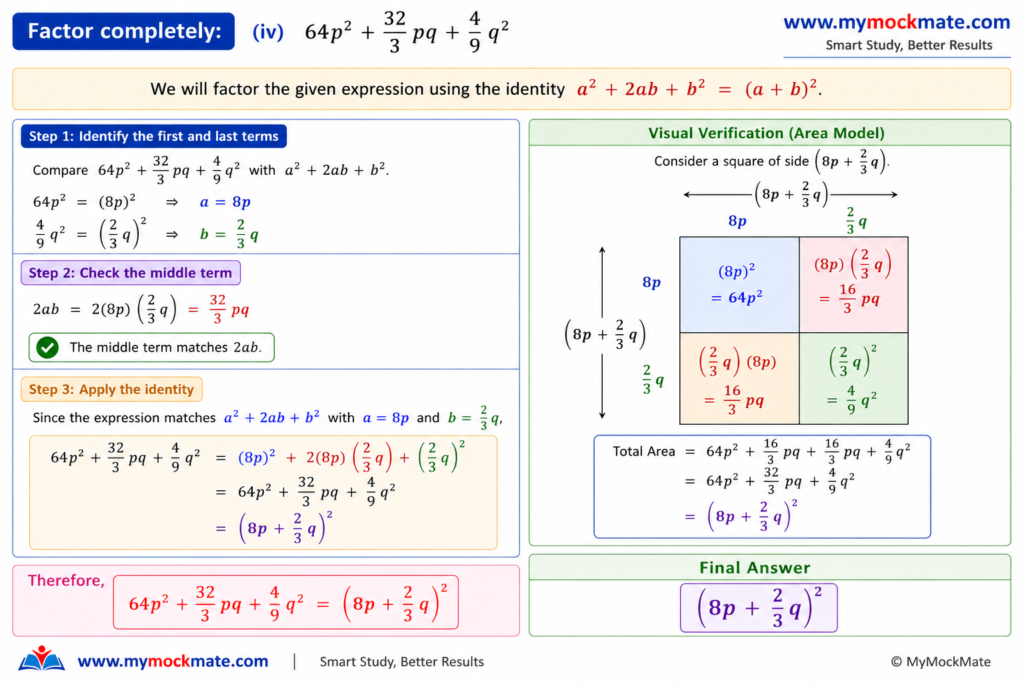
Answer
(8p + 2q/3)²
(v) 3a² + 4ab + (4/3)b²
Solution
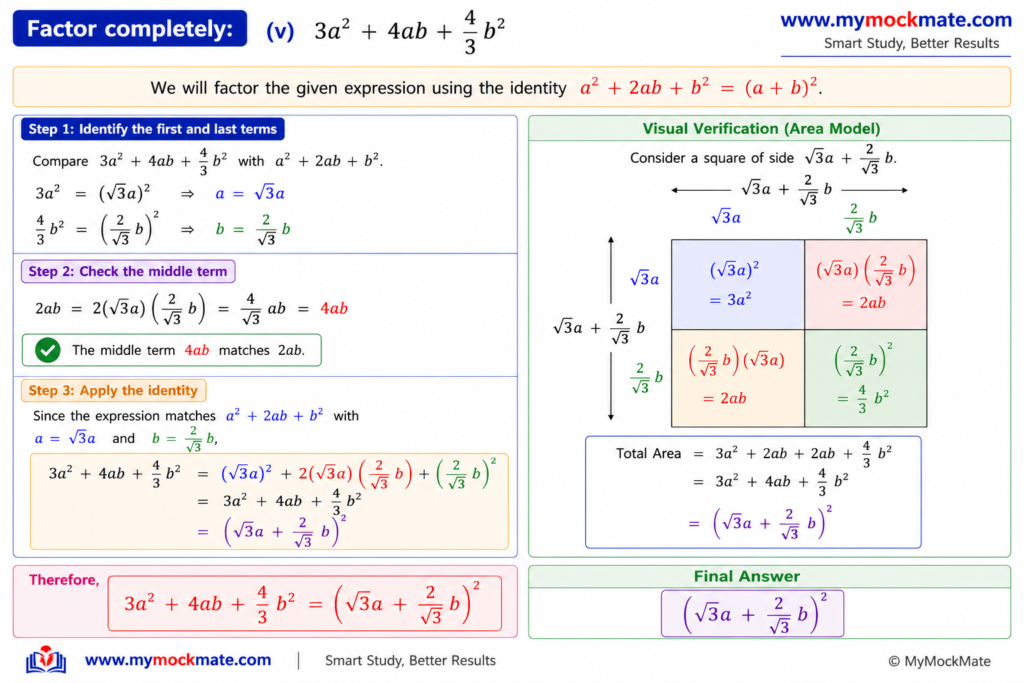
Answer
(1/3)(3a + 2b)²
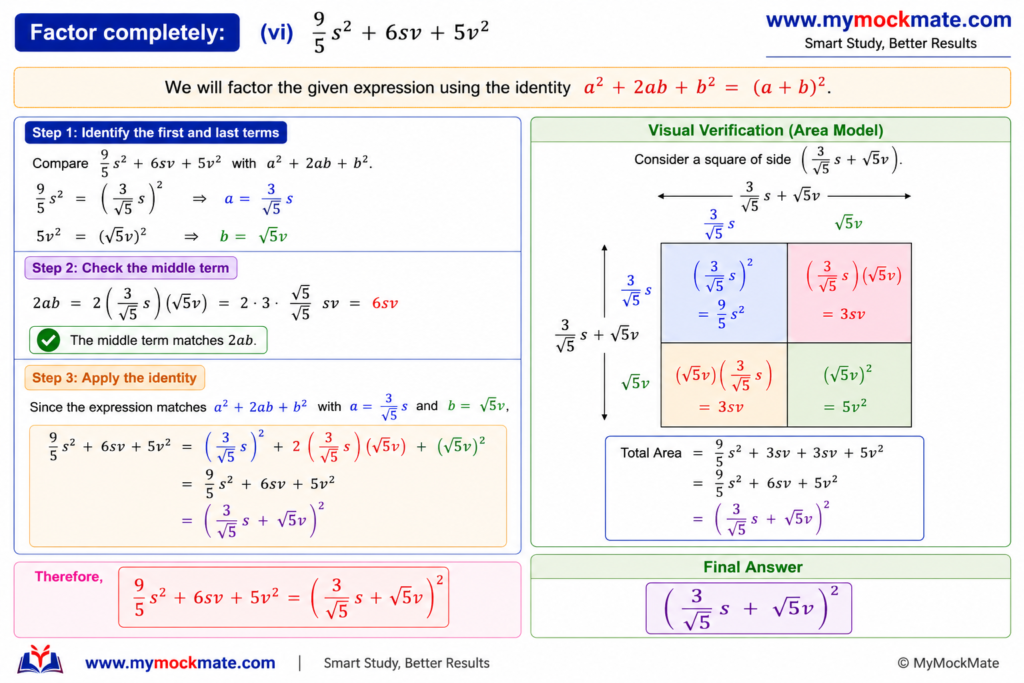
(vi) (9/5)s² + 6sv + 5v²
Solution
Answer
(1/5)(3s + 5v)²
Question 2
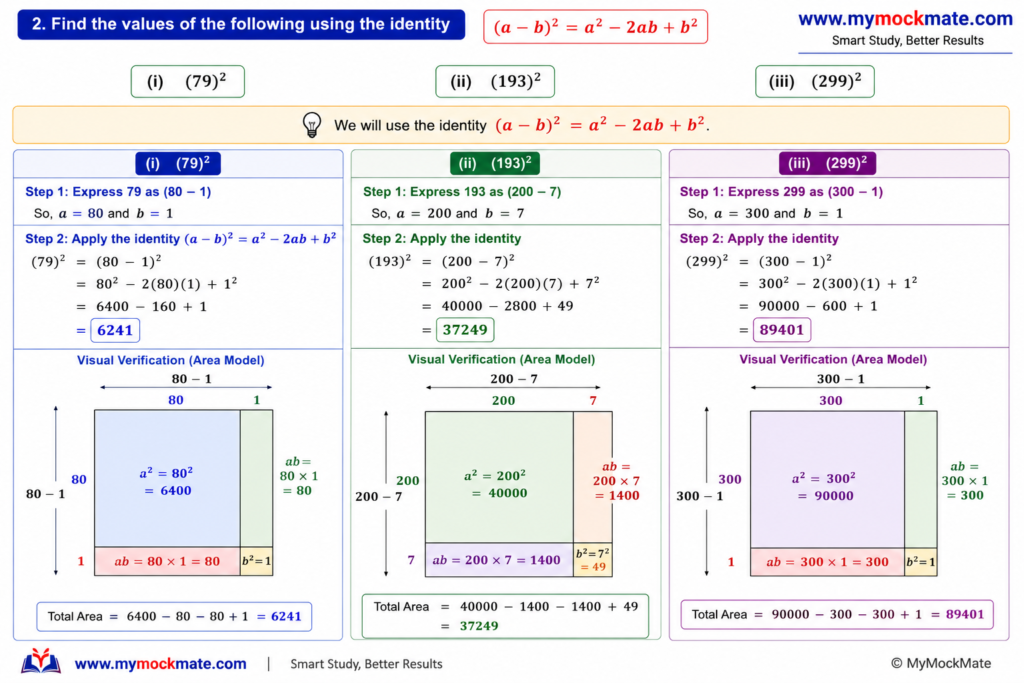
Find the values of the following using the identity
(a − b)² = a² − 2ab + b²
(i) (79)²
(ii) (193)²
(iii) (299)²
Solution
Final Answers Summary
Question 1
(i) (3x + 4y)²
(ii) (2s + 5t)²
(iii) (7x + 2y)²
(iv) (8p + 2q/3)²
(v) (1/3)(3a + 2b)²
(vi) (1/5)(3s + 5v)²
Question 2
(i) 6241
(ii) 37249
(iii) 89401
Common Mistakes
❌ Ignoring the middle term while checking identities.
❌ Forgetting to take common factors in Questions (v) and (vi).
❌ Wrong square of fractions.
❌ Incorrect calculation of 2ab.
Exam Tips
⭐ First identify the first square term.
⭐ Check whether the last term is also a perfect square.
⭐ Verify the middle term equals 2ab.
⭐ Always factor out common factors first.
⭐ Use identities for quick calculations of numbers near 100, 200 or 300.
Practice MCQs
1. Factorise x² + 10x + 25
A. (x+5)
B. (x+5)²
C. (x−5)²
D. x(x+25)
✅ Answer: B
2. Factorise 4a² +12ab +9b²
A. (2a+3b)
B. (2a+3b)²
C. (2a−3b)²
D. (4a+9b)
✅ Answer: B
3. 99² equals
A. 9801
B. 9901
C. 9701
D. 9999
✅ Answer: A
4. Which identity is used for (a−b)²?
A. a²+2ab+b²
B. a²−2ab+b²
C. a²−b²
D. (a+b)(a−b)
✅ Answer: B
FAQ Section
Q1. What is a perfect square trinomial?
An expression of the form:
a² + 2ab + b²
or
a² − 2ab + b²
is called a perfect square trinomial.
Q2. Why do we verify the middle term?
Because it must exactly equal 2ab.
Q3. Why was common factor taken in Question (v)?
Without taking the common factor, the expression does not directly match an identity.
Q4. Which identity is used for numerical squares?
(a−b)² = a² −2ab + b²
Q5. Is factorisation the reverse of expansion?
Yes. Expansion converts factors into expressions, while factorisation converts expressions into factors.
📚 Looking for complete Class 9 Maths solutions?
Get chapter-wise NCERT solutions, mock tests, MCQs, previous year questions and detailed explanations at:
Practice smarter and score higher with MyMockMate.