




Short Introduction
Exercise 4.3 introduces advanced algebraic identities and their applications in squaring numbers, factorisation, expansion of expressions, and proving identities. These identities simplify lengthy calculations and strengthen algebraic thinking.
Quick Information Box
| Particular | Details |
|---|---|
| Chapter | Exploring Algebraic Identities |
| Exercise | 4.3 |
| Class | 9 |
| Main Topic | More Algebraic Identities |
| Difficulty Level | Moderate |
| Skills Developed | Expansion, Factorisation, Proof of Identities |
Concepts Used (Topics Covered)
✅ (a+b)² = a² + 2ab + b²
✅ (a−b)² = a² − 2ab + b²
✅ (a+b+c)² = a²+b²+c²+2ab+2bc+2ca
✅ Perfect Square Trinomials
✅ Numerical Squaring
✅ Identity Verification
Important Formulas
Identity 1
(a+b)² = a² + 2ab + b²
Identity 2
(a−b)² = a² − 2ab + b²
Identity 3
(a+b+c)² = a²+b²+c²+2ab+2bc+2ca
Question 1
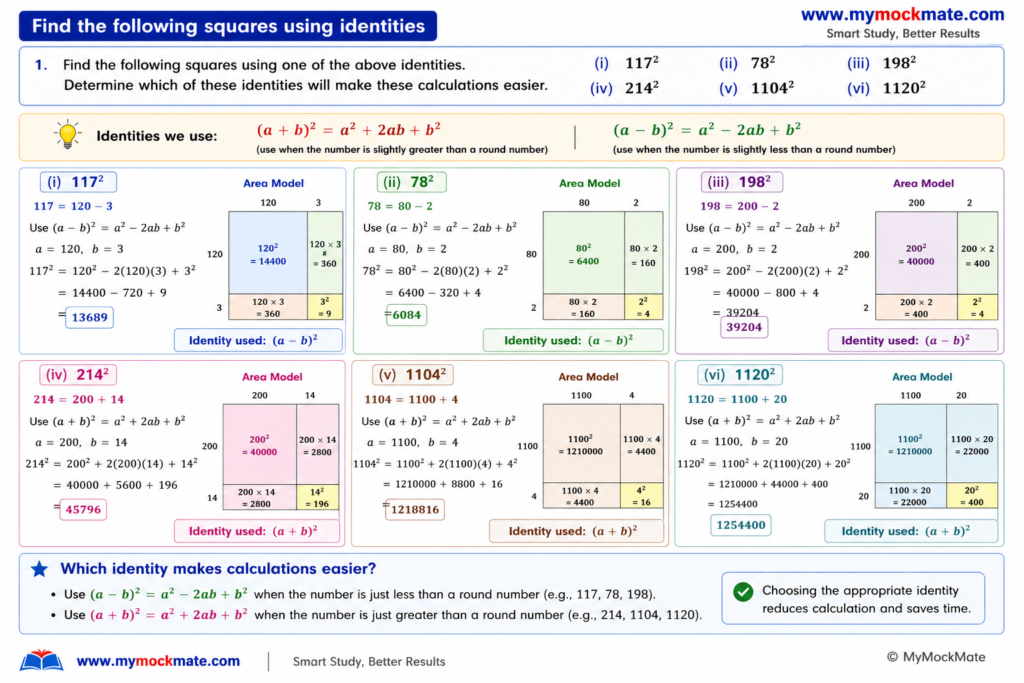
Find the following squares using one of the above identities. Determine which of these identities will make these calculations easier.
(i) 117²
(ii) 78²
(iii) 198²
(iv) 214²
(v) 1104²
(vi) 1120²
Question 2
Factor Using Suitable Identities
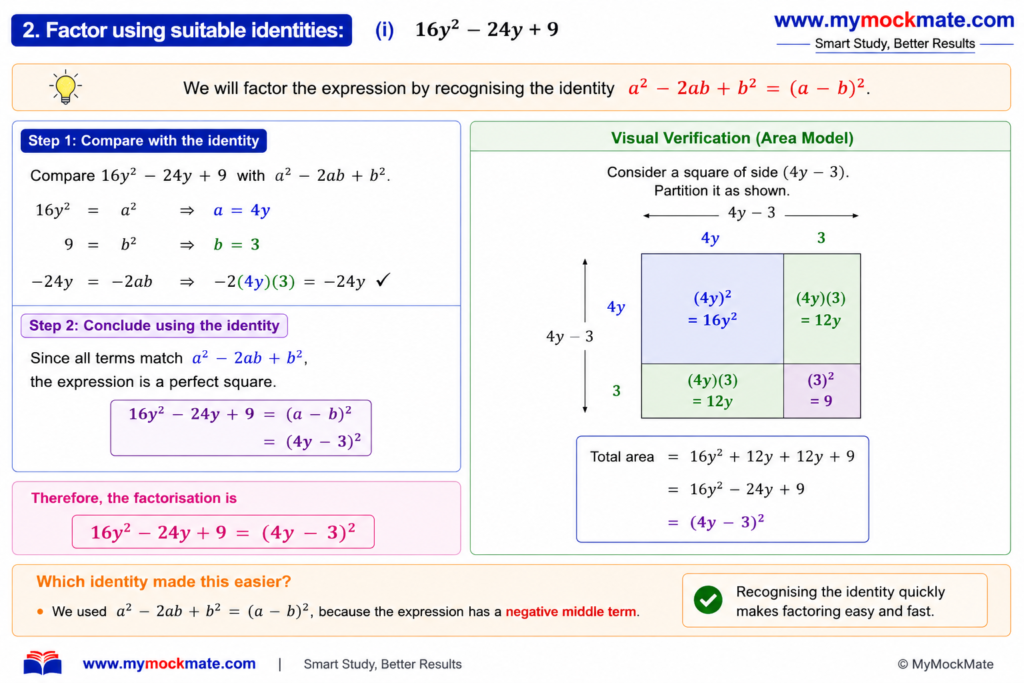
(i) 16y² − 24y + 9
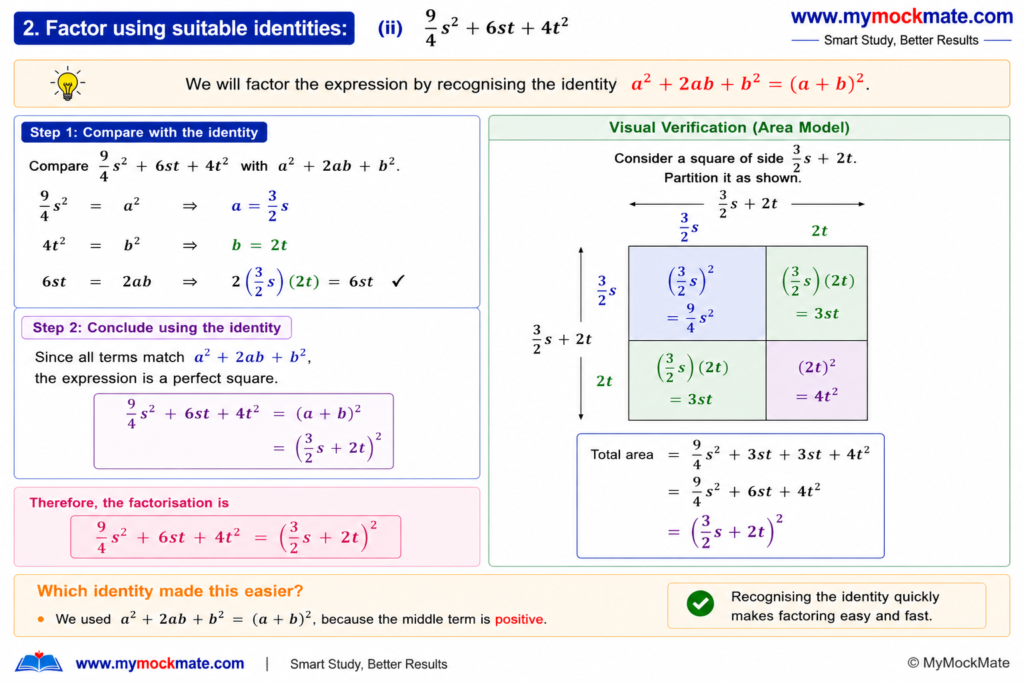
(ii) (9/4)s² + 6st + 4t²
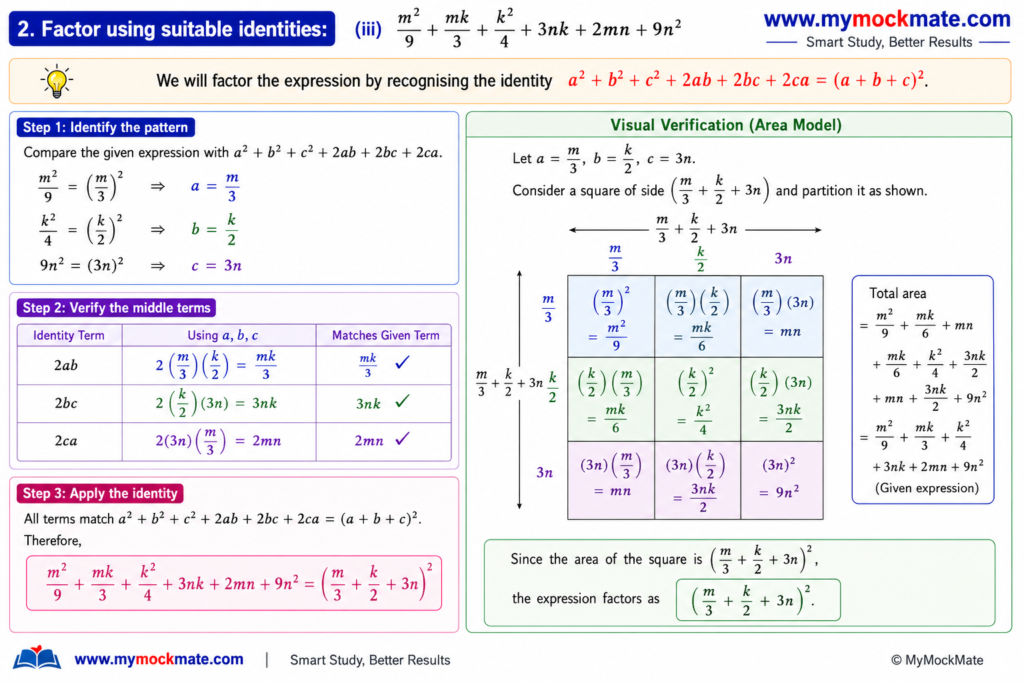
(iii)
m²/9 + mk/3 + k²/4 + 3nk + 2mn + 9n²
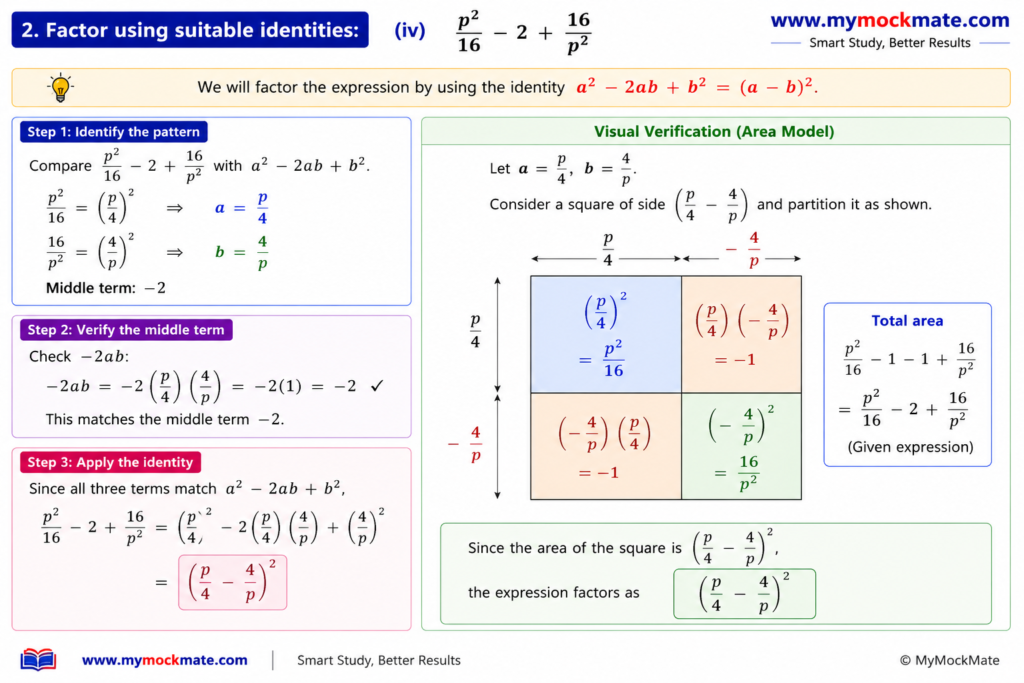
(iv)
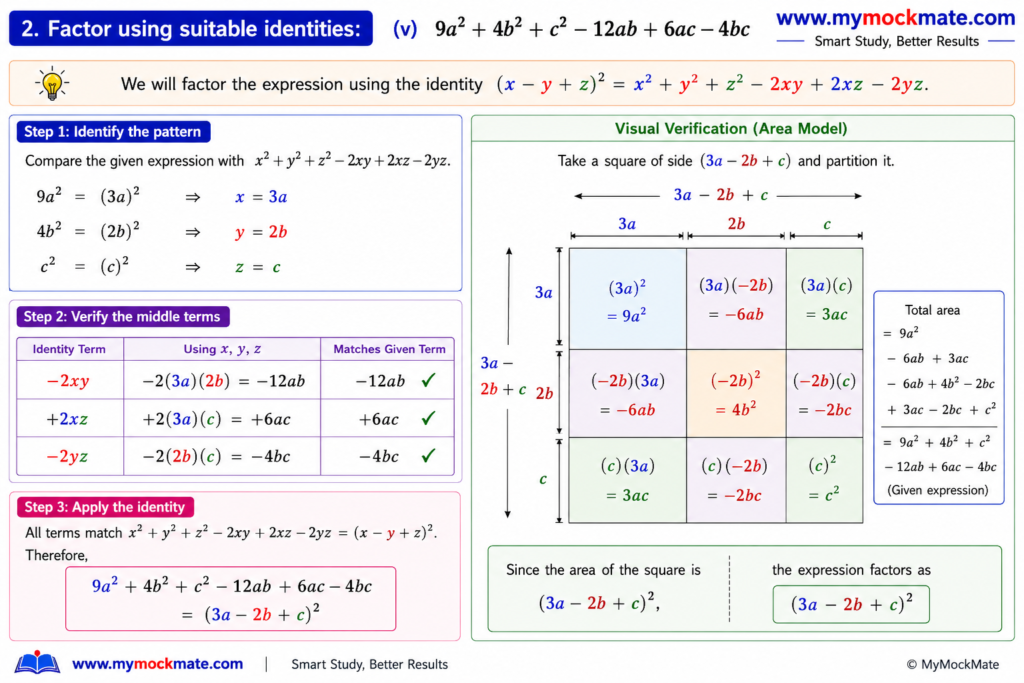
(v)
9a² + 4b² + c² −12ab +6ac −4bc
Question 3
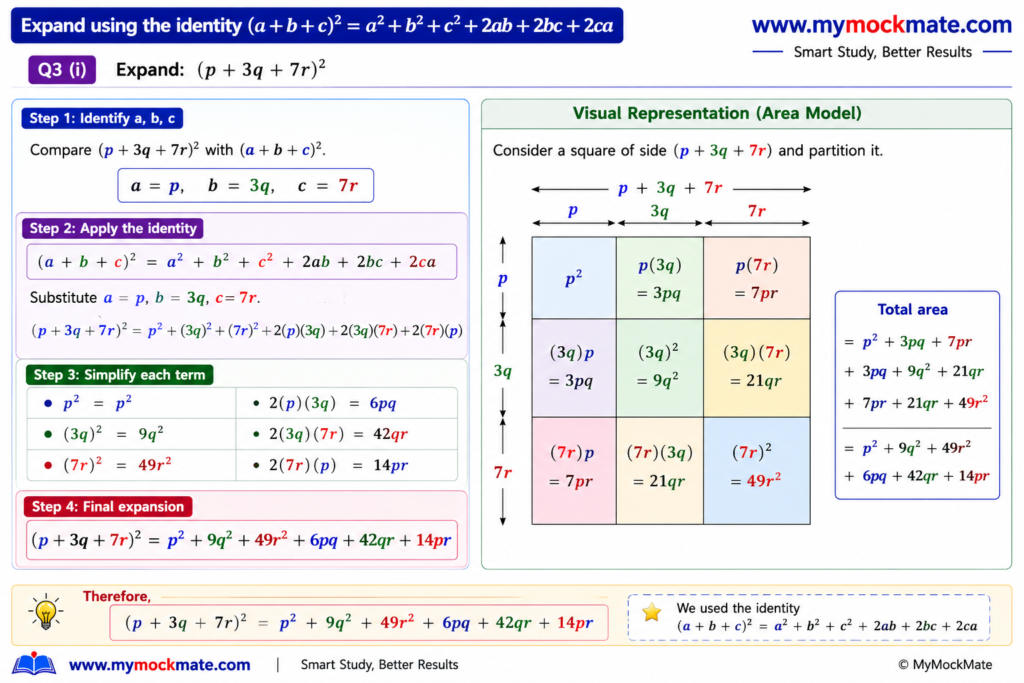
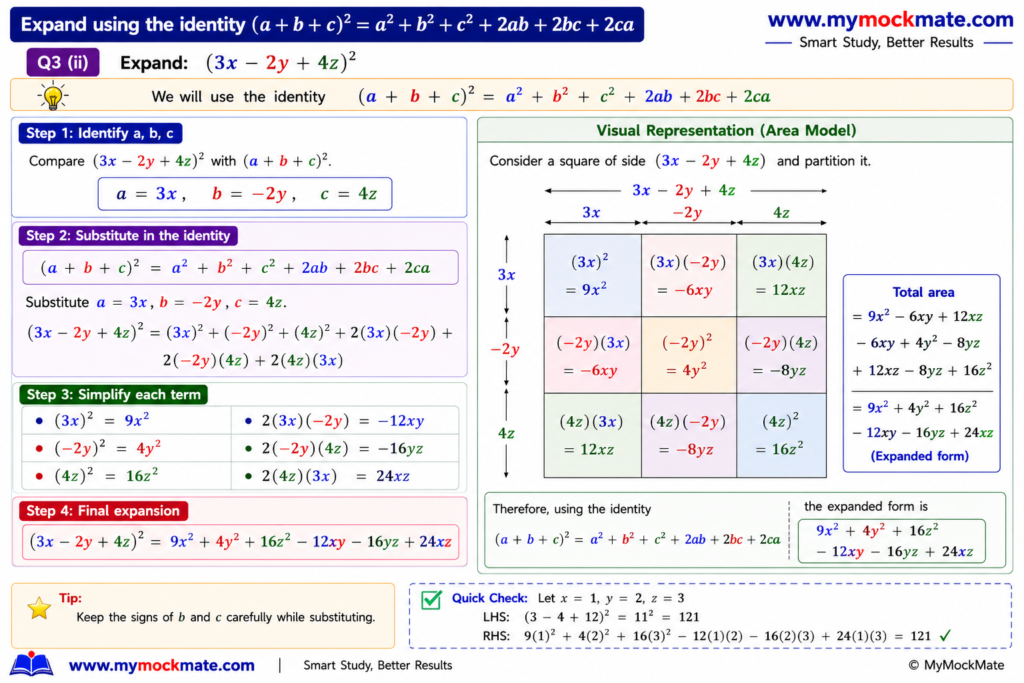
Expand the following using the identity

(a+b+c)² = a²+b²+c²+2ab+2bc+2ca
(i) (p + 3q + 7r)²
(ii) (3x − 2y + 4z)²
Question 4
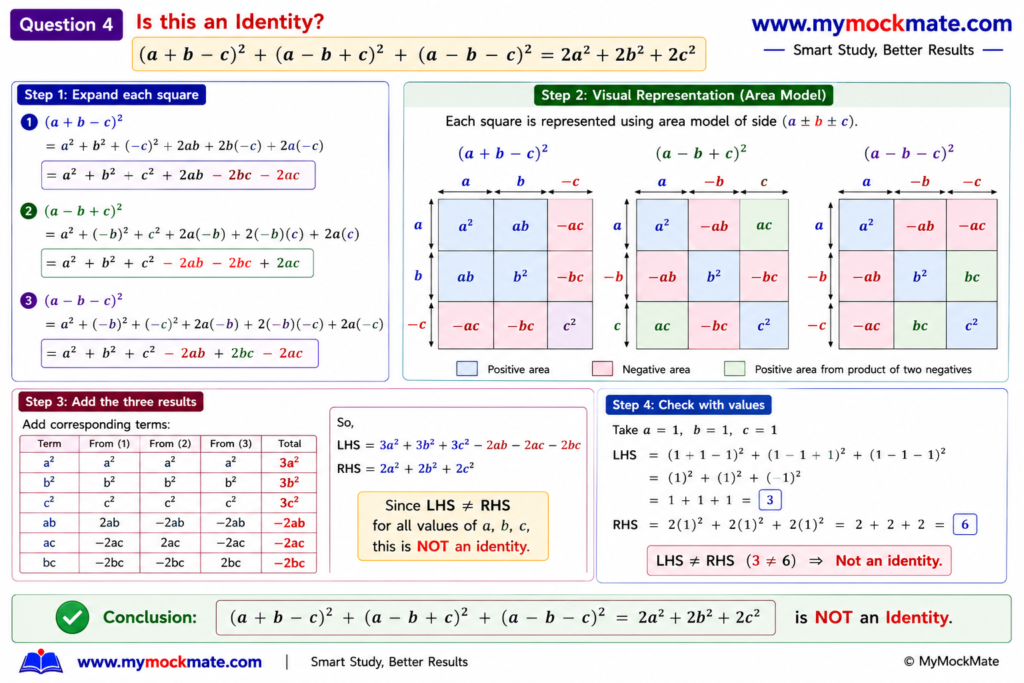
Is this an Identity?
(a+b−c)² + (a−b+c)² + (a−b−c)² = =2a²+2b²+2c²
Final Answers Summary
Question 1
(i) 13689
(ii) 6084
(iii) 39204
(iv) 45796
(v) 1218816
(vi) 1254400
Question 2
(i) (4y−3)²
(ii) (3s/2+2t)²
(iii) (m/3+k/2+3n)²
(iv) (p/4−4/p)²
(v) (3a−2b+c)²
Question 3
(i) p²+9q²+49r²+6pq+14pr+42qr
(ii) 9x²+4y²+16z²−12xy+24xz−16yz
Question 4
Not an Identity
Common Mistakes
❌ Forgetting cross-product terms in (a+b+c)².
❌ Wrong sign while expanding negative terms.
❌ Ignoring coefficients during factorisation.
❌ Confusing equation with identity.
Exam Tips
⭐ Identify the most suitable identity before solving.
⭐ Write identity first to gain step marks.
⭐ Check signs carefully in (a−b)².
⭐ Verify factorisation by re-expanding.
⭐ For numerical squares, choose nearest multiples of 10, 100, or 1000.
Practice MCQs
1. (a+b+c)² contains how many cross-product terms?
A. 2
B. 3
C. 4
D. 6
✅ Answer: B
2. Factorise x²−10x+25
A. (x−5)
B. (x+5)²
C. (x−5)²
D. x(x−25)
✅ Answer: C
3. 98² equals
A. 9604
B. 9804
C. 9504
D. 9904
✅ Answer: A
4. Which identity is used for 199²?
A. (a+b)²
B. (a−b)²
C. a²−b²
D. None
✅ Answer: B
FAQ Section
Q1. When should we use (a+b+c)²?
When an expression contains three terms whose square is required.
Q2. What is an identity?
An equation true for all values of variables.
Q3. How is identity different from an equation?
An equation is true only for specific values, while an identity is true for all values.
Q4. Why is factorisation important?
It simplifies algebraic expressions and helps solve equations quickly.
Q5. Can identities help in mental calculations?
Yes. They are widely used for quick squaring and simplification.
📚 Looking for complete Class 9 Maths solutions, chapter-wise notes, MCQs and mock tests?
👉 Visit www.mymockmate.com
Boost your Maths preparation with detailed solutions, exam tips, practice tests and chapter-wise study resources.