
The CBSE Class 12 Board Examination is an important academic milestone for students. Performance in the examination can influence college admissions, entrance examination preparation, scholarship opportunities, and future academic choices. Because of this, students need more than syllabus completion. They need a structured system that converts their knowledge into marks.
A common mistake among Class 12 students is to spend almost the entire preparation period reading textbooks, making notes, and watching lectures. These activities are important, but they do not fully prepare students for writing a three-hour examination paper under pressure.
This is where mock tests become essential.
A carefully planned mock test roadmap can help students improve answer-writing speed, time management, presentation, accuracy, question selection, and examination confidence. Instead of treating mock tests as an activity for the final few days before the examination, students should integrate them into the entire preparation process.
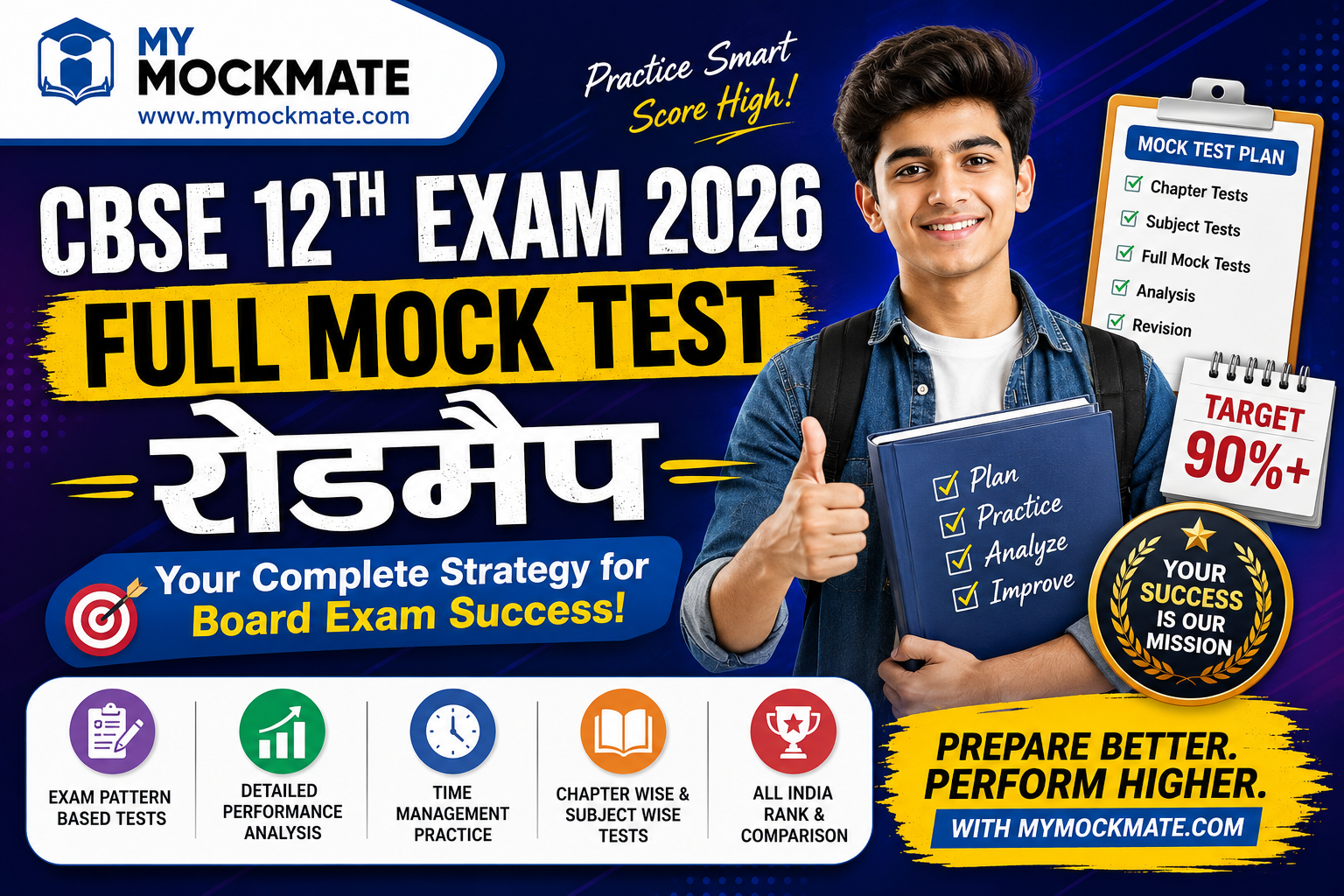
www.mymockmate.com provides students with an opportunity to make practice more systematic and performance-oriented. By combining concept preparation, chapter-wise testing, subject-wise practice, full-length mock examinations, and detailed performance analysis, students can identify weaknesses early and improve continuously.
This complete roadmap explains how CBSE Class 12 students can use mock tests effectively and build a practical preparation strategy for board examination success.
Why Do CBSE Class 12 Students Need Mock Tests?
Board examination preparation involves two different skills.
The first is learning the syllabus, and the second is presenting what you have learned within the examination time limit.
A student may understand every chapter but still lose marks because of:
- poor time management,
- incomplete answers,
- calculation errors,
- weak presentation,
- missing keywords,
- insufficient practice of application-based questions,
- failure to revise answers, or
- examination anxiety.
Mock tests create a bridge between learning and examination performance.
When students attempt a realistic test under timed conditions, they discover problems that are often invisible during normal study sessions. For example, a student may know how to solve a Mathematics problem but require too much time to complete it. Another student may understand a Physics derivation but miss important steps while writing the answer.
Regular testing reveals such problems before the actual examination.
The MyMockMate Approach: Learn, Test, Analyse and Improve
An effective Class 12 mock test strategy can be divided into four stages:
Learn → Test → Analyse → Improve
The cycle is simple but powerful.

First, study the chapter properly from the textbook, classroom notes, and other reliable learning resources. Next, attempt questions based on the completed topic. After that, analyse mistakes carefully. Finally, revise the weak concepts and attempt another test.
Students can use www.mymockmate.com as part of this performance-based preparation cycle.
The objective should not be to attempt the maximum possible number of tests. The real objective is to improve after every test.
A student who attempts 20 tests with careful analysis may gain more than a student who attempts 50 tests without reviewing mistakes.
Phase 1: Build the Foundation Before Full Mock Tests
The first stage of the roadmap is concept building.
Students should not immediately start attempting full-length mock papers without adequate preparation. Doing so can result in low scores and unnecessary frustration.
During the foundation stage, focus on:
- understanding concepts,
- completing textbook exercises,
- learning important definitions,
- practising numerical problems,
- preparing formulas,
- revising diagrams,
- understanding answer formats, and
- creating concise revision notes.
At this stage, tests should be short and focused.
For example, after completing one chapter of Mathematics, attempt a chapter test. After studying a Physics unit, solve numerical and conceptual questions from that unit. Commerce students can practise journal entries, accounting treatments, numerical problems, and case-based questions.
The purpose of Phase 1 is diagnosis.
Ask yourself:
Have I really understood the chapter, or have I only read it?
A test provides a more reliable answer than passive reading.
Phase 2: Start Chapter-Wise Mock Test Practice
Once the basic concepts are clear, students should begin systematic chapter-wise testing.
Chapter tests are useful because they provide immediate feedback. If you complete a chapter and wait two months before testing yourself, you may forget many concepts. Testing soon after learning strengthens recall.
A practical chapter test routine can be:
Day 1: Study the concepts.
Day 2: Complete textbook questions.
Day 3: Revise formulas, definitions, and important points.
Day 4: Attempt a chapter-wise test.
Day 5: Analyse mistakes and revise weak areas.
This structure can be adjusted according to subject and difficulty level.
On www.mymockmate.com, students can use practice tests as part of a regular study schedule rather than treating testing as a separate final activity.
Why Chapter Tests Are Important
Chapter-wise mock tests help students:
- check conceptual clarity,
- improve memory recall,
- identify difficult subtopics,
- understand common question patterns,
- strengthen application skills, and
- reduce the burden of final revision.
Suppose a student completes ten chapters but does not test any of them. During final revision, the student may discover serious weaknesses across multiple chapters.
In contrast, if every chapter is tested after completion, the final revision stage becomes much more manageable.
Phase 3: Move to Unit-Wise and Sectional Tests
After completing several related chapters, students should move from chapter tests to unit-wise or sectional tests.
This stage is extremely important because board papers do not present questions chapter by chapter in a predictable sequence. Students must quickly identify concepts and switch between different types of questions.
For example, a Mathematics test may combine questions from Relations and Functions, Calculus, Vectors, Probability, and other units. A Physics test may require students to move between theory, derivations, diagrams, and numerical problems.
Sectional tests develop mental flexibility.
They also help students understand whether they can retain previously studied topics while learning new ones.
A student may perform well in a chapter test immediately after completing the chapter. The real challenge is remembering the same concepts several weeks later in a mixed test.
Phase 4: Begin Subject-Wise Full Mock Tests
After substantial syllabus completion, students should start full subject tests.
This is where real board examination preparation begins.
A full-length mock test should be attempted in conditions similar to the actual examination:
- sit at a proper desk,
- keep only permitted materials nearby,
- follow the exact time limit,
- avoid mobile phones,
- do not take unnecessary breaks,
- attempt the complete paper, and
- reserve time for revision.
The test should be treated seriously.
Students can use MyMockMate to bring structure and regularity to their testing schedule. A mock test is most valuable when followed by performance analysis and corrective revision.
Subject-Wise Mock Test Strategy
Different Class 12 subjects require different testing strategies. A single approach cannot be applied to every subject.
Mathematics
Mathematics mock tests should focus on:
- concept application,
- formula recall,
- calculation accuracy,
- step-wise solutions,
- time allocation, and
- question selection.
After each Mathematics mock test, identify whether lost marks were caused by conceptual errors, calculation mistakes, incomplete steps, or poor time management.
Maintain an error notebook. Write the question type, your mistake, and the correct method.
Revisit this notebook regularly.
Physics
Physics requires a combination of conceptual understanding, numerical problem-solving, derivations, diagrams, and correct use of units.
During Physics mock test analysis, check:
- Did you write the correct formula?
- Did you substitute values correctly?
- Were units included?
- Were diagrams properly labelled?
- Did you miss steps in derivations?
- Did you understand application-based questions?
Repeated Physics mock tests improve both speed and structured answer writing.
Chemistry
Chemistry requires different approaches for Physical, Organic, and Inorganic Chemistry.
Physical Chemistry needs numerical practice.
Organic Chemistry requires reaction understanding, mechanisms where relevant, conversions, and systematic revision.
Inorganic Chemistry requires accurate recall and careful reading.
Mock tests help students learn how to shift between these different thinking patterns during one examination.
Accountancy
Accountancy requires strong conceptual clarity and extensive written practice.
Students should use mock tests to improve:
- working notes,
- formats,
- calculations,
- adjustment treatment,
- presentation, and
- speed.
After every Accountancy mock test, check not only the final answer but also the method used.
Business Studies
Business Studies requires concept clarity, keywords, structured answers, and application to case-based situations.
Mock tests help students practise identifying the concept hidden inside a case study. During analysis, check whether your answers include relevant terminology and whether points are presented clearly.
Economics
Economics preparation should combine conceptual understanding, diagrams, numerical problems where applicable, data interpretation, and structured explanations.
Full-length mock tests help students improve the balance between lengthy answers and short questions.
English
English mock tests should be used to improve reading speed, comprehension, writing format, grammar, and literature answer presentation.
Students should pay special attention to the time spent on each section. Many students lose marks because they spend too much time on one answer and rush through another.
Phase 5: Full Mock Test Roadmap for the Final Three Months
A three-month mock test plan can transform preparation if followed consistently.
Month 1: Accuracy and Diagnosis
During the first month, focus on understanding your current performance level.
Attempt:
- chapter tests regularly,
- sectional tests every week,
- one full subject mock test per week.
Do not worry excessively about the score. Focus on identifying patterns.
At the end of every week, review:
- strongest subject,
- weakest subject,
- most common mistakes,
- chapters requiring revision,
- questions consuming excessive time.
The first month is about collecting information about your own performance.
Month 2: Speed and Improvement
In the second month, increase testing frequency.
A practical target may include:
- regular short revision tests,
- two or three sectional tests each week,
- two full subject tests each week.
The focus should now shift toward speed and consistency.
Compare your latest scores with earlier results. Check whether accuracy is improving and whether you are completing papers on time.
Students can use the performance-oriented testing approach of www.mymockmate.com to make their preparation measurable.
Month 3: Examination Simulation
The final month should focus on real exam simulation.
Students should attempt full-length papers regularly, but every test must be followed by analysis and revision.
Do not make the mistake of attempting one paper every day without correcting weaknesses.
A better pattern is:
Mock Test → Analysis → Targeted Revision → Practice → Next Mock Test
This creates actual improvement.
The Right Way to Analyse a Mock Test
Mock test analysis is the most important part of the roadmap.
After every test, classify mistakes into four categories.
1. Conceptual Mistakes
These happen when the basic concept is unclear.
Solution: Return to the textbook or notes, understand the concept again, and solve similar questions.
2. Memory-Based Mistakes
These include forgotten formulas, reactions, definitions, dates, formats, or keywords.
Solution: Add them to a quick revision sheet and revise frequently.
3. Careless Mistakes
These include sign errors, incorrect copying of values, missed units, calculation errors, and misreading questions.
Solution: Slow down at critical steps and develop a final checking routine.
4. Time Management Mistakes
These happen when a student spends too long on difficult questions and cannot complete easier sections.
Solution: Practise question selection and divide the paper into time blocks.
Create a Mock Test Error Notebook
Every serious Class 12 aspirant should maintain a mock test error notebook.
The notebook can contain four columns:
Question/Topic | Type of Mistake | Correct Approach | Revision Date
This notebook becomes extremely useful during the final weeks.
Instead of revising the entire syllabus randomly, you can revise your personal mistake database.
This makes revision highly targeted.
How Many Mock Tests Should a Class 12 Student Attempt?
There is no universal number that guarantees success.
Quality matters more than quantity.
A student may aim for approximately 10–20 well-analysed full papers across important subjects during the intensive preparation phase, along with regular chapter and sectional tests. The exact number should depend on the student’s syllabus status, subject combination, and available time.
Do not chase test numbers for motivation.
The right question is not:
“How many tests have I completed?”
The better question is:
“How many weaknesses have I corrected because of my tests?”
How MyMockMate Can Support CBSE Class 12 Preparation
www.mymockmate.com can be integrated into a structured board preparation plan where students practise, test themselves, check performance, and work on improvement.
The platform-oriented approach is especially useful because students need measurable practice. Reading for six hours does not automatically show whether preparation has improved. A test score provides immediate feedback.
Students can use MyMockMate as part of a routine involving:
- exam-oriented practice,
- timed mock tests,
- instant performance feedback,
- detailed analysis,
- result tracking, and
- competitive performance awareness.
The goal is to make preparation active rather than passive.
Common Mock Test Mistakes to Avoid
Students should avoid several common errors.
First, do not attempt tests without completing basic preparation. Second, never ignore test analysis. Third, do not become emotionally affected by one low score. A mock test is a diagnostic tool, not a final result.
Students should also avoid checking answers during the test. Doing so destroys the purpose of exam simulation.
Another mistake is repeatedly practising only favourite subjects. Weak subjects often offer the greatest opportunity for score improvement.
Finally, do not sacrifice sleep to increase mock test numbers. Consistency and mental freshness are important for long-term performance.
A Practical Weekly Mock Test Plan
A student can follow a flexible weekly structure like this:
Monday: Chapter revision and short test.
Tuesday: Weak-topic practice.
Wednesday: Sectional test.
Thursday: Error analysis and concept revision.
Friday: Sample questions and answer-writing practice.
Saturday: Full subject mock test.
Sunday: Detailed analysis, revision, and planning for the next week.
This is only a model. Students should adapt it according to school schedules, coaching classes, practical examinations, and personal learning speed.
How Mock Tests Can Help Students Target 90% or More
High scores in Class 12 do not come only from studying more hours. They come from reducing the gap between knowledge and performance.
Mock tests help reduce this gap.
A student targeting a high percentage should monitor:
- syllabus completion,
- accuracy,
- paper completion time,
- presentation quality,
- revision frequency,
- repeated mistakes, and
- subject-wise score trends.
Suppose a student is consistently losing five marks because of incomplete answers and another five because of careless calculations. Correcting these problems can create a meaningful improvement without learning any new chapter.
This is the power of analysis-based mock test practice.
Final 15-Day Mock Test Strategy
During the final 15 days before an important board paper, students should avoid uncontrolled testing.
Use mock tests strategically.
Attempt selected full-length papers, analyse errors immediately, revise formulas and key concepts, and strengthen frequently tested areas.
Do not attempt a difficult test late at night just to measure your score. Test practice should support confidence and preparation, not disturb the study routine.
In the final days, focus on:
- error notebook revision,
- formulas,
- definitions,
- diagrams,
- important reactions,
- formats,
- case-based question practice, and
- previously incorrect questions.
The objective is consolidation.
Exam-Day Lessons Learned from Mock Tests
A properly followed mock test roadmap teaches several habits that become useful on the actual examination day.
Read instructions carefully.
Scan the paper calmly.
Start with questions you can answer confidently.
Maintain proper answer numbering.
Show steps where required.
Use diagrams and working notes appropriately.
Keep track of time.
Reserve a final revision window.
These habits should be practised during mock tests so that they become automatic in the board examination.
Conclusion
The CBSE Class 12 examination demands knowledge, revision, writing practice, accuracy, time management, and confidence. Mock tests bring all these elements together.
The best strategy is not to wait until the syllabus is completely over before testing yourself. Begin with chapter tests, progress to sectional tests, move to subject-wise papers, and finally practise full exam simulations.
Most importantly, analyse every test.
A good mock test roadmap follows a continuous cycle:
Study → Practise → Test → Analyse → Revise → Retest
Students looking for structured and performance-focused practice can make www.mymockmate.com a regular part of their CBSE Class 12 preparation journey.
The purpose of mock testing is not merely to predict your marks. It is to help you improve them.
Prepare systematically, test yourself regularly, learn from every mistake, and move toward your board examination goals with MyMockMate.
Frequently Asked Questions (FAQs)
1. When should I start taking CBSE Class 12 mock tests?
You should begin with chapter-wise tests after completing individual chapters. Full-length subject mock tests can be started after substantial syllabus completion.
2. How many mock tests should I attempt before the board exams?
There is no fixed number for every student. Focus on quality and analysis. A practical plan may include 10–20 carefully analysed full papers across major subjects, along with chapter and sectional tests.
3. Are mock tests useful for scoring above 90%?
Yes. Mock tests can help improve time management, accuracy, answer presentation, and examination confidence. However, they must be combined with syllabus completion and proper revision.
4. Should I attempt a mock test every day?
Not necessarily. Daily testing without analysis can become ineffective. Short tests may be practised frequently, while full-length tests should be followed by detailed analysis and targeted revision.
5. What should I do after getting a low score in a mock test?
Analyse why the score was low. Identify conceptual errors, memory gaps, careless mistakes, and time management issues. Revise the weak areas before taking the next test.
6. How does MyMockMate help Class 12 students?
www.mymockmate.com supports structured mock test practice and performance-oriented preparation, helping students make testing and analysis part of their regular study routine.
7. Are chapter-wise tests better than full mock tests?
Both have different purposes. Chapter tests are useful during syllabus preparation, while full mock tests are essential for time management and complete exam simulation.
8. How can I improve my writing speed for board exams?
Attempt timed written tests regularly. Set section-wise time limits and practise writing complete answers within those limits.
9. Should I solve sample papers or take mock tests?
Both are valuable. Sample papers help you understand question patterns, while timed mock tests help develop exam performance skills. The best preparation plan includes both.
10. What is the biggest benefit of mock test analysis?
Mock test analysis tells you exactly where marks are being lost. It helps you focus revision on weaknesses instead of repeatedly studying topics you already know well.
11. Can mock tests help reduce exam stress?
Yes. Regular exam-like practice makes students familiar with time pressure and paper-solving conditions, which can improve confidence.
12. What should I revise between two mock tests?
Revise the questions you answered incorrectly, weak concepts revealed by the test, forgotten formulas or definitions, and topics where you spent excessive time.
Call to Action
Want to make your CBSE Class 12 preparation more systematic?
Use www.mymockmate.com for structured mock test practice, performance analysis, and exam-oriented preparation.
Practice Smart. Analyse Better. Improve Continuously. Score Higher with MyMockMate.