



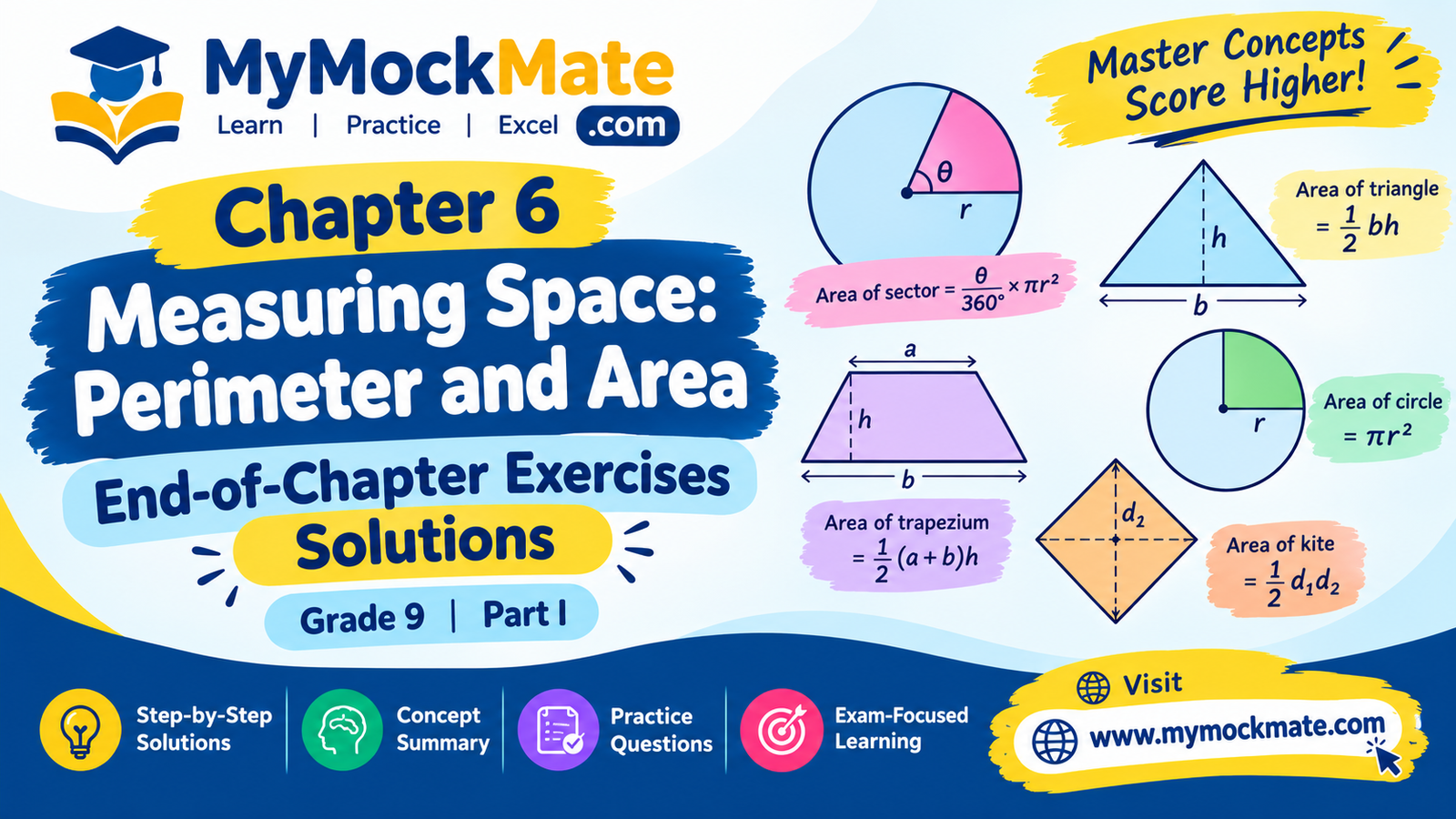

End-of-Chapter Exercises – Complete Solutions
1. Intro
This chapter develops the idea that area and perimeter can be understood through decomposition, rearrangement, similarity, scaling and circular geometry.
The End-of-Chapter Exercises bring together:
- Algebraic identities using area models
- Areas of triangles and quadrilaterals
- Heron’s formula
- Circumference and distance travelled by wheels
- Areas of circles and quadrants
- Trapezium and kite formulas
- Scaling of shapes
- Shaded-region problems
- Circle packing
- Geometric dissections
- Pythagorean relationships using semicircles
- Advanced area relationships
Unless stated otherwise, the textbook asks students to use
2. Learning Outcomes
After completing these exercises, students should be able to:
- Represent algebraic identities using geometric areas.
- Calculate areas of triangles using suitable methods.
- Apply Heron’s formula.
- Find circumference and use it to calculate distance travelled.
- Calculate the area of a circle and quadrant.
- Derive and apply the area formula of a trapezium.
- Find the area of a kite.
- Understand how area changes when dimensions are scaled.
- Solve shaded-area and circle-packing problems.
- Use geometric dissection to prove area relationships.
- Apply the Pythagorean theorem through semicircle areas.
- Solve advanced problems involving circles, triangles and rectangles.
3. Mind Map
MEASURING SPACE: PERIMETER & AREA
→ Triangle
- Area = ½ × base × height
- Heron’s Formula
- Isosceles Triangle
- Right Triangle
→ Circle
- Circumference =
- Area =
- Quadrant =
- Semicircle =
→ Quadrilateral
- Rectangle
- Trapezium
- Kite
- Area relationships
→ Scaling
- Length scale factor =
- Area scale factor =
→ Area Models
- Algebraic identities
- Rearrangement
- Dissection
→ Advanced Geometry
- Shaded regions
- Circle packing
- Congruent shapes
- Semicircle constructions
- Area proofs
The chapter summary confirms the core circle, triangle, arc and sector formulas used throughout the chapter.
4. Questions & Complete Solutions
Question 1
The textbook first gives the identity:
and asks students to draw figures representing:
and

Solution
(a)
Start with a square of side .
Its area is:
Remove a smaller square of side :
Therefore, remaining area is:
The remaining L-shaped region can be rearranged into a rectangle having dimensions:
Therefore,
(b)
Draw a square of side:
Divide each side into lengths .
The large square consists of:
- two rectangles
- two rectangles
- two rectangles
Therefore,
Answer: Both identities can be demonstrated by dividing a large square into smaller squares and rectangles.
Question 2
An isosceles triangle has perimeter cm and equal sides cm each. Find its area.
Solution
Base:
The altitude bisects the base:
Using Pythagoras:
Area:
Answer:
Question 3
An isosceles triangle has base cm and area . Find the equal sides.
Solution
Therefore,
The altitude divides the base into two parts of cm each.
Equal side:
Answer
Question 4
A right-angled triangle has area . One leg is cm. Find its perimeter.
Solution
Let the other leg be .
Hypotenuse:
Perimeter:
Answer
Question 5
The sides of a triangle are in the ratio , and its perimeter is cm. Find its area.
Solution
Total ratio:
One part:
Therefore, sides are:
Semi-perimeter:
By Heron’s formula:
Answer
Approximately,
Question 6
The sides of a triangle are cm, cm and cm. Find its area in two different ways.
Method 1: Right Triangle
Since
the triangle is right-angled.
Therefore,
Method 2: Heron’s Formula
Answer
Both methods give the same answer.
Question 7
A bicycle wheel has diameter cm. Find the distance travelled after 100 rotations.
Solution
Circumference:
For 100 rotations:
Converting into metres:
Question 8
Find the area of a quadrant whose circumference is cm.
Solution
Using :
Quadrant area:
Question 9
A car wheel has an outer radius of cm. Find:
- Distance travelled in one complete turn.
- Number of turns in km.
Solution
Circumference:
Distance in one turn
Turns in 1 km
Answer
and approximately
Question 10
Two rectangles have the same area and the same perimeter. Are they necessarily congruent?
Solution
Let the sides be and .
Area:
Perimeter:
If both area and perimeter are fixed, then both:
and
are fixed.
Thus and are determined as the two roots of the same quadratic equation:
Hence the two rectangles have the same pair of side lengths.
Answer
They may differ only in orientation.
Questions 11–15
Question 11
Show that the area of a trapezium is:
where are the parallel sides.
Solution
Take two identical copies of the trapezium.
When joined suitably, they form a parallelogram.
The parallelogram has:
and height .
Therefore,
Since it consists of two equal trapeziums:
Therefore,
Question 12
Show the trapezium formula by dividing the trapezium into two triangles.
Solution
Divide the trapezium into two triangles.
Their areas are:
and
Therefore,
Answer
Question 13
Show how two identical trapeziums can form a parallelogram.
Solution
Take two congruent trapeziums and rotate one of them appropriately.
Join their non-parallel sides.
They form a parallelogram whose:
- base =
- height =
Hence,
Since two trapeziums form it:
Question 14
Show that the area of a kite is half the product of its diagonals, using algebra and geometry.
Algebraic Method
Let the diagonals be and .
The diagonals of a kite are perpendicular.
They divide the kite into four right triangles.
Total area:
Therefore,
Geometrical Method
Draw both diagonals.
They divide the kite into four right-angled triangles. Combining their areas gives exactly half the product of the diagonals.
Thus,
Question 15
(i) Rectangle
If rectangle has sides , its area is:
Rectangle has sides .
Its area:
Therefore,
Yes, four copies can be arranged to form the larger rectangle.
(ii) Triangle
If every side is doubled, the linear scale factor is .
Area scale factor:
Therefore,
Four copies can be arranged to form the larger similar triangle.
(iii) Triangle
If every side is tripled:
Therefore,
Hence,
Nine copies can be arranged to form the larger similar triangle.
Question 16
Find the fraction of the shaded area in:
(a) Fig. 6.43 – Triangle
Using the equal-area divisions shown in the figure, the shaded central region is equal to half of the complete triangle.
Therefore,
The figure-based solution can be obtained by using the fact that a median divides a triangle into two equal areas.
(b) Fig. 6.44 – Square
Draw lines parallel to the sides of the square through the vertices of the shaded region.
The square divides into equal small regions, and the shaded portion corresponds to of them.
Therefore,
Question 17
Find the fraction of the rectangle covered by the circles.
Fig. 6.45
Let radius of each circle be .
Rectangle dimensions:
Rectangle area:
Area of 3 circles:
Fraction:
Fig. 6.46
Rectangle dimensions:
Area:
Four circles:
Fraction:
Answer
In both figures:
Question 18
Make a conjecture about circles fitted into a rectangle and test it for 10, 20 and 50 circles.
Conjecture
If equal circles of radius are arranged in one row inside a rectangle:
and
Therefore,
Area of circles:
Hence,
For 10 circles
For 20 circles
For 50 circles
Conclusion
The number of circles cancels out.
Question 19
Nine identical rectangles are arranged as shown. Their combined area is . Find the perimeter of each small rectangle.
Let the dimensions of each small rectangle be and .
From the arrangement:
Thus,
The large rectangle has dimensions:
Its area is :
Therefore,
Perimeter:
Approximately,
Question 20
Show that the blue and red triangles have equal areas and explain how the blue triangle can be rearranged to cover the red triangle.
Solution
The points on the opposite side divide it into three equal parts.
The blue and red triangles have:
- equal bases,
- the same altitude from the common vertex to the opposite side.
Since:
and both and are equal,
Rearrangement
The blue triangle can be divided into suitable smaller pieces along lines parallel to the base and the sides. These pieces can then be translated/rearranged to occupy exactly the same area as the red triangle.
Thus, the equality is a consequence of equal base × equal height.
Question 21
Show that shaded regions and have equal areas.
Let the side of the square be .
Area of the quadrant:
Each semicircle has diameter , so radius:
Area of one semicircle:
Two semicircles:
Thus,
The common parts cancel when comparing the two shaded regions.
Therefore,
Question 22
Four semicircles form a four-petalled flower inside a square of side units. Find its perimeter and area.
Each semicircle has diameter , so:
Perimeter
The boundary consists of eight quarter-circle arcs of radius .
One quarter-circle arc:
Eight arcs:
Area
Each petal is formed from two sectors and two right triangles.
Area of two sectors:
Area of two right triangles:
Area of one petal:
There are four petals:
Question 23
Two concentric circles have a chord of the larger circle touching the smaller circle at . Show that the area between the circles is:
Let the outer radius be and inner radius be .
Since touches the smaller circle:
and
Also,
Half the chord:
By Pythagoras:
Therefore,
Area between circles:
Question 24
Show that:
for semicircles constructed on the sides of a right-angled triangle.
Let the legs of the right triangle be , and hypotenuse be .
By Pythagoras:
Area of semicircle on :
Similarly,
and
Therefore,
Since ,
Hence,
This is a beautiful area-based interpretation of the Pythagorean theorem.
Question 25
Two congruent circles of radius pass through each other’s centres. Find the area of their common region.
The distance between the centres is .
The common chord subtends at each centre.
One half of the common region consists of:
Sector area:
Equilateral triangle area:
One half:
There are two equal halves.
Therefore,
or
Question 26
In Fig. 6.54, three triangles have areas . Show that the area of the rectangle is:
Proof
Let the dimensions associated with the figure be .
The rectangle has dimensions:
Therefore,
From the figure:
Now,
Similarly,
Therefore,
After cancellation:
But this is exactly the area of the rectangle.
Hence,
The same algebraic relationship is independently reflected in published solution treatments of the figure.
Question 27
Show that the two shaded regions formed by a quarter circle, a semicircle and a triangle have equal areas.
Let the right triangle have equal perpendicular sides .
Then its hypotenuse is:
Area of quarter circle
Area of semicircle
Its diameter is .
Therefore radius:
So,
Thus,
The triangle is common to the two constructions.
Therefore, after subtracting the same triangular area from equal circular areas, the two remaining shaded regions are equal.
Hence,
5. Common Errors
Error 1: Using the wrong radius
If diameter is given:
Do not use the diameter directly in .
Error 2: Forgetting the factor
For a triangle:
Error 3: Confusing circumference and area
but
Error 4: Wrong scaling rule
If lengths are multiplied by , areas are multiplied by:
not .
Error 5: Using Heron’s formula without semi-perimeter
Always calculate:
before applying Heron’s formula.
Error 6: Forgetting that is an approximation
The textbook explicitly notes that:
but
Error 7: Adding shaded areas directly
In complex figures, identify:
Required region = Total region − unwanted region
or use:
Required region = larger region − common region.
Error 8: Assuming equal area means congruent
Two figures may have the same area without having the same shape.
6. PYQs / Exam-Oriented Practice
Note: The uploaded PDF does not label any questions as previous-year questions (PYQs). Therefore, the following are best presented on MyMockMate as PYQ-style / exam-oriented practice questions, rather than claiming they are official previous-year questions.
PYQ-Style Question 1
An isosceles triangle has equal sides cm and base cm. Find its area.
Answer:
PYQ-Style Question 2
A wheel of radius cm makes 100 complete rotations. Find the distance travelled.
Answer:
PYQ-Style Question 3
The parallel sides of a trapezium are cm and cm and its height is cm. Find its area.
Answer:
PYQ-Style Question 4
A square has side cm. Find the area of its inscribed circle.
Answer:
Radius:
PYQ-Style Question 5
The dimensions of a rectangle are doubled. How does its area change?
Answer:
PYQ-Style Question 6
Show that the areas of semicircles constructed on the three sides of a right triangle satisfy the same relationship as the squares of its sides.
Answer:
This follows from:
and
Therefore,
7. FAQ
Q1. What is the most important formula for a circle?
Q2. What is the formula for circumference?
Q3. What is the area of a quadrant?
Q4. When should Heron’s formula be used?
Use Heron’s formula when the three sides of a triangle are known.
Q5. What happens to area when all dimensions are doubled?
Area becomes:
Q6. What happens when all dimensions are tripled?
Area becomes:
Q7. Why is the fraction of circles covering the rectangle always ?
Because:
The number and radius cancel.
Q8. What is the trapezium area formula?
Q9. What is the kite area formula?
Q10. What is the key idea behind Question 24?
The areas of semicircles are proportional to the squares of their diameters, so Pythagoras gives:
8. Summary
The End-of-Chapter Exercises consolidate the complete chapter through numerical problems, proofs, constructions and area puzzles.
Must-Remember Formulas
Key Concepts
- Area models can prove algebraic identities.
- Heron’s formula is useful when all three sides are known.
- Scaling lengths by kk scales areas by .
- Circle area depends on .
- Semicircle areas can demonstrate the Pythagorean theorem.
- Complex figures can often be solved by breaking them into simpler shapes.
- Equal bases and equal heights lead to equal triangle areas.
- Circle-packing problems often reveal a constant ratio of:
The chapter’s own summary reinforces the central formulas for circumference, arc length, triangle area, Heron’s formula, circle area and sector area.
Final Takeaway
Measure smartly: break complicated figures into simple shapes, apply the right formula, and look for relationships rather than calculating blindly.
MyMockMate Learning Tip:
Understand → Visualise → Apply Formula → Simplify → Verify → Practise.