





Short Introduction
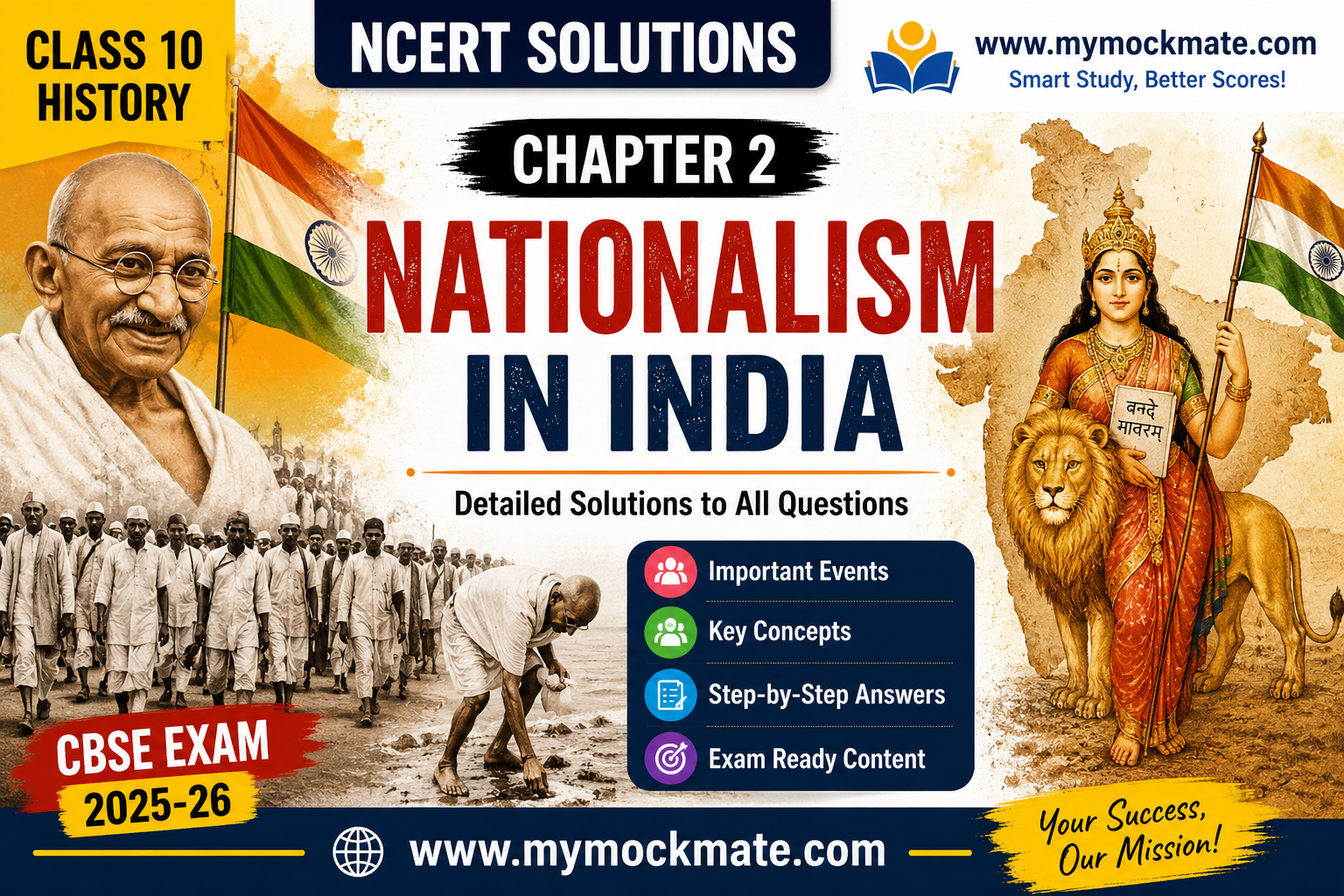
Nationalism in India is one of the most important chapters in Class 10 History. It explains how India’s freedom struggle evolved under Mahatma Gandhi’s leadership and how different social groups participated in the national movement. This chapter covers the Rowlatt Act, Jallianwala Bagh Massacre, Non-Cooperation Movement, Civil Disobedience Movement, Salt March, and the rise of collective nationalism.
Quick Information Box
| Particular | Details |
|---|---|
| Class | 10 |
| Subject | History |
| Chapter | 2 |
| Chapter Name | Nationalism in India |
| Board | CBSE |
| Important Topics | Satyagraha, Non-Cooperation, Civil Disobedience, Salt March |
| Exam Importance | Very High |
Concepts Used (Topics Covered)
- Growth of Nationalism in India
- First World War and National Movement
- Satyagraha
- Rowlatt Act
- Jallianwala Bagh Massacre
- Khilafat Movement
- Non-Cooperation Movement
- Civil Disobedience Movement
- Salt March
- Participation of Various Social Groups
- Bharat Mata and National Symbols
- Sense of Collective Belonging
Important Formulas
History chapter does not contain mathematical formulas. However, important concepts include:
- Satyagraha = Truth + Non-Violence
- Swaraj = Self Rule
- Non-Cooperation = Boycott of British Institutions
- Civil Disobedience = Breaking Unjust Colonial Laws
Questions and Step-by-Step Solutions
Write in Brief
Q1(a). Why growth of nationalism in the colonies is linked to an anti-colonial movement?
Answer:
Step 1: Understand Colonial Rule
Colonial governments exploited people economically, politically, and socially.
Step 2: Shared Suffering
People from different backgrounds faced common hardships under colonial rule.
Step 3: Rise of Unity
The common struggle against foreign rule created a sense of unity among people.
Final Answer
The growth of nationalism in colonies is linked to anti-colonial movements because people developed a common identity while fighting against colonial oppression. Shared experiences of exploitation united various groups and strengthened national consciousness.
Q1(b). How did the First World War help in the growth of the National Movement in India?
Answer:
Step 1: Economic Burden
The British increased taxes and defense expenditure.
Step 2: Rising Prices
Prices doubled, causing hardship for common people.
Step 3: Forced Recruitment
Villagers were compelled to join the army.
Step 4: Famines and Epidemics
Crop failures and influenza epidemics worsened conditions.
Final Answer
The First World War created economic hardship, increased taxes, forced recruitment, food shortages, and suffering. These conditions increased public dissatisfaction and strengthened the national movement against British rule.
Q1(c). Why were Indians outraged by the Rowlatt Act?
Answer:
Step 1: Repressive Law
The Act gave the government extensive powers.
Step 2: No Fair Trial
Political prisoners could be detained without trial for two years.
Step 3: Violation of Rights
It restricted civil liberties and democratic rights.
Final Answer
Indians were outraged because the Rowlatt Act allowed imprisonment without trial and gave the government extraordinary powers to suppress political activities, violating basic civil rights.

Q1(d). Why did Gandhiji decide to withdraw the Non-Cooperation Movement?
Answer:
Step 1: Chauri Chaura Incident
Violence broke out in Gorakhpur.
Step 2: Clash with Police
An angry mob burned a police station.
Step 3: Gandhiji’s Principles
Gandhiji strongly believed in non-violence.
Final Answer
Gandhiji withdrew the Non-Cooperation Movement after the Chauri Chaura incident because it turned violent, which went against his principle of non-violent struggle.
Q2. What is meant by the idea of Satyagraha?
Answer:
Step 1: Meaning
Satyagraha means insistence on truth.
Step 2: Principle
It emphasizes truth and non-violence.
Step 3: Objective
The aim is to persuade opponents through moral force rather than physical force.
Final Answer
Satyagraha is the philosophy developed by Mahatma Gandhi based on truth and non-violence. It seeks to fight injustice through peaceful resistance and moral strength rather than violence.
Q3(a). Newspaper Report on the Jallianwala Bagh Massacre
Headline:
Hundreds Killed in Jallianwala Bagh Firing
Report:
Amritsar, April 13, 1919: A peaceful gathering at Jallianwala Bagh turned into a tragedy when General Dyer ordered troops to open fire on an unarmed crowd. Hundreds of men, women, and children were killed and many more injured. The incident shocked the nation and intensified opposition to British rule.
Q3(b). Newspaper Report on the Simon Commission
Headline:
Nationwide Protests Against Simon Commission
Report:
India, 1928: The Simon Commission arrived in India to examine constitutional reforms. Since the commission had no Indian member, people across the country protested with the slogan “Simon Go Back.” Leaders from various political parties joined demonstrations demanding self-government.
Q4. Compare the Images of Bharat Mata and Germania
Answer:
| Bharat Mata | Germania |
| Symbol of India | Symbol of Germany |
| Depicted as a mother figure | Depicted as a warrior woman |
| Represents spiritual strength | Represents bravery and heroism |
| Associated with Indian nationalism | Associated with German nationalism |
Final Answer
Both Bharat Mata and Germania were national symbols used to inspire patriotism and unity. Bharat Mata represented India as a divine mother, whereas Germania symbolized German nationalism through strength and courage.
Discuss Questions
Q1. List all the different social groups which joined the Non-Cooperation Movement. Choose any three and explain why they joined.
Social Groups
- Students
- Teachers
- Lawyers
- Peasants
- Tribal communities
- Plantation workers
- Traders and merchants
Example Explanation
Peasants
They wanted reduced taxes and relief from landlord exploitation.
Tribal Communities
They opposed forest restrictions imposed by the British.
Plantation Workers
They wanted freedom of movement and better working conditions.
Q2. Why was the Salt March an effective symbol of resistance?
Answer
- Salt was used by everyone.
- Salt tax affected rich and poor alike.
- Breaking the salt law directly challenged British authority.
- It united people from different backgrounds.
Therefore, the Salt March became a powerful symbol of resistance against colonial rule.
Q3. Imagine you are a woman participating in the Civil Disobedience Movement.
Answer
As a woman participating in the Civil Disobedience Movement, I would feel proud to contribute to India’s freedom struggle. I would participate in protests, make salt, boycott foreign goods, and encourage others to join the movement. It would give me confidence and a sense of responsibility toward my nation.
Q4. Why did political leaders differ over separate electorates?
Answer
Leaders like Dr. B.R. Ambedkar believed separate electorates would ensure political representation for Dalits. Mahatma Gandhi opposed them because he felt they would divide Indian society. Therefore, leaders differed due to different views on social justice and national unity.
Common Mistakes
- Confusing Non-Cooperation Movement with Civil Disobedience Movement.
- Forgetting the significance of the Salt March.
- Mixing up Rowlatt Act and Government of India Act.
- Not explaining social groups separately.
- Ignoring the role of women and peasants.
Exam Tips
- Learn important dates and events.
- Remember causes and outcomes of major movements.
- Practice difference-based questions.
- Use keywords such as Satyagraha, Swaraj, Non-Violence, Civil Disobedience.
- Write answers in chronological order.
Practice MCQs
1. Who introduced Satyagraha in India?
A. Jawaharlal Nehru
B. Mahatma Gandhi
C. Subhas Chandra Bose
D. Bal Gangadhar Tilak
Answer: B
2. In which year was the Rowlatt Act passed?
A. 1917
B. 1918
C. 1919
D. 1920
Answer: C
3. The Salt March ended at:
A. Ahmedabad
B. Dandi
C. Bombay
D. Delhi
Answer: B
4. Which incident led Gandhiji to withdraw the Non-Cooperation Movement?
A. Simon Commission
B. Jallianwala Bagh
C. Chauri Chaura
D. Dandi March
Answer: C
5. Bharat Mata was first visualized by:
A. Abanindranath Tagore
B. Mahatma Gandhi
C. Jawaharlal Nehru
D. Subhas Chandra Bose
Answer: A
FAQ Section
Q1. What is Satyagraha?
Satyagraha is a method of peaceful resistance based on truth and non-violence.
Q2. Why is the Salt March important?
It challenged British salt laws and united Indians against colonial rule.
Q3. What was the purpose of the Non-Cooperation Movement?
To withdraw support from British institutions and demand self-rule.
Q4. Why did Gandhiji oppose violence?
He believed non-violence was the most effective and moral method of struggle.
Q5. What does Swaraj mean?
Swaraj means self-rule or self-government.
Found these NCERT Class 10 History Chapter 2 solutions helpful? Explore more chapter-wise NCERT solutions, CBSE notes, MCQs, sample papers, and board exam preparation resources on www.mymockmate.com to boost your exam performance.