




Short Introduction
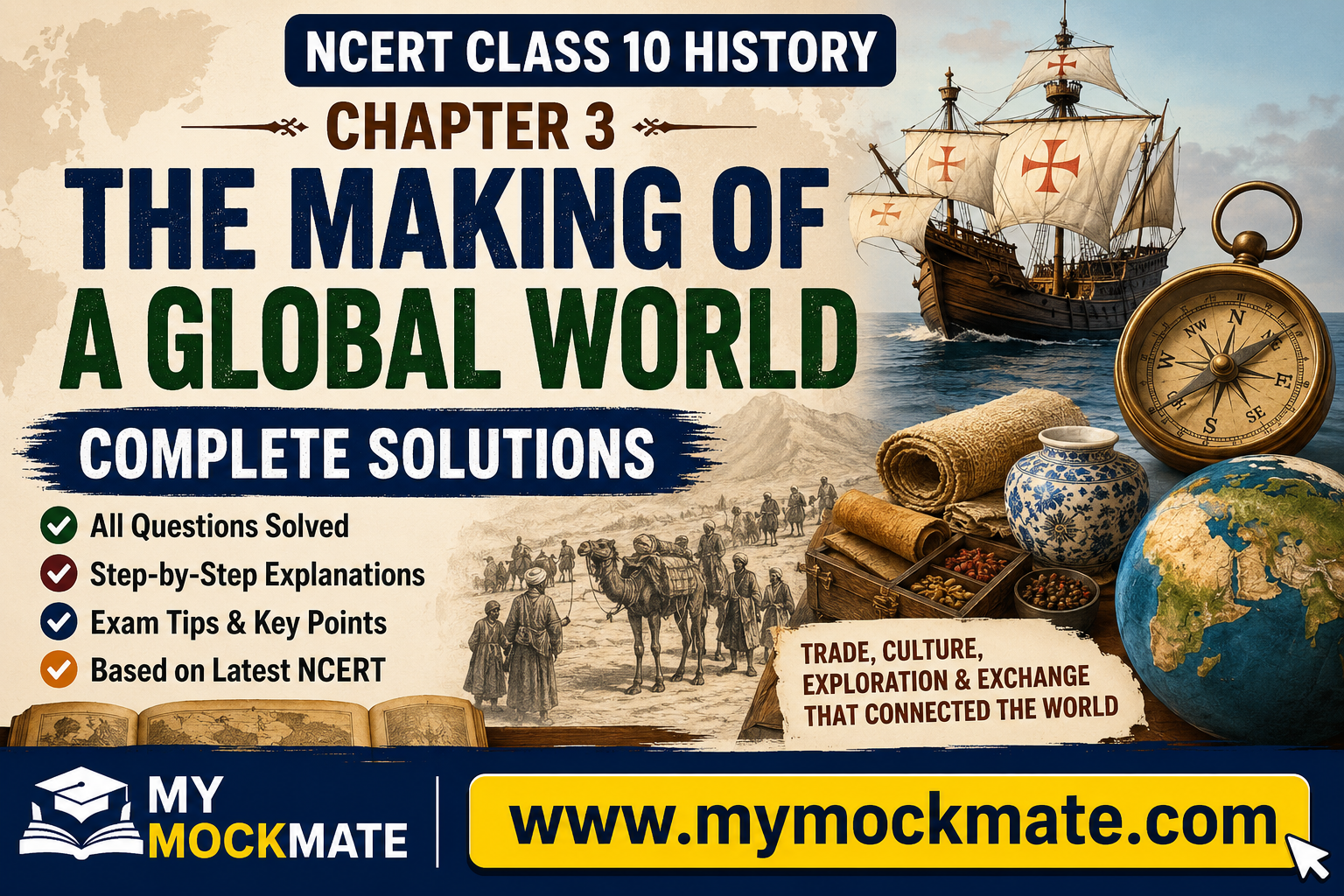
The Making of a Global World explains how trade, migration, cultural exchange, and exploration connected different regions of the world long before modern globalization. This question focuses on examples of global exchanges before the seventeenth century.
Quick Information Box
| Particular | Details |
|---|---|
| Chapter | The Making of a Global World |
| Class | 10 |
| Subject | History |
| Question No. | 1 |
| Topic | Global Exchanges Before the Seventeenth Century |
| Marks Level | Short Answer |
Concepts Used (Topics Covered)
- Pre-modern globalisation
- Silk Routes
- Trade and cultural exchanges
- Columbian Exchange
- Discovery of the Americas
- Spread of crops and ideas
Important Formulas
No mathematical formulas are involved in this History chapter.
Question
Give two examples of different types of global exchanges which took place before the seventeenth century, choosing one example from Asia and one from the Americas.
Step-by-Step Solution with Explanation
Example from Asia
The Silk Routes connected Asia with Europe and Northern Africa. Through these routes:
- Chinese silk was exported to distant regions.
- Indian spices and textiles were traded internationally.
- Religious ideas such as Buddhism spread from India to many parts of Asia.
- Cultural interactions took place among traders, pilgrims, and missionaries.
Explanation:
The Silk Routes were not only trade routes but also channels for cultural and religious exchange. They helped connect different civilizations across continents.
Example from the Americas
After the discovery of the Americas, many crops spread to Europe, Asia, and Africa.
Examples include:
- Potato
- Maize
- Tomato
- Groundnut
- Chilli
Explanation:
These crops transformed food habits across the world. The potato, for example, improved nutrition in Europe and became an important food source for millions of people.
Final Answer
- Asia: The Silk Routes connected Asia with Europe and Africa, facilitating the trade of silk, spices, textiles, and the spread of religions such as Buddhism.
- Americas: Crops such as potatoes, maize, tomatoes, and chillies were introduced from the Americas to Europe and Asia after their discovery, significantly changing food habits worldwide.
Common Mistakes
- Writing only trade examples and ignoring cultural exchange.
- Confusing Silk Routes with modern trade routes.
- Mentioning examples that occurred after the seventeenth century.
- Giving examples without explanation.
Exam Tips
- Always provide one example from Asia and one from the Americas.
- Mention both trade and cultural significance.
- Use keywords such as Silk Routes, Buddhism, potato, maize, and global exchange.
- Write concise explanations for better scoring.
Practice MCQs
1. Which trade network connected Asia with Europe and Africa?
A. Spice Route
B. Silk Route
C. Atlantic Route
D. Pacific Route
Answer: B. Silk Route
2. Which crop was introduced from the Americas?
A. Rice
B. Wheat
C. Potato
D. Barley
Answer: C. Potato
3. Which religion spread through the Silk Routes?
A. Christianity
B. Buddhism
C. Judaism
D. Shintoism
Answer: B. Buddhism
4. The exchange of crops between the Americas and the Old World is associated with:
A. Industrial Revolution
B. Renaissance
C. Columbian Exchange
D. French Revolution

Answer: C. Columbian Exchange
5. Chinese silk was mainly traded through:
A. Grand Trunk Road
B. Silk Routes
C. Suez Canal
D. Panama Canal
Answer: B. Silk Routes
FAQ Section
Q1. What were the Silk Routes?
The Silk Routes were a network of trade routes connecting Asia, Europe, and Africa for trade and cultural exchange.
Q2. Why are potatoes important in world history?
Potatoes improved food security and nutrition in Europe after being introduced from the Americas.
Q3. Did only goods travel through the Silk Routes?
No. Religions, ideas, technologies, and cultures also spread through these routes.
Q4. What is meant by global exchange?
Global exchange refers to the movement of goods, people, ideas, crops, and cultures across different regions of the world.
Looking for complete NCERT Class 10 History Chapter 3 solutions? Explore all chapter-wise answers, MCQs, revision notes, and exam preparation resources only on www.mymockmate.com.