



Short Intro
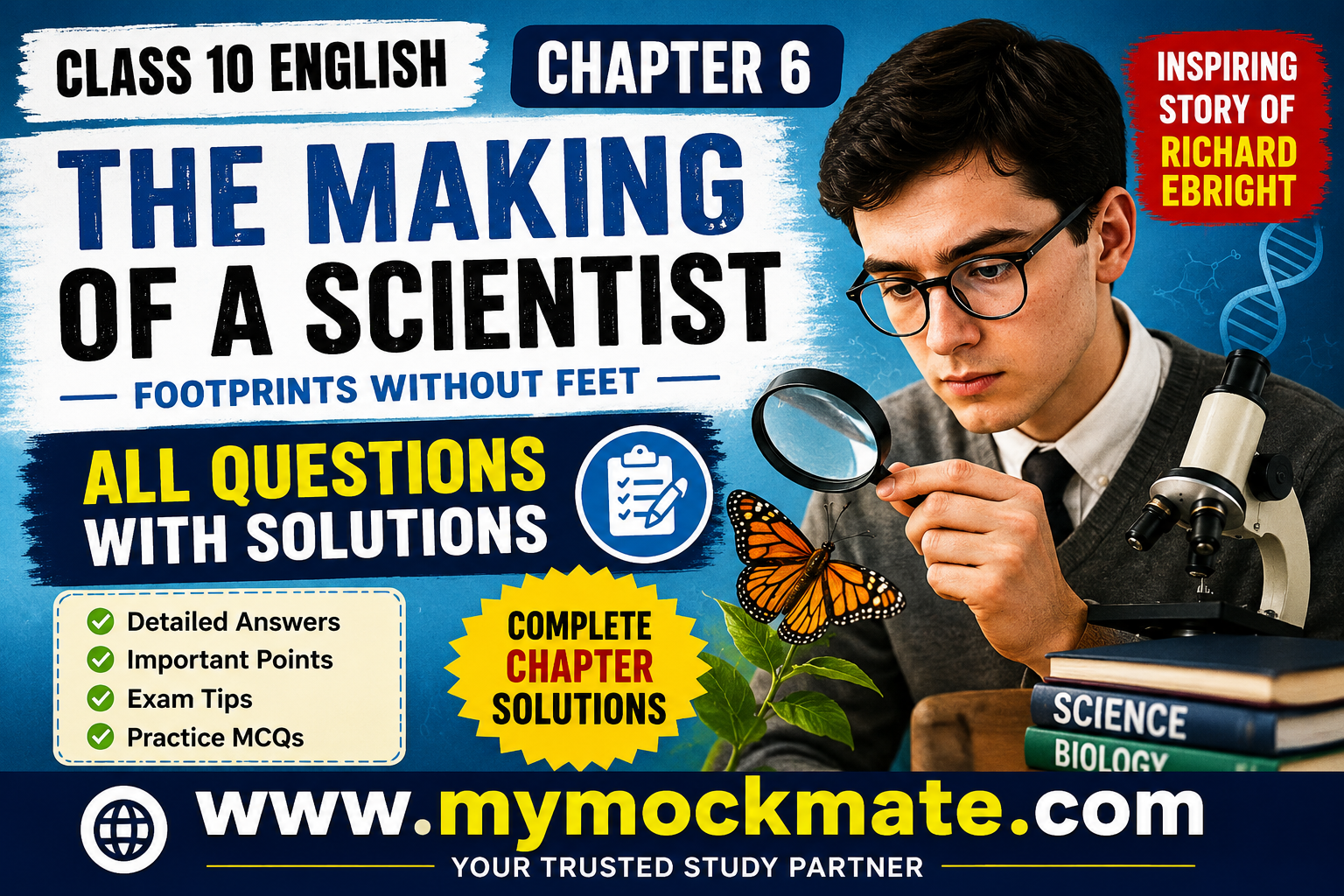
“The Making of a Scientist” chapter me Richard Ebright ki inspiring journey batayi gayi hai jinhone butterflies ke prati apni curiosity ko scientific research me badal diya. Yeh chapter students ko hard work, observation aur scientific thinking ki importance samjhata hai. Neeche diye gaye sabhi important questions ke detailed solutions exam-oriented explanation ke sath diye gaye hain.
Quick Information Box
| Topic | Details |
|---|---|
| Chapter Name | The Making of a Scientist |
| Book | Footprints Without Feet |
| Class | 10th |
| Subject | English |
| Author | Robert W. Peterson |
| Main Character | Richard Ebright |
| Main Theme | Curiosity, Scientific Thinking & Hard Work |
Concepts Used (Topics Covered)
- Scientific Curiosity
- Importance of Observation
- Hard Work and Determination
- Role of Parents in Success
- Research and Experiments
- Motivation and Learning
- Development of Scientific Temper
Important Formulas / Key Points
- Curiosity + Observation + Hard Work = Success
- Real Science = Experiment + Research + Analysis
- Success comes through continuous learning and dedication.
Questions & Step-by-step Solutions with Explanation
Question 1
How did a book become a turning point in Richard Ebright’s life?
Answer
The book “The Travels of Monarch X” became a turning point in Richard Ebright’s life because it introduced him to the scientific study of butterflies. Earlier, he only collected butterflies as a hobby, but after reading the book he became interested in butterfly migration and scientific research.
The book also invited readers to help Dr. Frederick Urquhart in tagging monarch butterflies for research. Richard joined this project and started conducting scientific experiments. This experience developed his interest in science and later helped him become a successful scientist.
Explanation
The chapter clearly shows that one good book can completely change a person’s life and career direction.
Question 2
How did Richard Ebright’s mother help him?
Answer
Richard Ebright’s mother played a very important role in his success. She encouraged his curiosity and learning from childhood. She bought him telescopes, microscopes, cameras and other scientific equipment. She also took him on educational trips and spent time helping him learn new things.
After Richard’s father died, she became his constant companion and motivated him to study and explore science. Her support developed confidence and curiosity in Richard.
Explanation
Parents’ encouragement and proper guidance can help children achieve great success.
Question 3
What lesson did Ebright learn when he did not win anything at a science fair?
Answer
When Richard Ebright did not win anything at the science fair, he realized that simply displaying facts was not enough. The winners had performed real experiments and research.
This taught him the importance of scientific investigation and practical experiments. After that, he started working on original scientific projects instead of simple displays.
Explanation
Failure became the motivation for his future success.
Question 4
What experiments and projects did Ebright undertake?
Answer
Richard Ebright conducted several scientific experiments related to butterflies.
Major Projects:
- He studied a viral disease that killed monarch caterpillars.
- He tested whether birds ate monarch butterflies.
- He researched the purpose of the gold spots on a monarch pupa.
- He discovered that the spots produced a hormone necessary for butterfly development.
- He later developed a theory about how cells read DNA.
These projects won him prizes at science fairs and made him famous in the scientific community.
Question 5
What are the qualities that go into the making of a scientist?
Answer
The qualities required to become a scientist are:
- Curiosity
- Sharp observation
- Hard work
- Dedication
- Competitive spirit
- Patience
- Willingness to learn
- Positive attitude towards failure
Richard Ebright possessed all these qualities, which helped him become a successful scientist.
Explanation
Scientific success is achieved through continuous effort and curiosity.

Think About It – Answers
Question 1
How can one become a scientist, economist or historian?
Answer
A person can become a scientist, economist or historian through deep study, observation, practical work, experiments and continuous learning. Reading books alone is not enough. One must think critically, ask questions and apply knowledge practically.
Question 2
Discuss Richard Ebright’s work in the light of what you have studied about cells and DNA.
Answer
Richard Ebright’s research focused on how cells function and how DNA controls life processes. DNA acts as the blueprint of life and controls the structure and function of cells. His experiments on butterfly hormones helped him develop theories about how cells read DNA instructions.
This research contributed greatly to biology and medical science.
Question 3
Which field would you like to work on and why?
Sample Answer
I would like to work in the field of space science because I am fascinated by planets, stars and the universe. I want to contribute to discoveries related to space technology and human exploration.
Common Mistakes Students Make
- Writing very short answers without explanation
- Forgetting key scientific projects of Richard Ebright
- Confusing monarch butterflies with viceroy butterflies
- Missing the moral/theme of the chapter
- Not mentioning the role of Ebright’s mother
Exam Tips
- Learn all major experiments done by Richard Ebright.
- Remember the importance of “The Travels of Monarch X”.
- Practice character sketch questions of Richard Ebright.
- Write answers in simple and clear language.
- Include keywords like curiosity, hard work, observation and research.
Practice MCQs
1. Who wrote “The Making of a Scientist”?
A. Ruskin Bond
B. Robert W. Peterson
C. James Herriot
D. Victor Canning
Answer:
B. Robert W. Peterson
2. Which book changed Richard Ebright’s life?
A. Discovery of India
B. Wings of Fire
C. The Travels of Monarch X
D. Time Machine
Answer:
C. The Travels of Monarch X
3. What did Richard Ebright collect in childhood?
A. Coins only
B. Rocks only
C. Butterflies, rocks, fossils and coins
D. Stamps only
Answer:
C. Butterflies, rocks, fossils and coins
4. What was Ebright’s theory related to?
A. Space Science
B. Cell Life
C. Physics
D. Chemistry
Answer:
B. Cell Life
5. Which quality helped Ebright become successful?
A. Laziness
B. Curiosity
C. Anger
D. Fear
Answer:
B. Curiosity
FAQ Section
Q1. Who was Richard Ebright?
Richard Ebright was a famous scientist known for his research on butterflies, cells and DNA.
Q2. Which chapter is “The Making of a Scientist”?
It is Chapter 6 of the Class 10 English supplementary book “Footprints Without Feet”.
Q3. What inspired Richard Ebright to become a scientist?
The book “The Travels of Monarch X” inspired him to become a scientist.
Q4. What lesson do students learn from this chapter?
Students learn that curiosity, hard work and dedication lead to success.
Q5. Why is Richard Ebright called a successful scientist?
He conducted important scientific research and developed theories related to cells and DNA.
CTA (Call To Action)
📚 More Class 10 English Notes, NCERT Solutions, MCQs, Important Questions aur Board Exam Study Material ke liye visit karein: