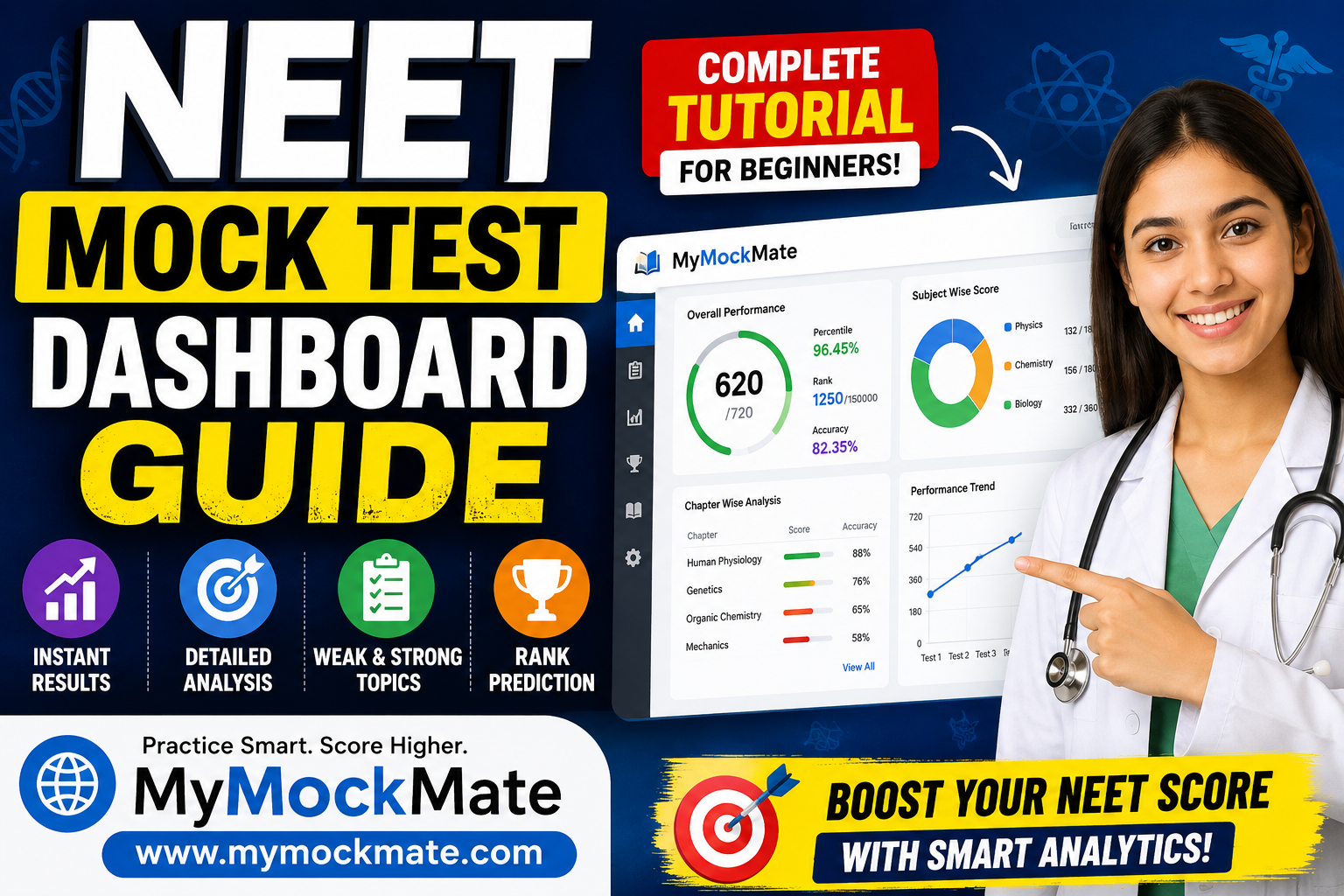
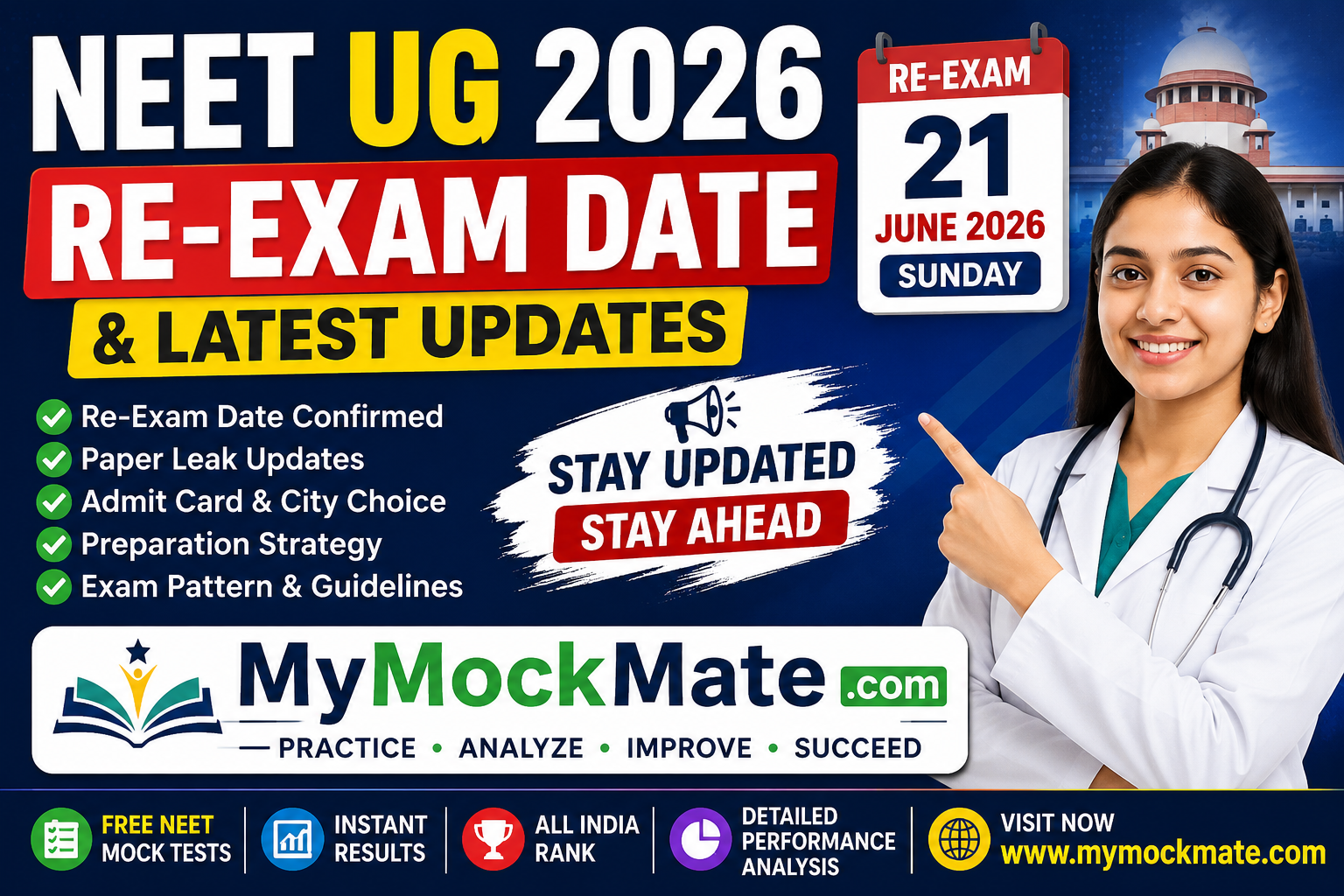
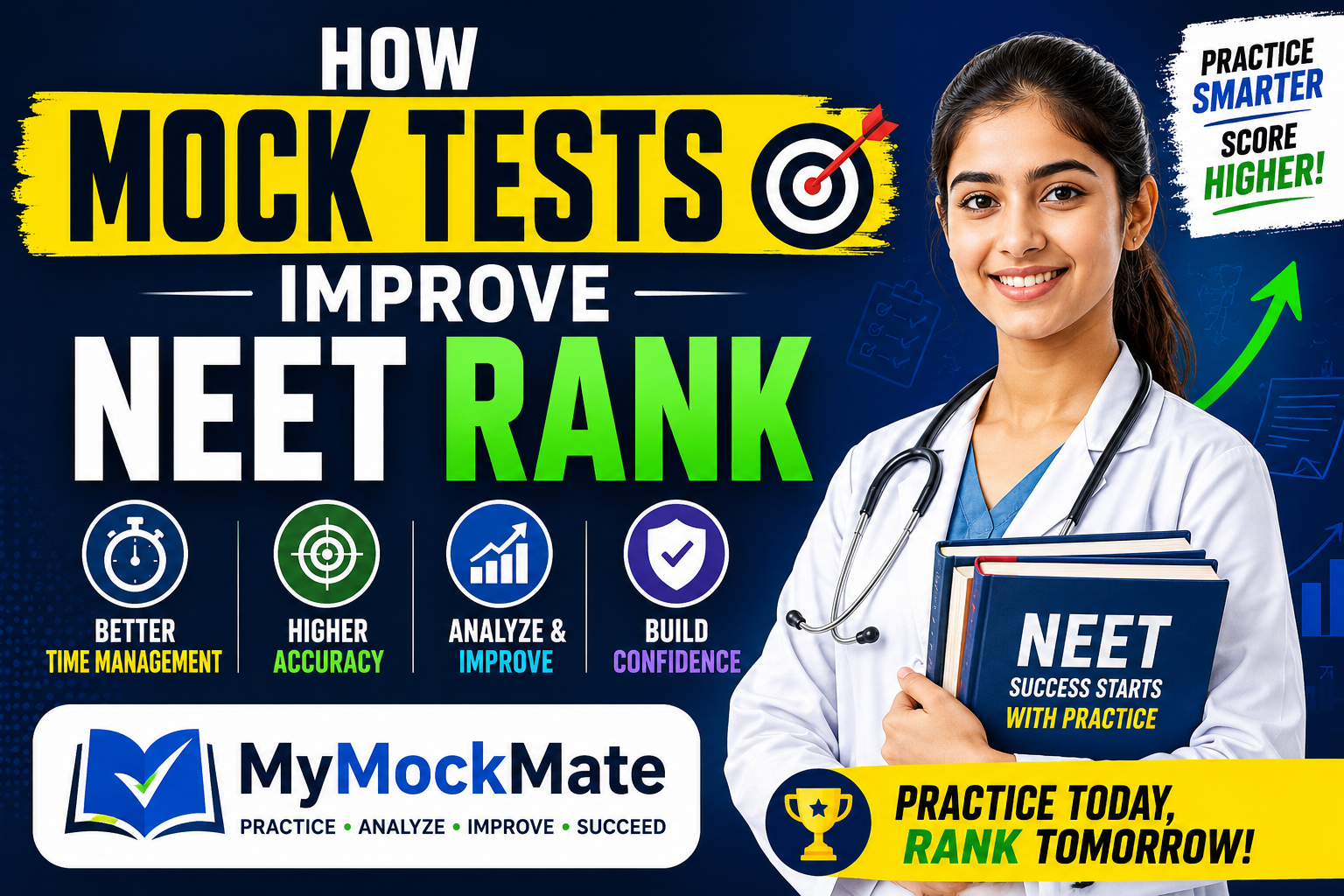
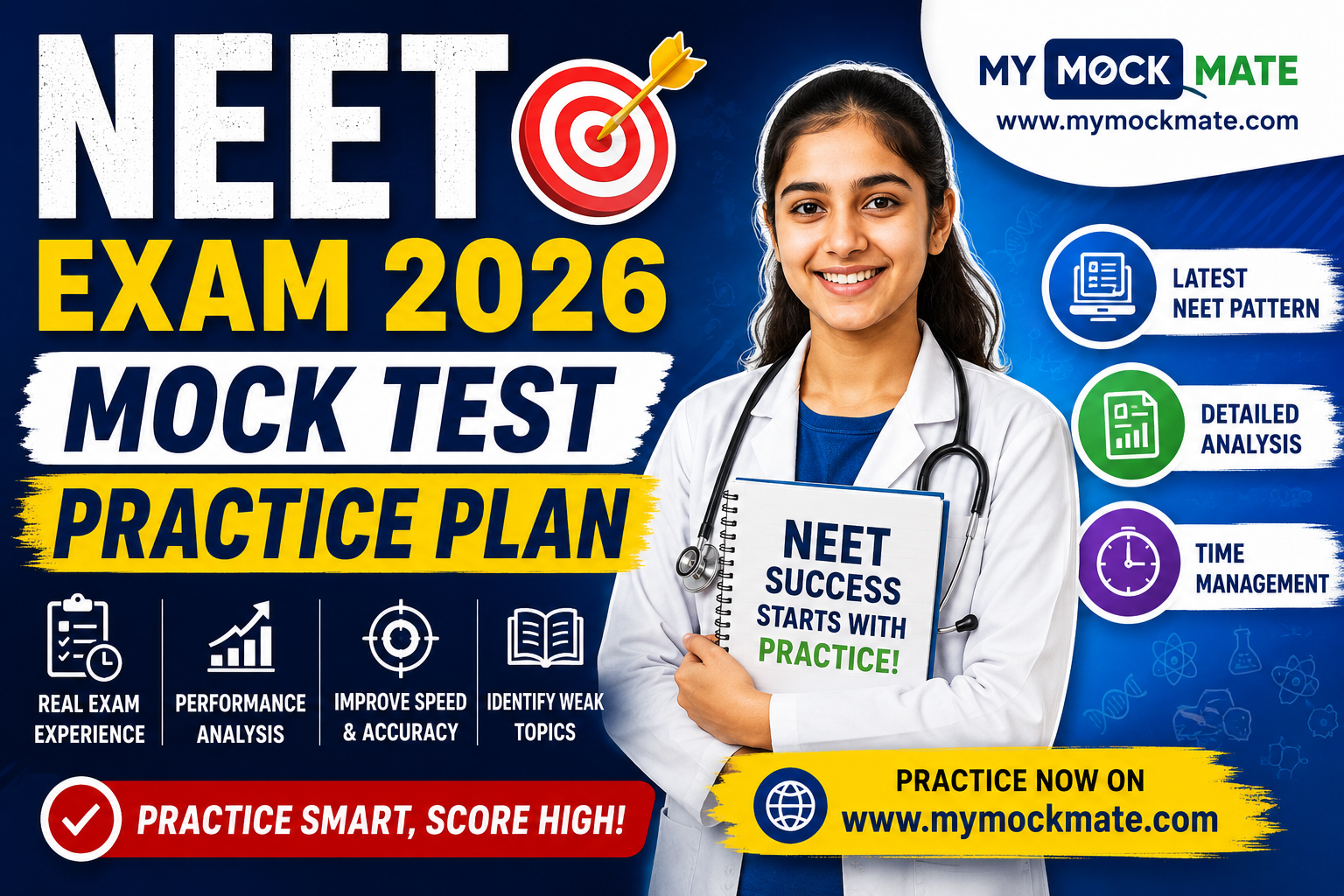
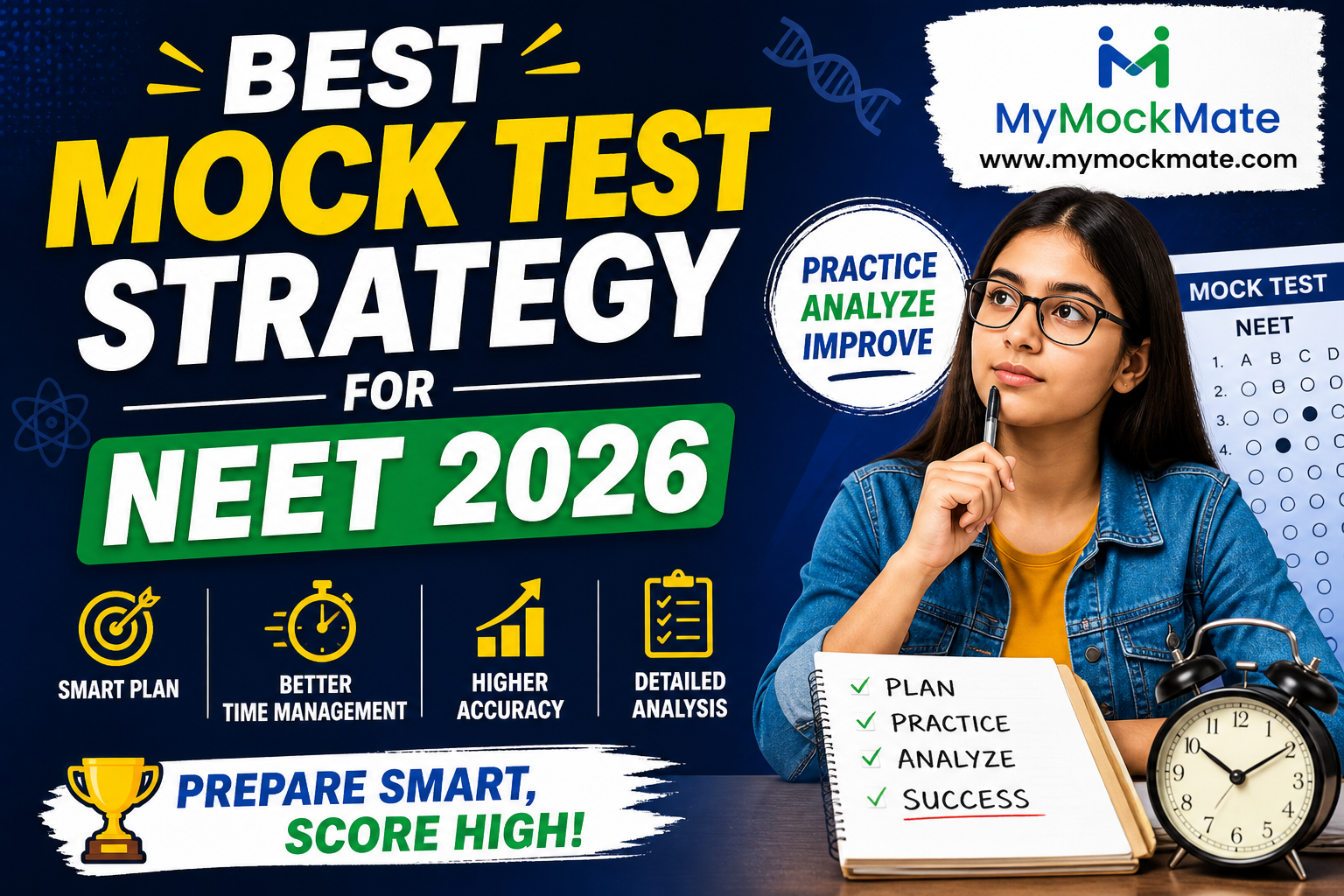
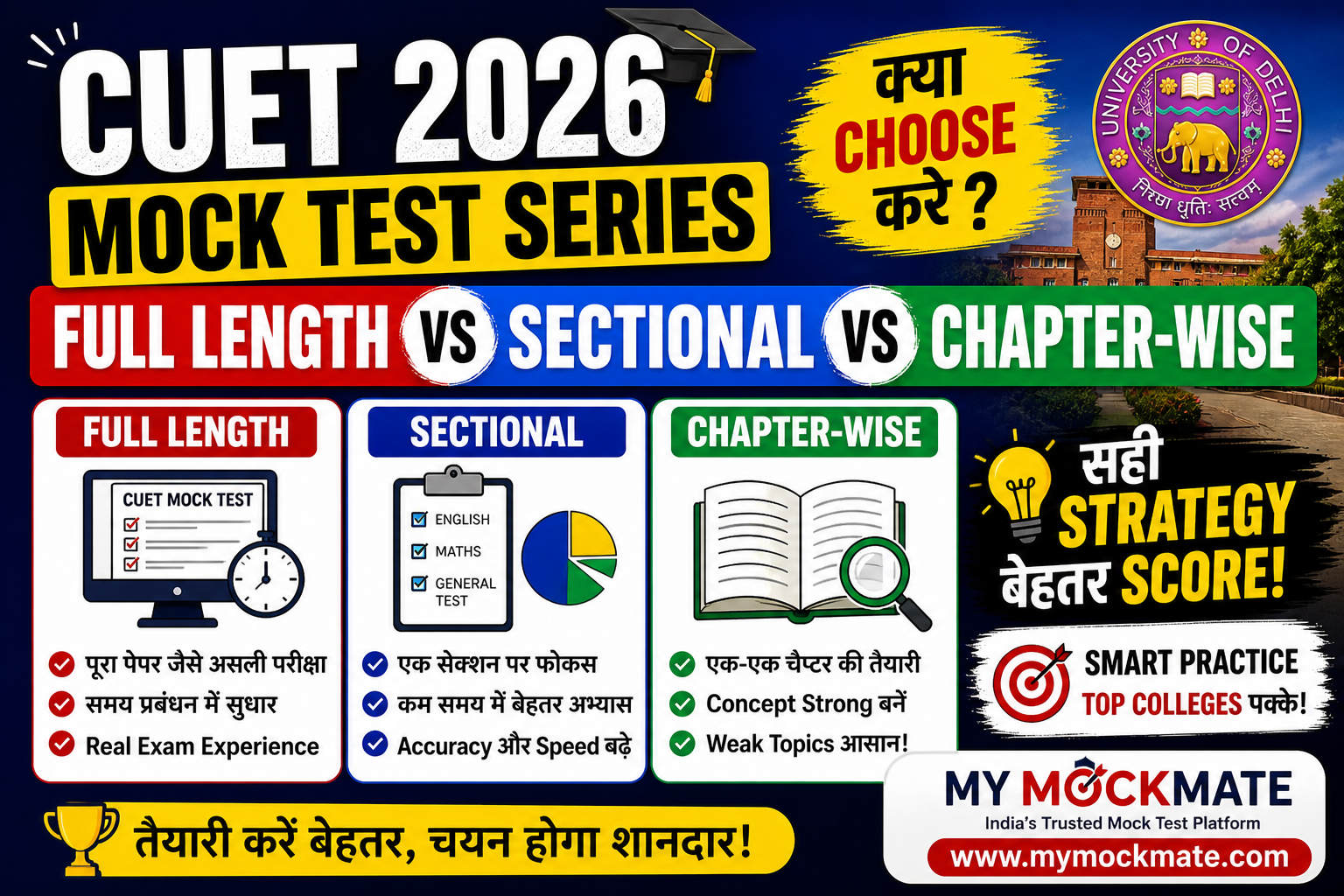
 Prepare smartly for NEET Exam 2026 with the ultimate mock test roadmap. Learn how to use full-length tests, chapter-wise practice, revision plans, and performance analysis with MyMockMate to improve your NEET score and secure a top rank.
The competition for NEET 2026 is expected to be tougher than ever before. Lakhs of students across India will compete for limited medical seats in top government and private colleges. In such a competitive environment, simply studying NCERT books is not enough. Students must regularly practice mock tests, analyze mistakes, improve speed, and strengthen time management skills.
This is where MyMockMate becomes an important companion for NEET aspirants. A structured mock test strategy can transform average preparation into top-rank performance. Whether you are starting early or revising during the final months, a proper roadmap helps you stay consistent and focused.
In this detailed guide, you will learn:
-
Why mock tests are essential for NEET 2026
-
Month-wise mock test strategy
-
How to analyze test performance
-
Best revision techniques
-
Common mistakes to avoid
-
Smart preparation tips for Physics, Chemistry, and Biology
-
Frequently Asked Questions about NEET mock test preparation
Let’s begin your complete NEET 2026 mock test roadmap.
Why Mock Tests Are Important for NEET 2026
Many students spend months studying theory but fail to score well in the actual exam because they lack exam practice. Mock tests help bridge this gap between preparation and performance.
Benefits of NEET Mock Tests
1. Improve Time Management
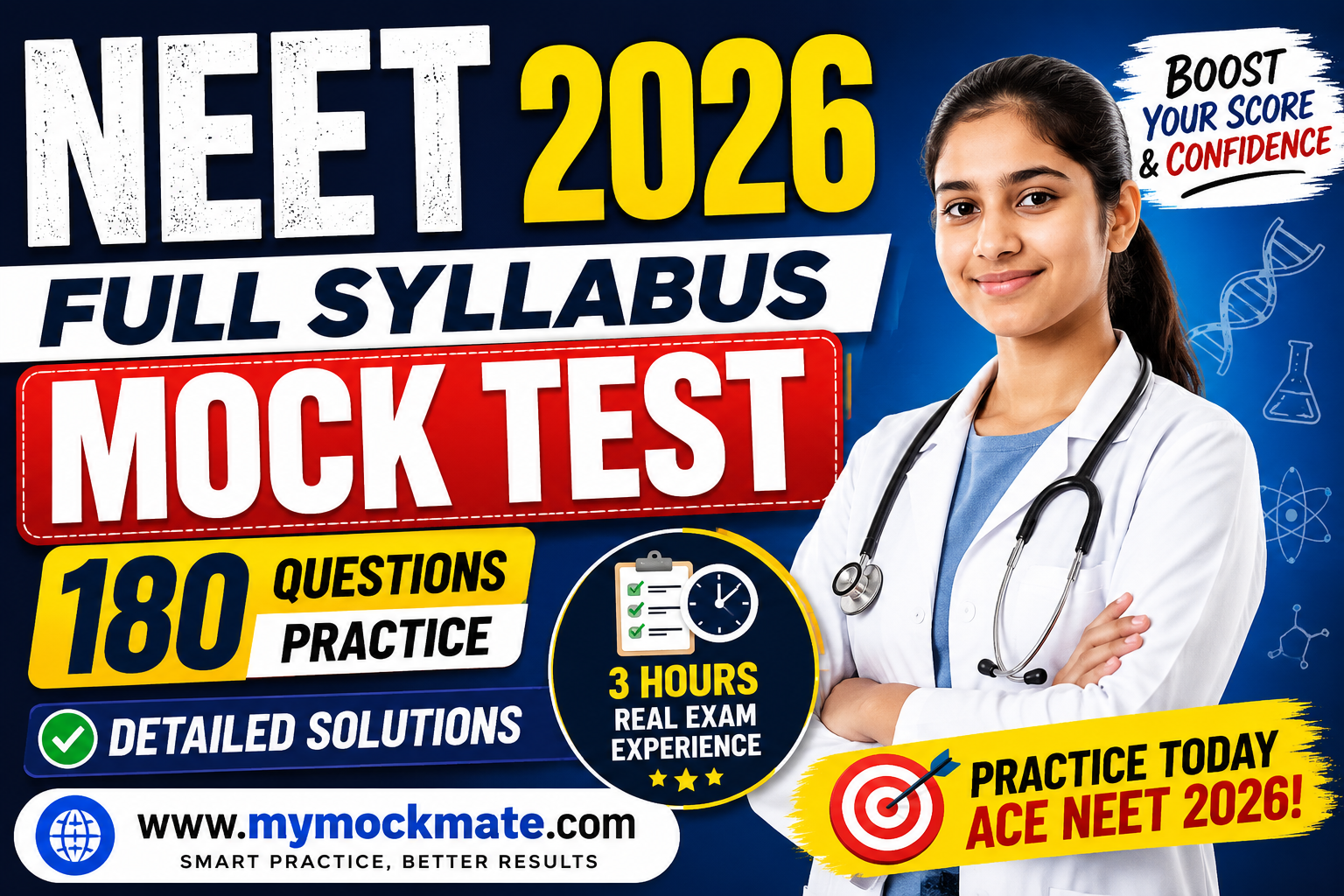
NEET is a time-based exam with 180 questions to be solved within limited hours. Regular mock tests teach students how to manage time efficiently.
2. Build Exam Confidence
Students often feel nervous during the real exam. Full-length practice tests reduce anxiety and increase confidence.
3. Identify Weak Areas
Mock tests highlight chapters and concepts where improvement is needed.
4. Increase Speed and Accuracy
Regular practice develops faster problem-solving skills and minimizes silly mistakes.
5. Familiarize with Exam Pattern
Students become comfortable with the latest NEET question format and marking scheme.
Platforms like MyMockMate provide realistic exam simulations that help students experience the actual NEET environment from home.
Understanding the NEET 2026 Exam Pattern
Before planning mock test preparation, students must understand the exam structure.
| Subject | Questions | Marks |
|---|---|---|
| Physics | 45 | 180 |
| Chemistry | 45 | 180 |
| Biology | 90 | 360 |
| Total | 180 | 720 |
Marking Scheme
-
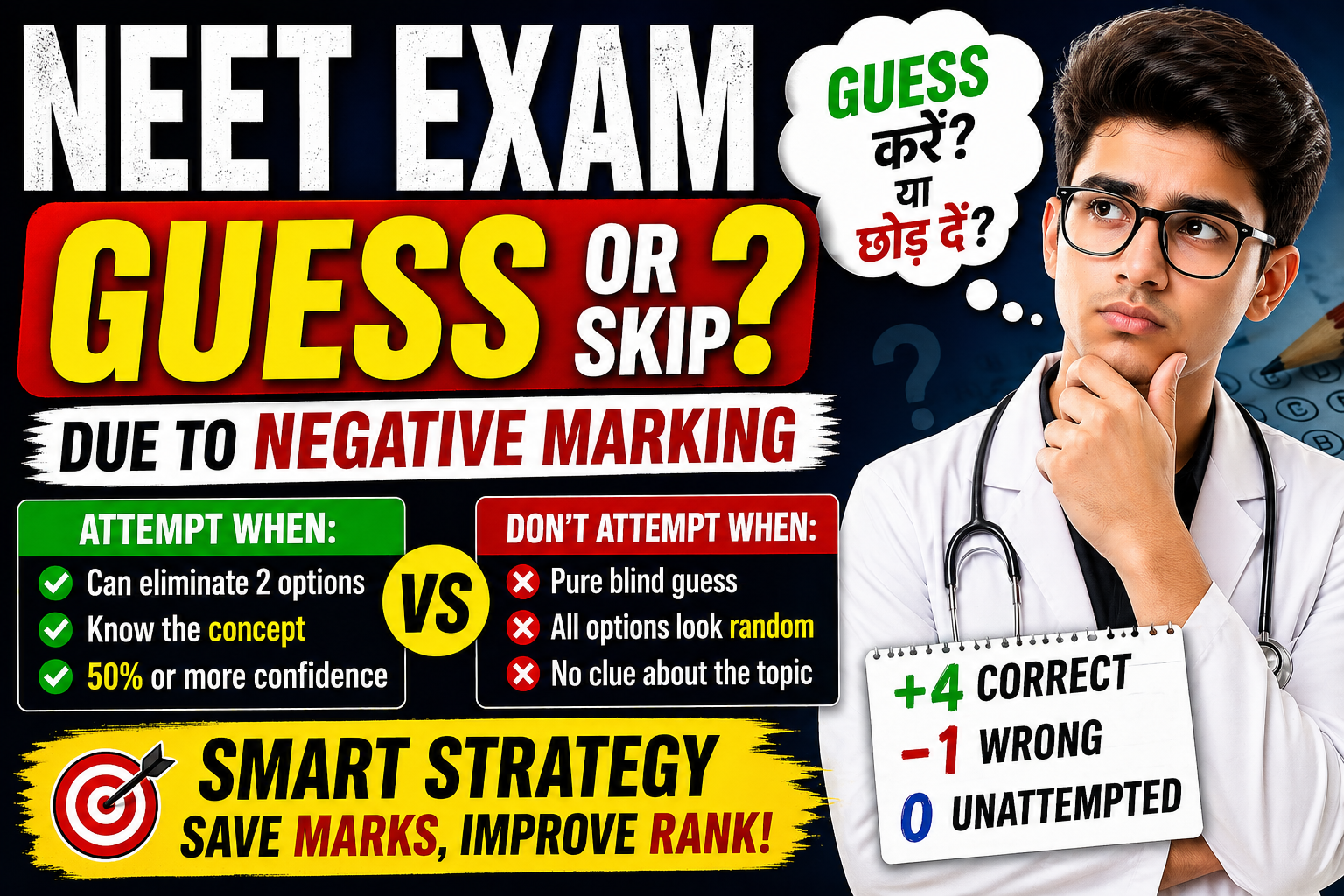
+4 for every correct answer
-
-1 for every wrong answer
This negative marking system makes accuracy extremely important.
Phase-Wise Mock Test Roadmap for NEET 2026
A proper strategy should be divided into phases.
Phase 1: Foundation Building (May 2025 – September 2025)
During this stage, students should focus mainly on concept clarity.
Strategy
-
Complete NCERT reading thoroughly
-
Solve chapter-wise MCQs
-
Attempt topic-wise mini tests
-
Practice previous year NEET questions
Mock Test Frequency
-
2–3 chapter tests per week
-
1 subject-wise mock every weekend
Focus Areas
-
NCERT Biology line-by-line preparation
-
Physics numerical basics
-
Organic Chemistry fundamentals
Students can use MyMockMate for chapter-wise practice tests that help strengthen fundamentals gradually.
Phase 2: Strengthening & Practice (October 2025 – January 2026)
This is the most important preparation phase.
Goals During This Phase
-
Complete full syllabus once
-
Increase question-solving speed
-
Improve accuracy
-
Begin full-length mock tests
Mock Test Frequency
-
2 full mock tests every week
-
Daily practice of 100–150 MCQs
Subject-Wise Approach
Biology
-
Revise NCERT repeatedly
-
Focus on diagrams and terminology
-
Practice assertion-reason questions
Chemistry
-
Memorize reactions and formulas
-
Practice Physical Chemistry numericals
-
Focus on NCERT examples
Physics
-
Solve conceptual and numerical questions daily
-
Maintain formula revision notebook
-
Practice high-weightage chapters repeatedly
At this stage, detailed test analysis becomes more important than simply giving tests.
Phase 3: Full Syllabus Revision (February 2026 – April 2026)
This phase decides your final rank.
Main Objectives
-
Full syllabus revision
-
Eliminate weak areas
-
Improve exam temperament
-
Maximize score consistency
Mock Test Frequency
-
3–4 full-length mock tests every week
What Students Should Do
-
Attempt tests in real exam timing
-
Follow OMR practice regularly
-
Revise error notebook daily
-
Analyze every mistake carefully
A high-quality online platform like MyMockMate helps students simulate real NEET conditions effectively.
How to Analyze NEET Mock Tests Properly
Giving tests alone will not improve your rank. Proper analysis is the real game changer.
Step 1: Check Accuracy Rate
Formula:
ext{Accuracy Rate} = frac{ ext{Correct Answers}}{ ext{Total Attempted Questions}} imes 100
Aim for:
-
85%+ accuracy in Biology
-
75%+ accuracy in Chemistry
-
70%+ accuracy in Physics
Step 2: Identify Mistake Categories
Divide mistakes into:
-
Conceptual errors
-
Silly mistakes
-
Calculation mistakes
-
Time-pressure mistakes
This helps in targeted improvement.
Step 3: Create an Error Notebook
Maintain a separate notebook containing:
-
Incorrect questions
-
Important formulas
-
Frequently forgotten concepts
-
Short tricks
Revise this notebook every week.
Step 4: Track Progress
Maintain score records of every mock test.
Track:
-
Overall score
-
Subject-wise performance
-
Accuracy percentage
-
Time spent per section
Continuous tracking helps students understand growth areas.
Best Time Management Strategy for NEET
Many students know concepts but fail because of poor time allocation.
Ideal Time Distribution
| Subject | Recommended Time |
|---|---|
| Biology | 45–50 minutes |
| Chemistry | 45–50 minutes |
| Physics | 60–70 minutes |
Smart Tips
-
Start with your strongest subject
-
Avoid spending too much time on one question
-
Mark doubtful questions for review
-
Maintain calm during difficult sections
Regular practice on MyMockMate helps students improve speed naturally.
Important Topics for NEET 2026
Biology High-Weightage Chapters
-
Genetics and Evolution
-
Human Physiology
-
Ecology
-
Reproduction
-
Biotechnology
Chemistry Important Chapters
-
Organic Chemistry
-
Coordination Compounds
-
Chemical Bonding
-
Thermodynamics
-
Electrochemistry
Physics Important Chapters
-
Modern Physics
-
Current Electricity
-
Mechanics
-
Optics
-
Thermodynamics
Students should prioritize these chapters during mock test revision.
Common Mistakes NEET Aspirants Must Avoid
1. Ignoring NCERT
Especially in Biology and Chemistry, NCERT is the backbone of NEET preparation.
2. Giving Too Many Tests Without Analysis
Quality matters more than quantity.
3. Avoiding Weak Subjects
Many students ignore Physics because it feels difficult. This reduces overall rank potential.
4. Lack of Revision
Without revision, retention decreases significantly.
5. Random Study Plan
Students need a structured roadmap instead of unplanned preparation.
How MyMockMate Helps NEET Aspirants
MyMockMate offers multiple features that make NEET preparation smarter and more effective.
Key Benefits
Full-Length NEET Mock Tests
Students can experience actual exam-level difficulty.
Chapter-Wise Tests
Helpful for strengthening individual topics.
Performance Analytics
Detailed reports help identify weak areas.
Real Exam Simulation
Improves confidence and exam temperament.
Flexible Practice
Students can practice anytime from home.
Affordable Learning
Online mock tests reduce coaching dependency and help students prepare efficiently.
For students targeting top medical colleges, consistent practice through a reliable platform can make a huge difference.
Daily Study Routine for NEET 2026 Aspirants
Here is a sample study schedule.
| Time | Activity |
|---|---|
| 6 AM – 8 AM | Biology Revision |
| 8 AM – 9 AM | Breakfast & Break |
| 9 AM – 12 PM | Physics Concepts & Numericals |
| 12 PM – 1 PM | Lunch |
| 1 PM – 3 PM | Chemistry Practice |
| 3 PM – 4 PM | Rest |
| 4 PM – 6 PM | Mock Test Practice |
| 6 PM – 7 PM | Exercise/Refreshment |
| 7 PM – 10 PM | Revision & Error Analysis |
Students should modify this schedule according to their personal routine and school/coaching timings.
Last 30 Days Strategy Before NEET 2026
The final month is extremely critical.
What to Do
-
Revise NCERT repeatedly
-
Give full-length mocks every alternate day
-
Focus on accuracy
-
Sleep properly
-
Revise formulas daily
What NOT to Do
-
Avoid new books
-
Do not compare yourself with others
-
Avoid excessive social media
-
Do not panic because of low mock scores
Consistency matters more than temporary performance fluctuations.
Motivation Tips for NEET Aspirants
Preparing for NEET can be mentally exhausting. Students often feel stressed because of competition and pressure.
Stay Motivated By
-
Setting weekly goals
-
Tracking improvement
-
Taking short breaks
-
Maintaining healthy sleep
-
Exercising regularly
-
Practicing meditation
Remember that every mock test is a learning opportunity, not just a scorecard.
Final Thoughts
NEET 2026 preparation requires smart strategy, consistency, and disciplined practice. Mock tests are not just practice papers; they are tools that shape your exam temperament, confidence, and performance.
Students who regularly attempt tests, analyze mistakes, revise weak areas, and maintain consistency are far more likely to achieve high scores.
Using a trusted platform like MyMockMate can help aspirants create a structured preparation journey with realistic mock exams, detailed analytics, and chapter-wise practice support.
Success in NEET is not about studying endlessly. It is about studying strategically.
Start your mock test roadmap today and move one step closer to your dream medical college.
Frequently Asked Questions (FAQs)
1. How many mock tests should I give before NEET 2026?
Students should aim for at least 80–120 quality mock tests before the actual exam.
2. Are online mock tests useful for NEET preparation?
Yes, online mock tests help students improve speed, accuracy, time management, and exam confidence.
3. Which is the best platform for NEET mock tests?
MyMockMate is a useful platform for chapter-wise practice, full-length tests, and performance analysis.
4. How can I improve my Physics score in NEET?
Practice numericals daily, revise formulas regularly, and analyze mistakes after every mock test.
5. Is NCERT enough for NEET Biology?
NCERT is extremely important and covers most Biology questions asked in NEET.
6. How should I analyze mock tests?
Check accuracy, identify weak topics, maintain an error notebook, and revise mistakes regularly.
7. When should I start full-length mock tests?
Students should ideally begin full-length mocks after completing a significant portion of the syllabus.
8. How many hours should I study daily for NEET 2026?
Most serious aspirants study around 8–12 hours daily depending on their schedule and preparation level.
9. What is the ideal score in NEET mock tests?
A consistent score above 600 is generally considered strong for top medical colleges.
10. Can mock tests improve NEET rank?
Yes, regular mock tests significantly improve performance, confidence, speed, and overall rank.