




Short Introduction
Continuity is one of the most important concepts of Calculus. It helps us understand whether a function behaves smoothly around a point without any sudden breaks or jumps. In CBSE Class 12 Mathematics, Chapter 5 “Continuity and Differentiability” introduces students to the formal definition of continuity and its applications.
Exercise 5.1 focuses on checking the continuity of polynomial, rational, modulus, piecewise and trigonometric functions at specific points.
This complete solution guide by www.mymockmate.com provides easy-to-understand step-by-step explanations that are highly useful for CBSE Board Exams and competitive examinations.
Quick Information Box
| Particular | Details |
|---|---|
| Chapter | 5 |
| Chapter Name | Continuity and Differentiability |
| Exercise | 5.1 |
| Board | CBSE |
| Class | 12 |
| Difficulty Level | Easy to Moderate |
| Important For | Board Exams, JEE, CUET |
Concepts Used (Topics Covered)
✔ Definition of Continuity
✔ Left Hand Limit (LHL)
✔ Right Hand Limit (RHL)
✔ Existence of Function Value
✔ Continuous Functions
✔ Polynomial Functions
✔ Rational Functions
✔ Modulus Functions
✔ Piecewise Functions
✔ Trigonometric Functions
✔ Greatest Integer Function
✔ Composite Functions

Important Formulas
Definition of Continuity
A function f(x) is continuous at x = a if
lim x→a f(x) = f(a)
That is,
LHL = RHL = f(a)
Polynomial Functions
Every polynomial function is continuous for all real numbers.
Rational Functions
A rational function is continuous wherever its denominator is not zero.
Modulus Function
f(x)=|x|
is continuous for every real number.
Sum, Difference and Product Rule
If f(x) and g(x) are continuous at x=a, then
- f(x)+g(x)
- f(x)-g(x)
- f(x)×g(x)
are also continuous.
Question 1
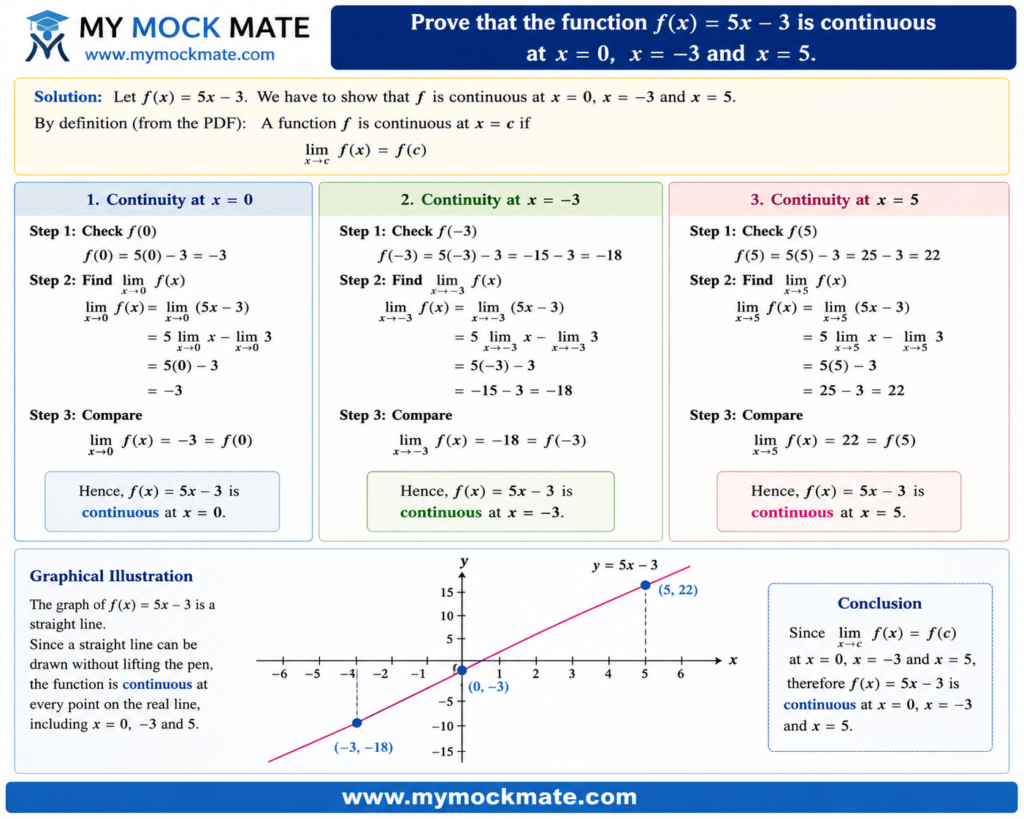
1. Prove that the function f(x) = 5x – 3 is continuous at x = 0, at x = – 3 and at x = 5.
Solution
Since is a polynomial function, it is continuous for every real number.
Still, we verify the three points.
At
Therefore,
Hence, ff is continuous at x=0x=0.
At
Thus,
Hence, ff is continuous at x=−3x=-3.
At
Therefore, ff is continuous at x=5x=5.
Answer
f(x)=5x−3 is continuous at 0,−3, and 5.
Question 2
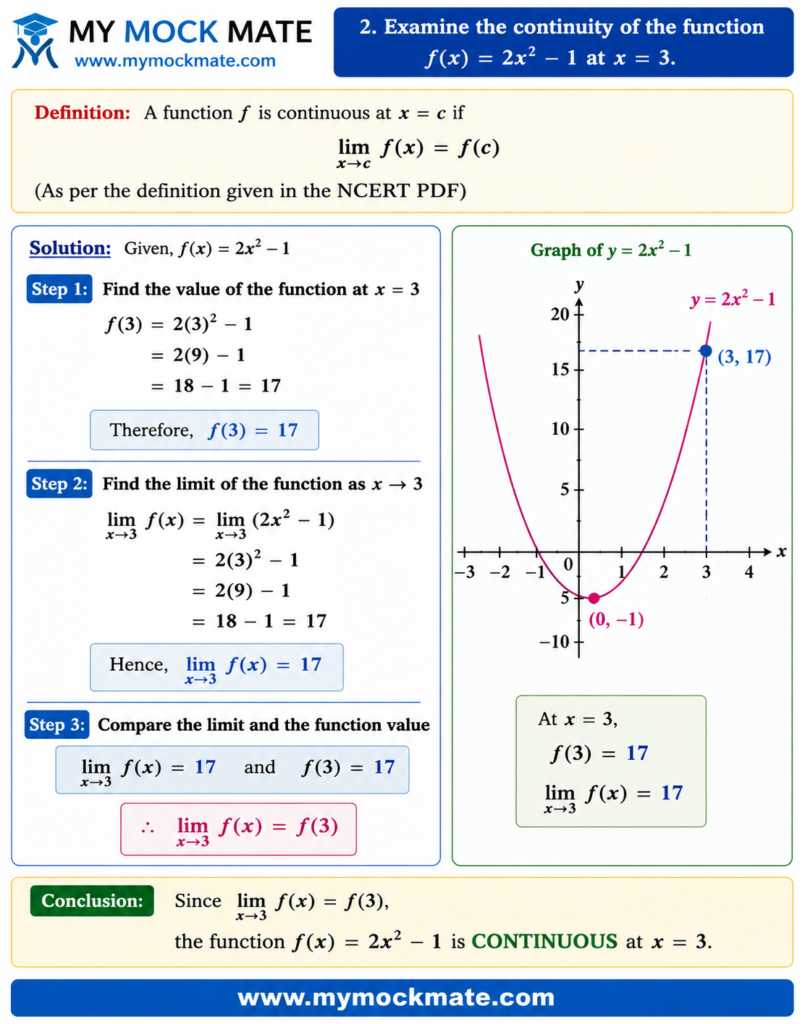
Examine the continuity of the function f(x) = 2×2 – 1 at x = 3.
Solution
First calculate :
Now,
Therefore,
Hence, f(x) is continuous at x=3.
Question 3
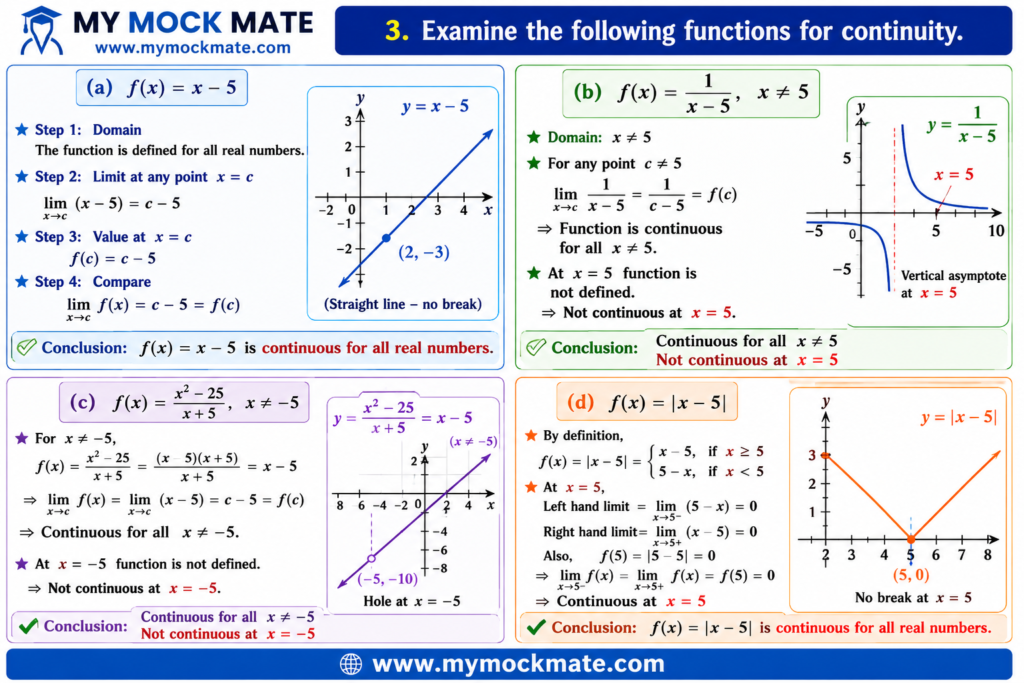
Examine the following functions for continuity.
(a)
This is a polynomial function.
For any ,
Therefore,
(b)
The denominator is zero at , so the function is not defined there.
For every ,
Hence,
It is not defined, and hence discontinuous as an extended real-line function, at .
(c)
Factor the numerator:
Therefore,
Thus, for every , , which is continuous.
Hence,
At , the original function is not defined.
(d)
The modulus function is continuous, and is continuous.
Therefore, ∣x−5∣ is continuous for all real x.
Question 4
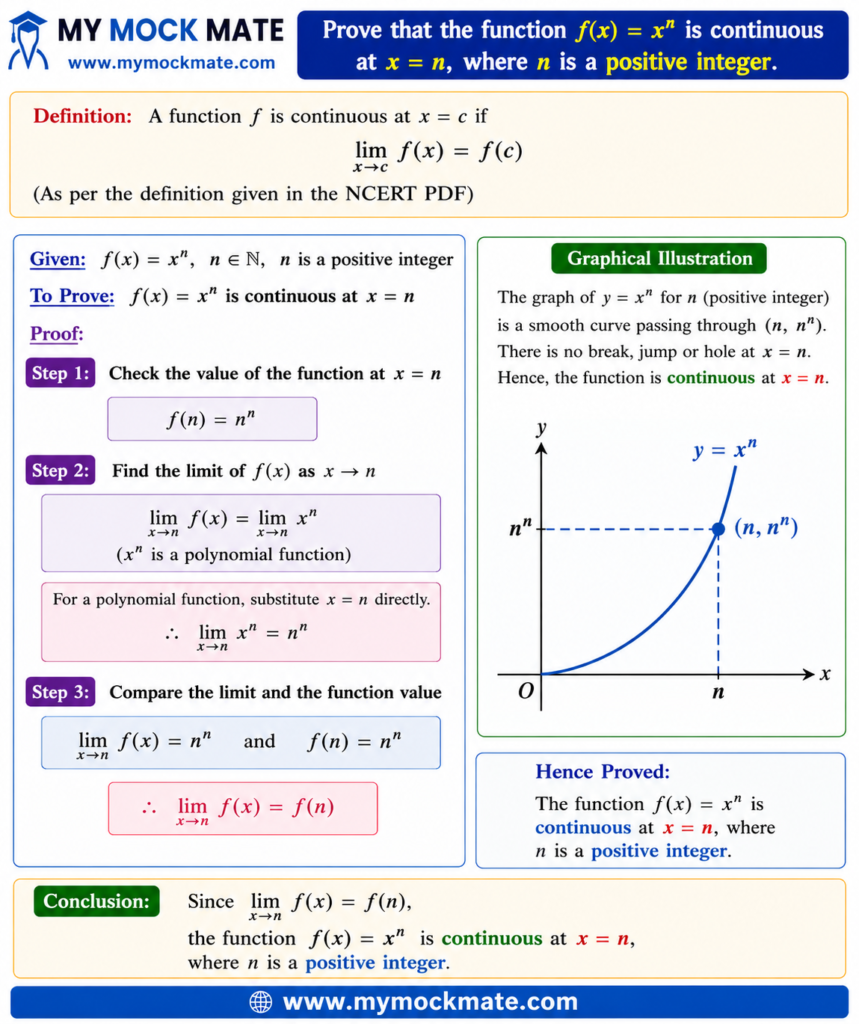
Prove that the function f(x) = xn is continuous at x = n, where n is a positive integer.
Solution
We have
Also,
Thus,
Therefore,
In fact, is continuous for every real .
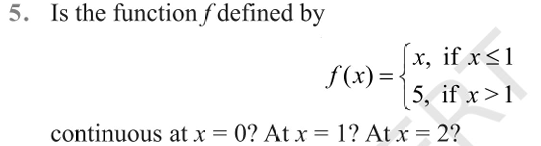
At
Since the first rule applies near ,
Thus,
So, continuous at x=0x=0.
At
Left-hand limit:
Right-hand limit:
Since
the function is not continuous at x=1x=1.
At
For ,
Therefore,
Hence, continuous at x=2x=2.
Answer
Continuous at x=0,2;discontinuous at x=1.
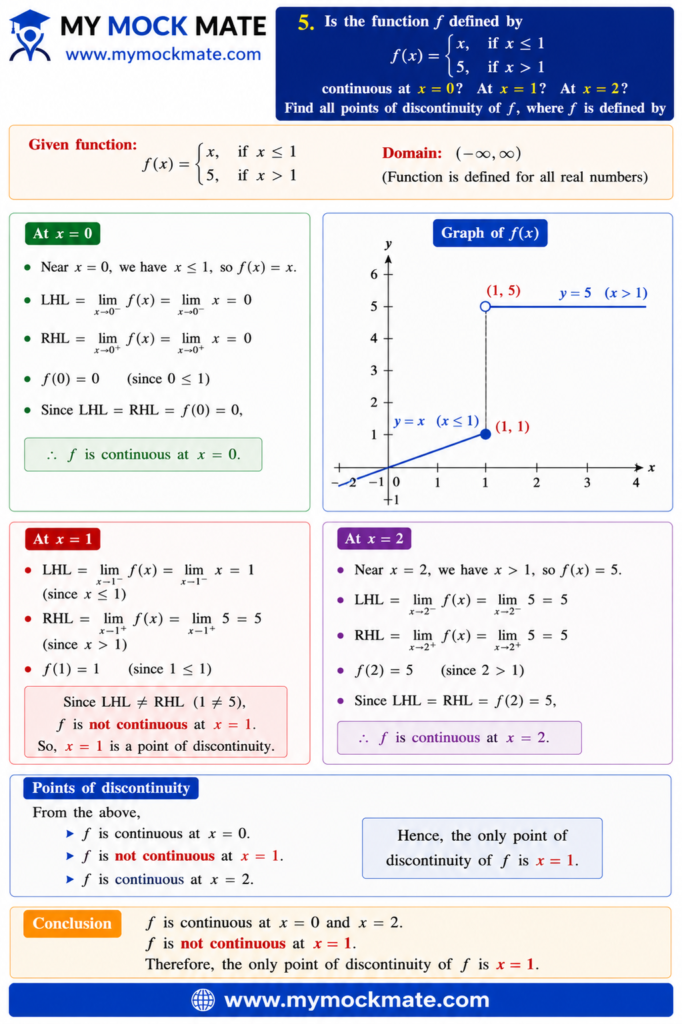
Find all points of discontinuity of f, where f is defined by
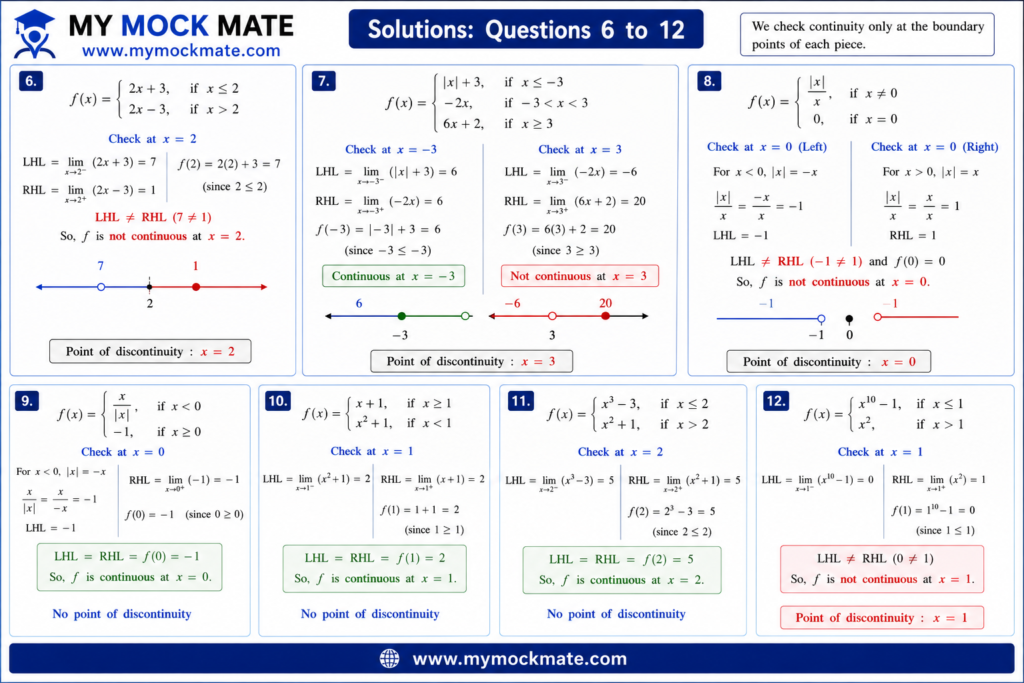
Question 6
The possible point of discontinuity is .
LHL:
RHL:
Since
the function is discontinuous at .
Answer
Question 7
Possible discontinuities occur at and .
At
LHL:
RHL:
Thus,
So is continuous at .
At
LHL:
RHL:
Since
is discontinuous at .
Answer
Question 8
At :
For ,
Therefore,
For ,
Therefore,
Since
the limit does not exist.
Hence,
It is continuous for .
Question 9
At ,
LHL:
RHL:
Thus,
Therefore,
Each part is continuous on its respective open interval, so
Question 10
At ,
LHL:
RHL:
Therefore,
Hence,
Question 11
At ,
LHL:
RHL:
Thus,
Therefore,
Question 12
At ,
LHL:
RHL:
Since
the function is discontinuous at .
Answer
x=1 is the only point of discontinuity.
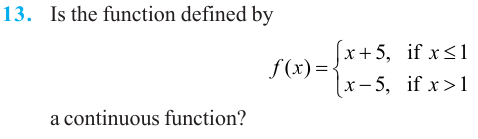
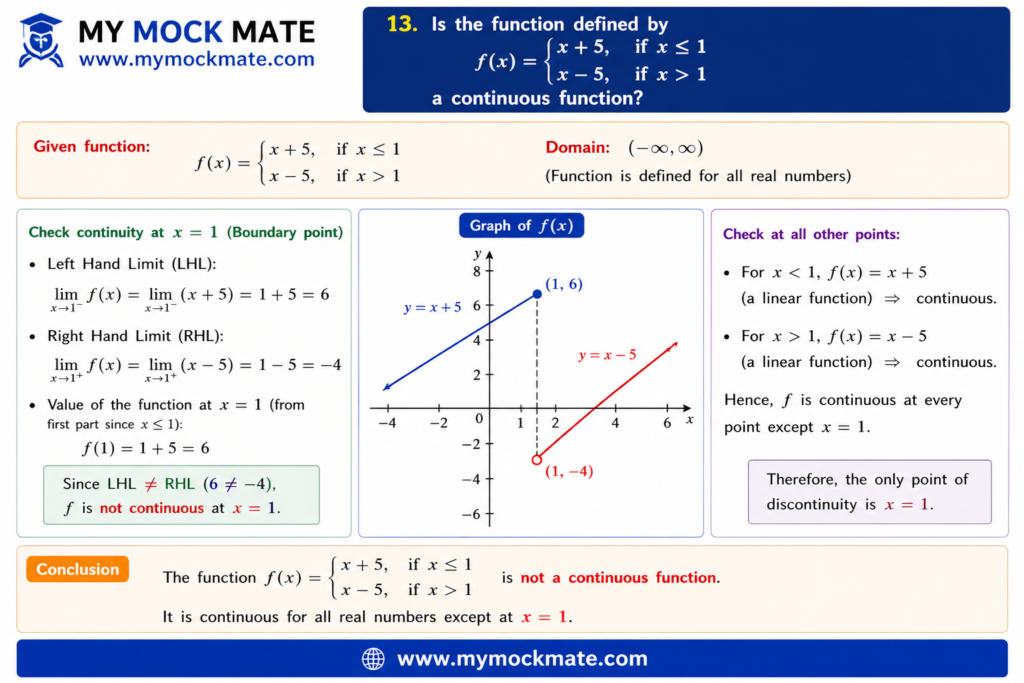
At ,
LHL:
RHL:
Since
the function is discontinuous at .
Answer
The exercise asks this continuity check explicitly.
Discuss the continuity of the function f, where f is defined by
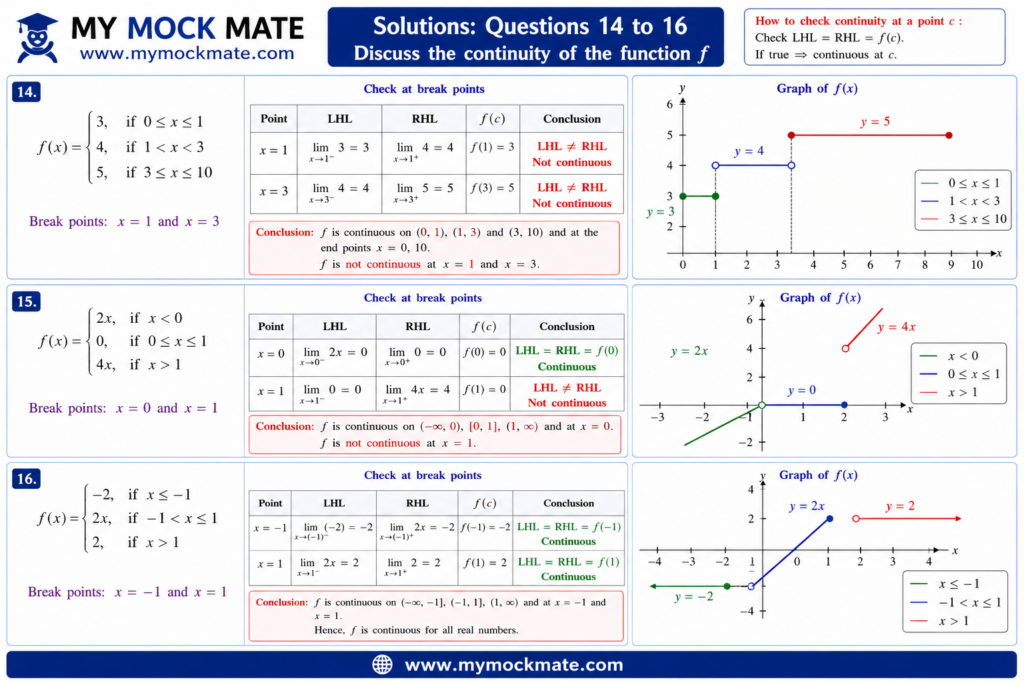
Question 14
Possible points are and .
At
LHL , while RHL .
Therefore, discontinuous at .
At
LHL , while RHL .
Therefore, discontinuous at .
Answer
Question 15
Possible points: .
At
LHL:
RHL:
Thus, continuous at .
At
LHL:
RHL:
Since ,
Question 16
At
LHL:
RHL:
Hence continuous at .
At
LHL:
RHL:
Hence continuous at .
Therefore, f is continuous for all real x.

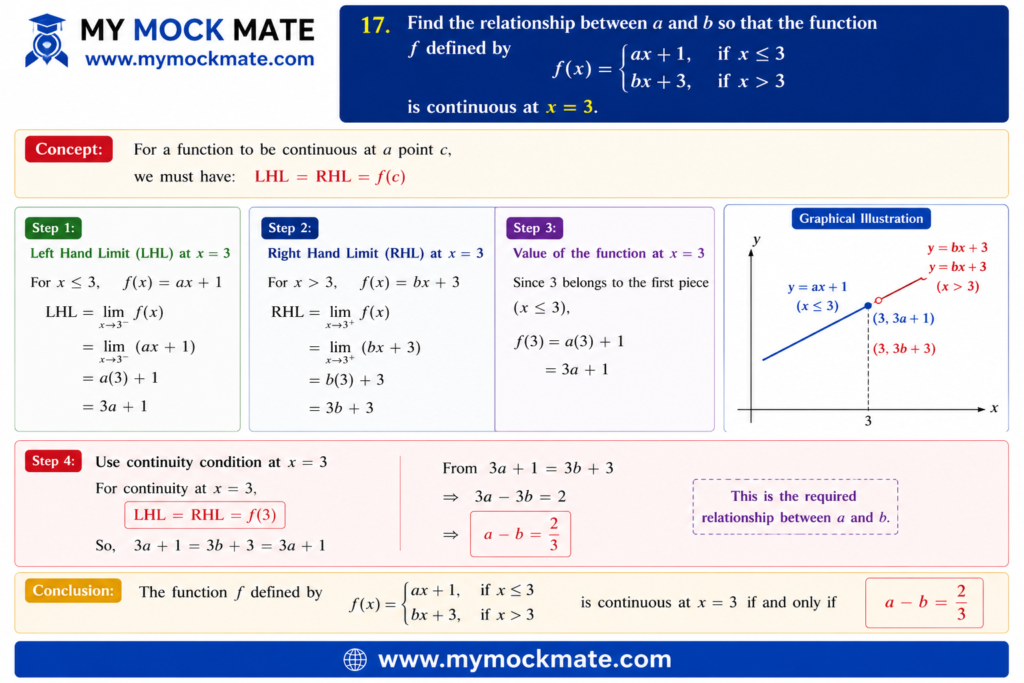
For continuity at ,
LHL:
RHL:
Therefore,
Hence,
or a=b+2/3
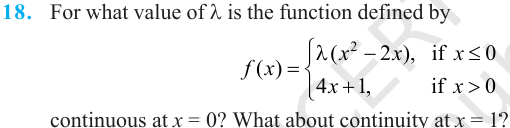
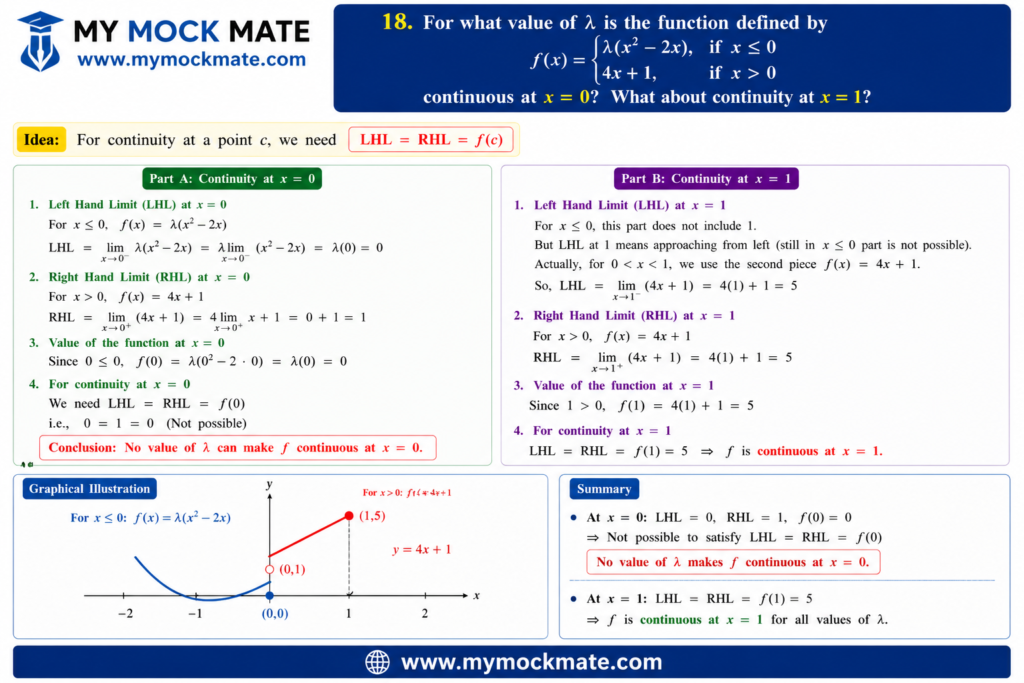
At
LHL:
RHL:
For continuity,
Thus,
At
Since , near ,
which is a linear function and therefore continuous.
Hence,
For the value required for continuity at , .
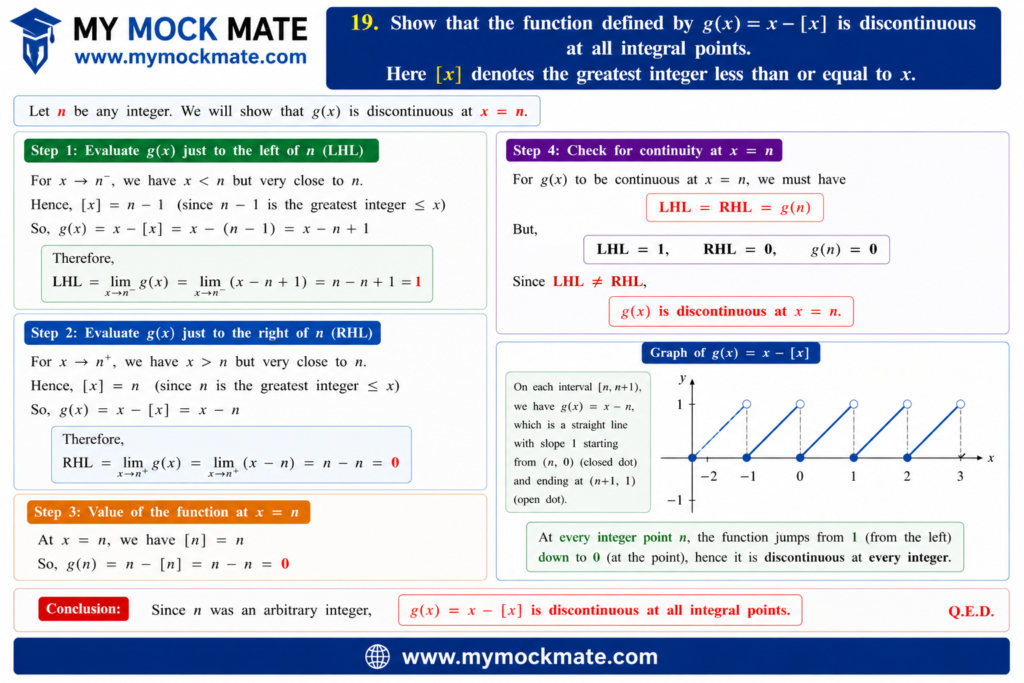
- Show that the function defined by g(x) = x – [x] is discontinuous at all integral points. Here [x] denotes the greatest integer less than or equal to x.
Let be any integer.
At ,
Therefore,
For ,
Hence,
For ,
Therefore,
Thus,
Since LHL RHL, g(x) is discontinuous at every integral point.
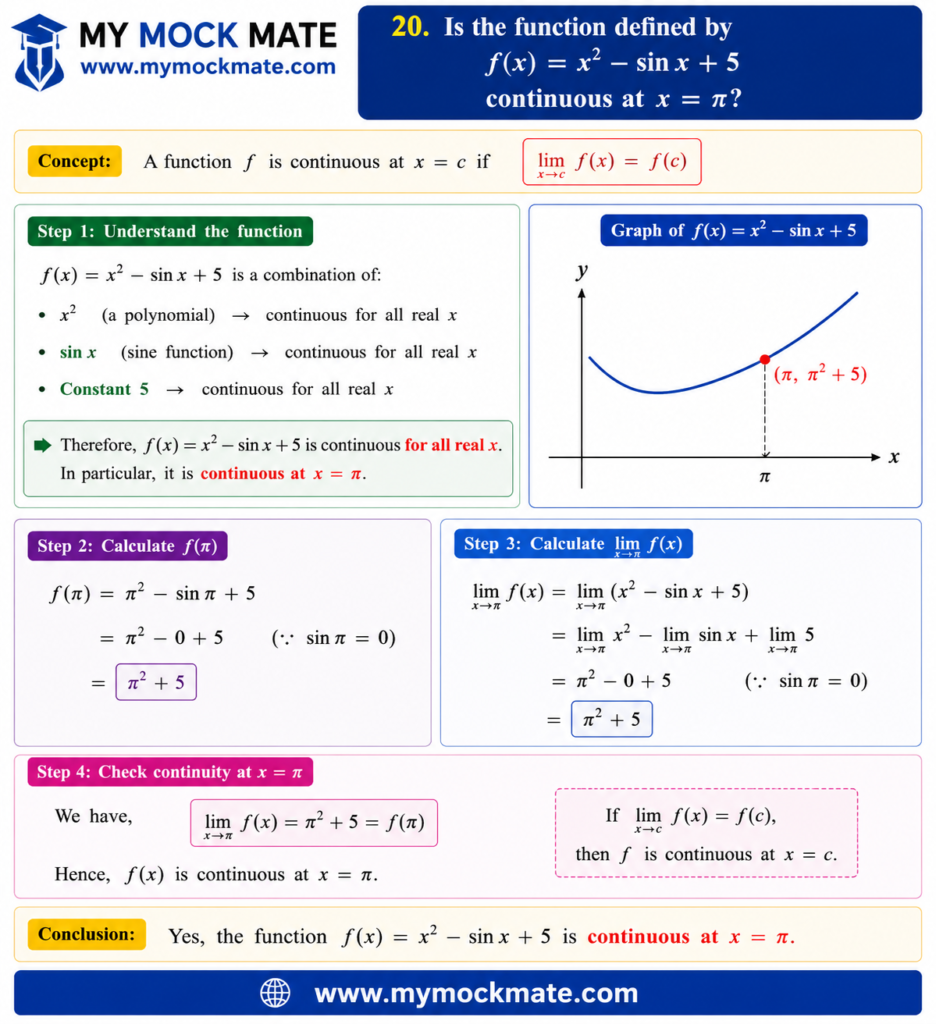
20. Is the function defined by f(x) = x2 – sin x + 5 continuous at x = π?
The functions , , and the constant function are continuous everywhere.
Therefore, their sum/difference is also continuous.
Hence,
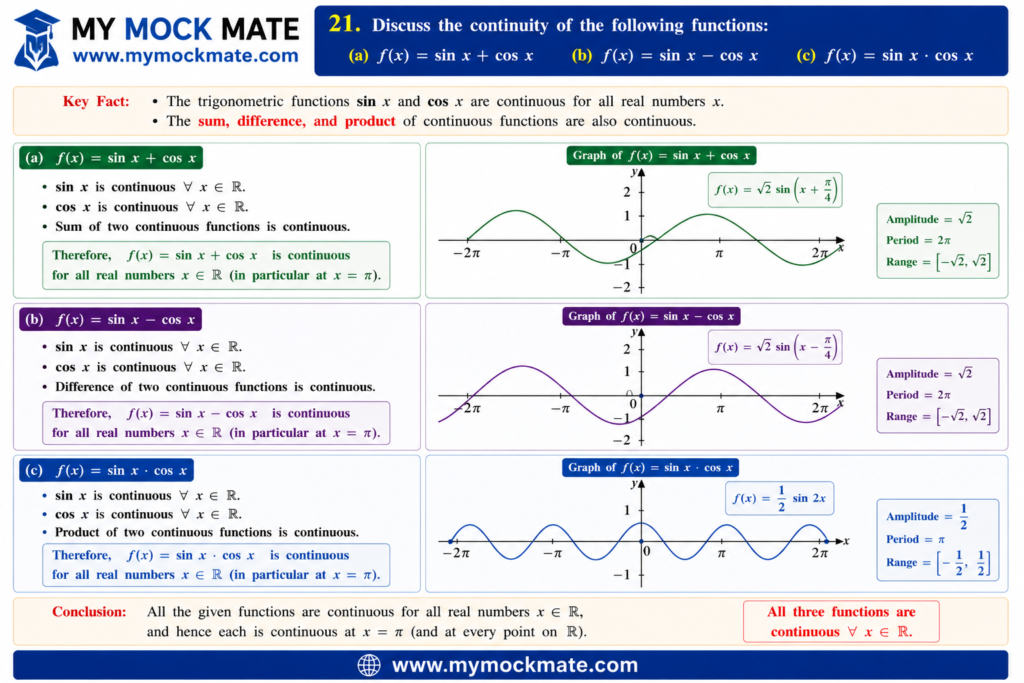
- Discuss the continuity of the following functions:
(a) f(x) = sin x + cos x
(b) f(x) = sin x – cos x
(c) f(x) = sin x . cos x
(a)
Both and are continuous for all real .
Therefore,
(b)
Difference of two continuous functions is continuous.
(c)
Product of continuous functions is continuous.
The three functions are specified in the exercise statement.
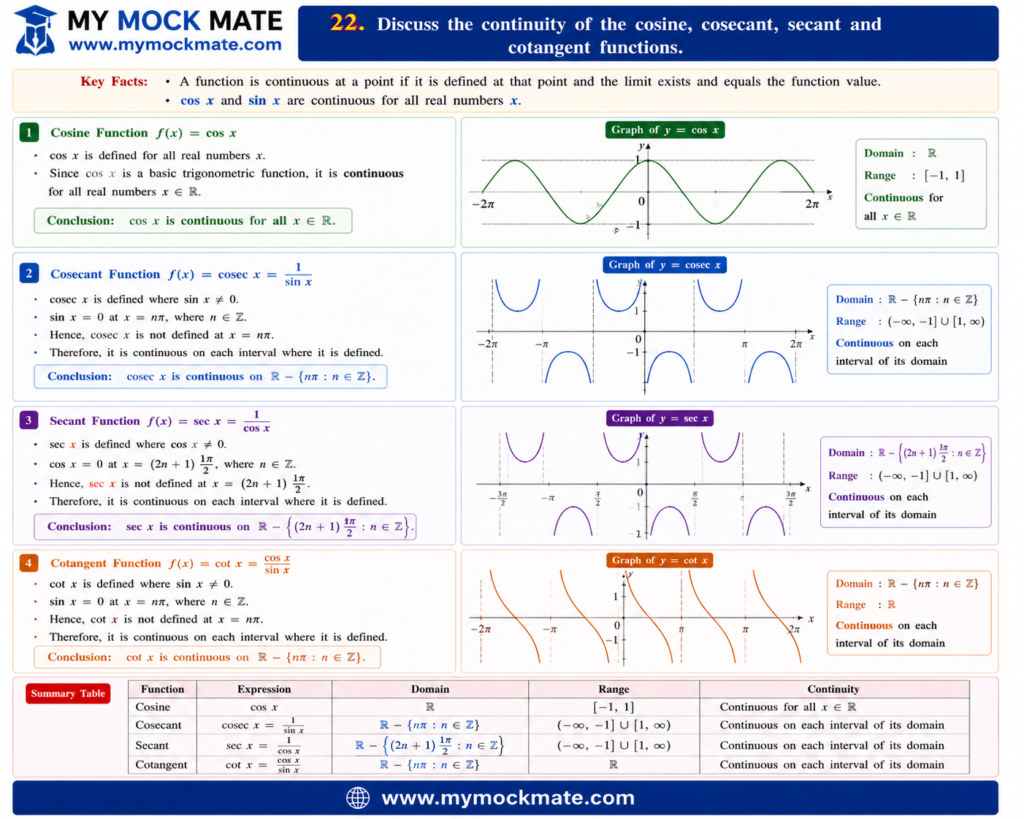
22. Discuss the continuity of the cosine, cosecant, secant and cotangent functions.
Discuss the continuity of cosine, cosecant, secant and cotangent functions.
1. Cosine function
Cosine is continuous for every real number.
2. Cosecant function
It is continuous wherever .
Since
we have
3. Secant function
It is continuous wherever .
at
Therefore,
4. Cotangent function
It is continuous wherever .
Therefore, cotx is continuous for x Not = nπ.
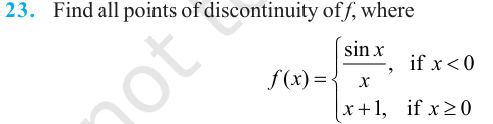
LHL:
RHL:
Also,
Therefore,
Hence, the function is continuous at .
Answer
There are no points of discontinuity.
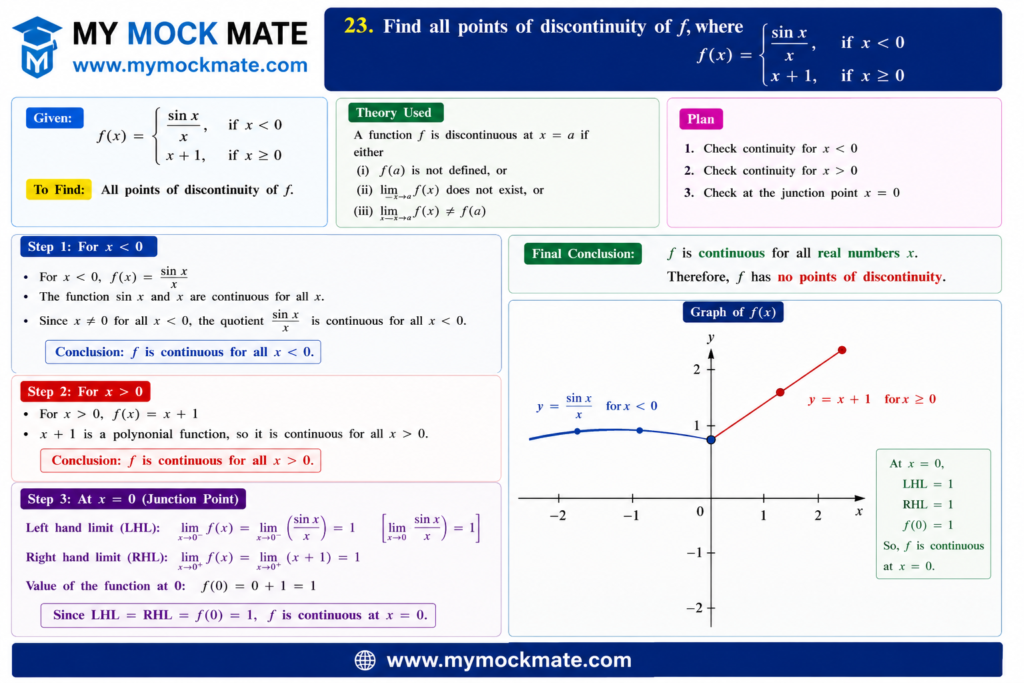
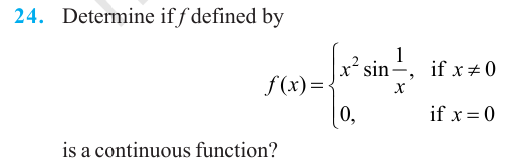
At ,
Multiplying by ,
As ,
Hence, by the squeeze theorem,
Since
we get
Therefore,
It is also continuous for .
Thus, f is continuous on R.
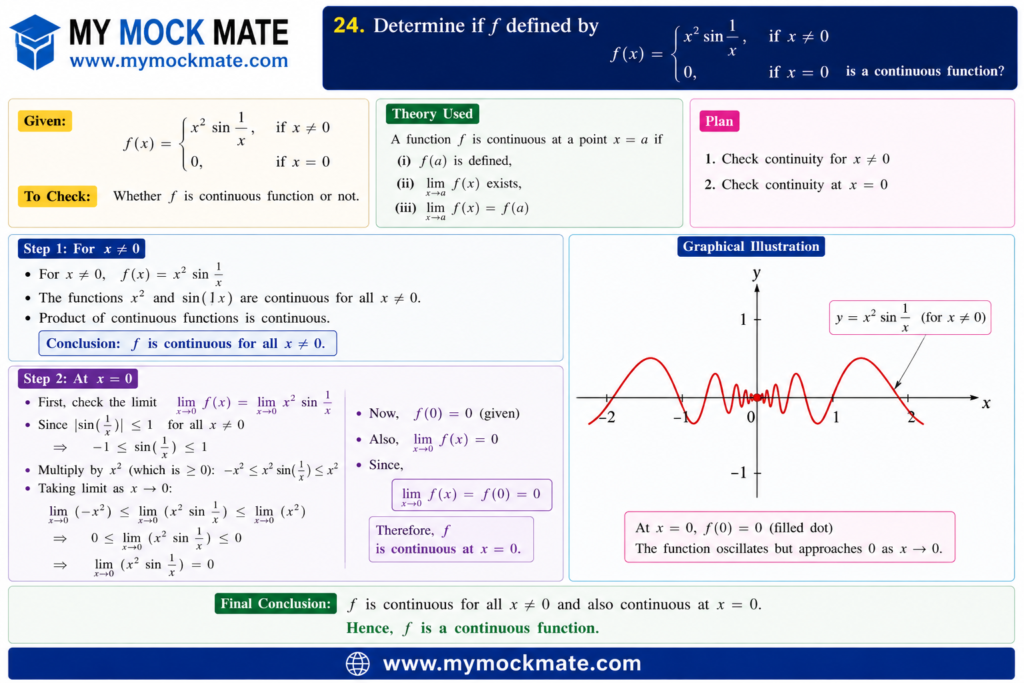
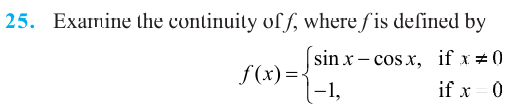
At ,
Also,
Therefore,
Hence,
Since is continuous elsewhere, f is continuous for all real x.
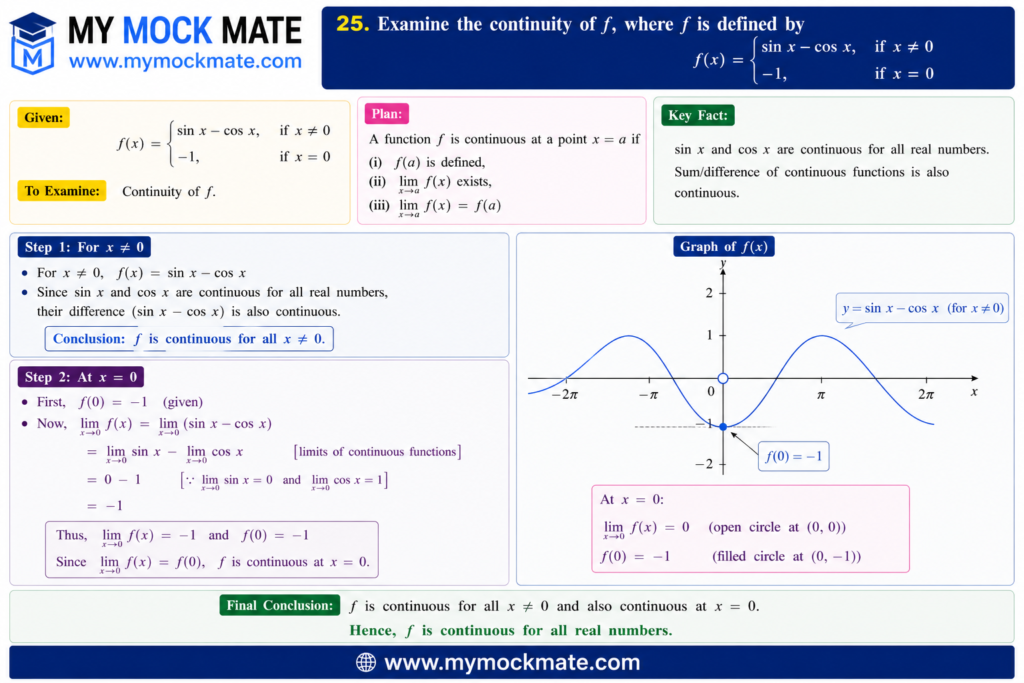
Find the values of k so that the function f is continuous at the indicated point in Exercises 26 to 29.
Question 26
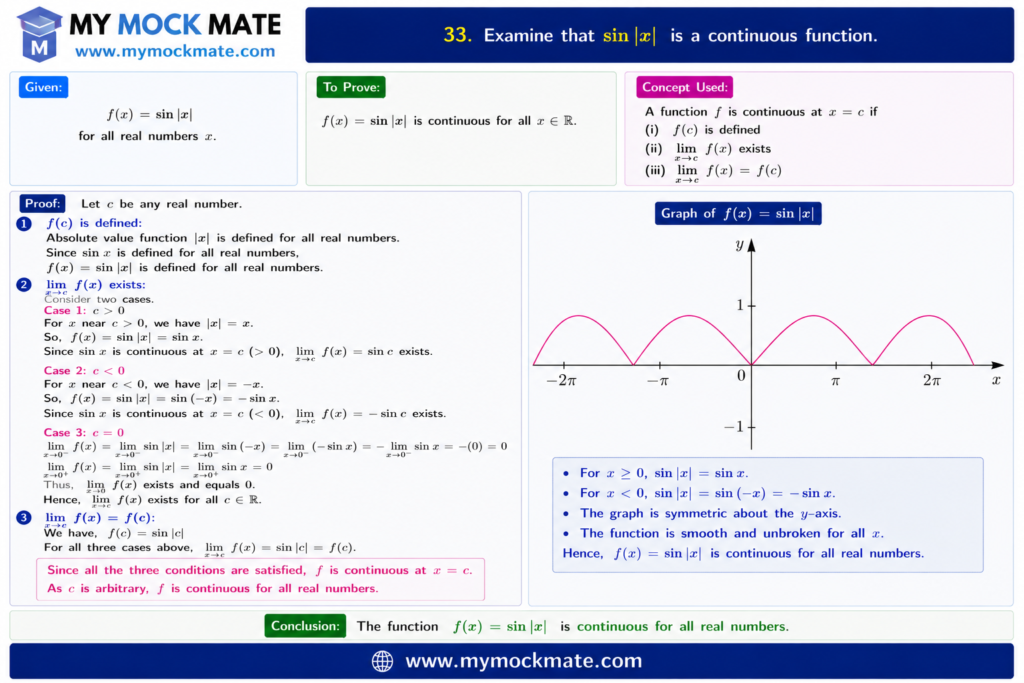
Find for continuity at .
We require
Put .
Then
and
Therefore,
For continuity,
Hence,
Question 27
For continuity at ,
LHL:
RHL:
Thus,
Question 28
At ,
LHL:
RHL:
For continuity,
Hence,
Question 29
At ,
RHL:
For continuity,
Therefore, k=9/5
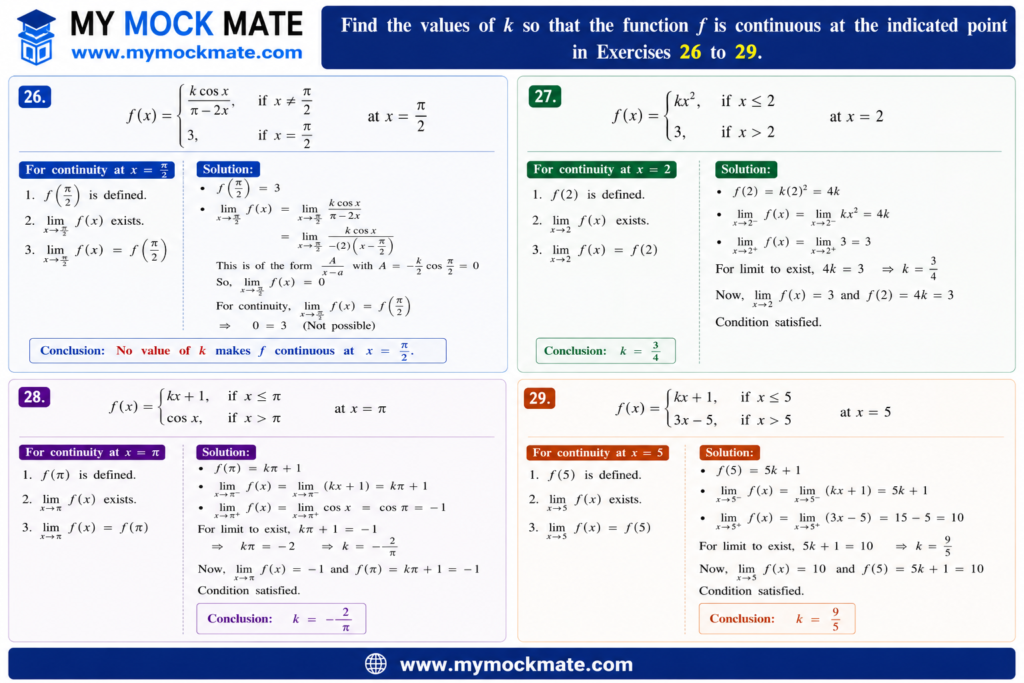
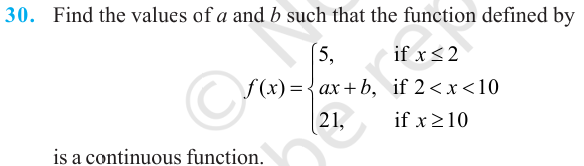
For continuity at ,
For continuity at ,
Subtract (1) from (2):
Substitute into (1):
Hence,
The original exercise asks for these values so that the entire piecewise function is continuous.
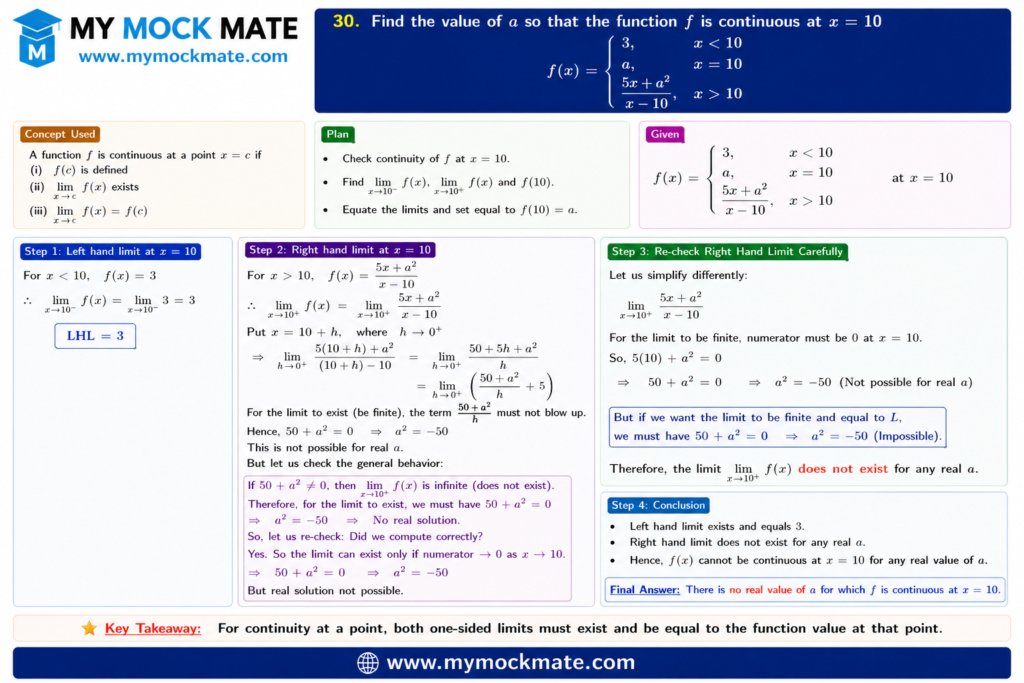
31. Show that the function defined by f(x) = cos (x2) is a continuous function.
We know:
is continuous for every real , and
is continuous for every real .
The composition of continuous functions is continuous.
Therefore, cos(x2) is continuous for all x∈R.
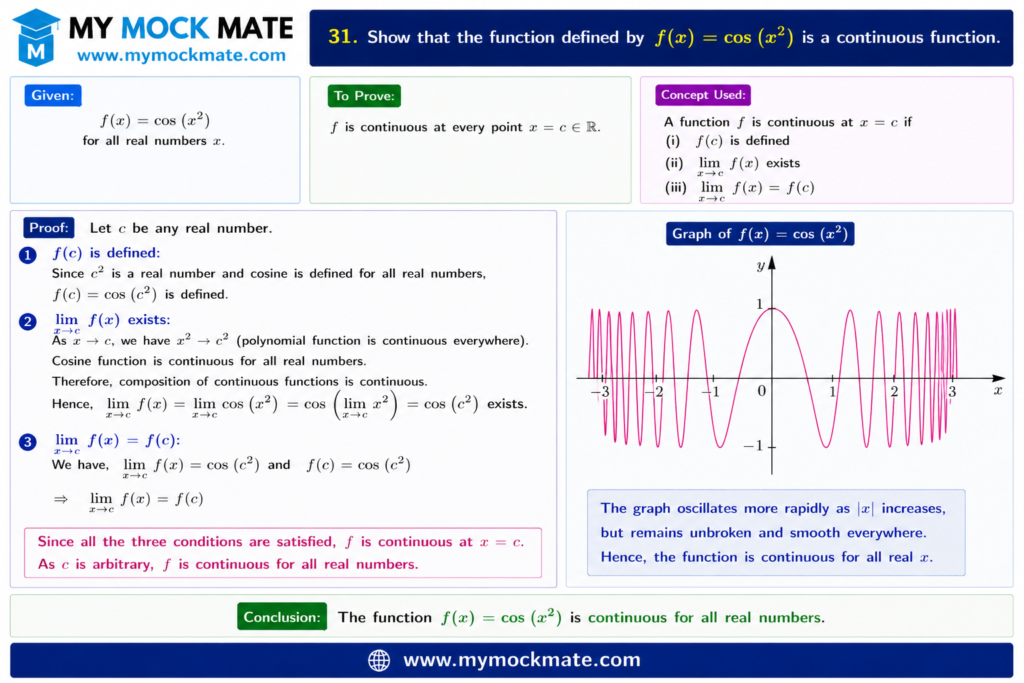
32. Show that the function defined by f(x) = |cos x| is a continuous function.
We know that
is continuous for every real .
Also, the modulus function
is continuous.
Therefore, the composition
is continuous.
Hence, ∣cosx∣ is continuous for all real x.
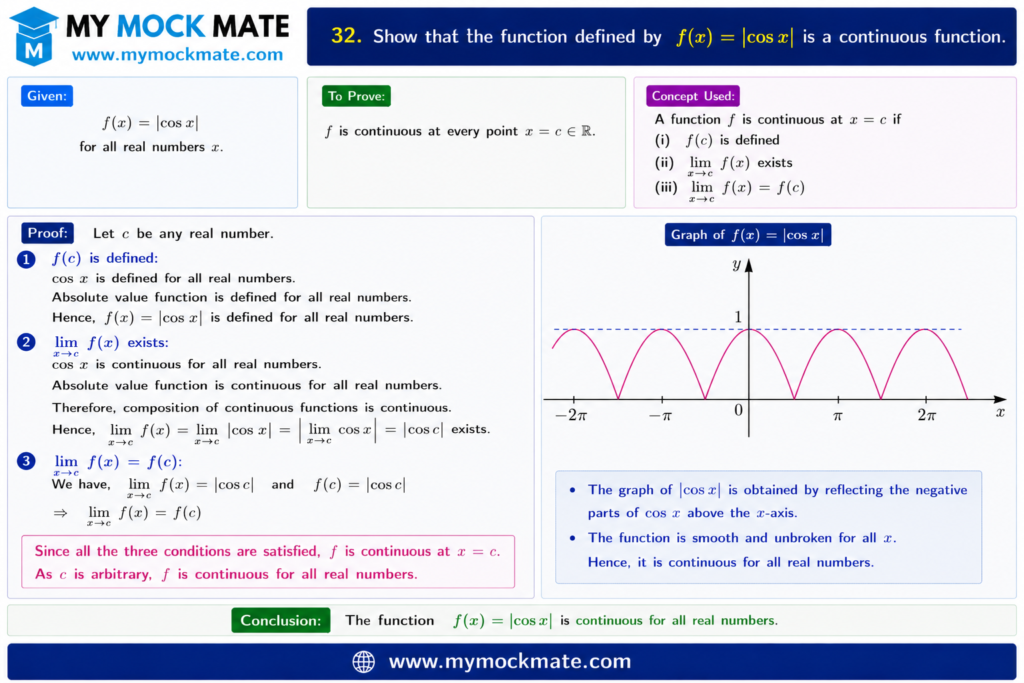
33. Examine that sin |x| is a continuous function.
The function
is continuous for every real .
The function
is also continuous for every real .
Therefore, their composition
is continuous.
Hence, sin∣x∣ is continuous for all x∈R.
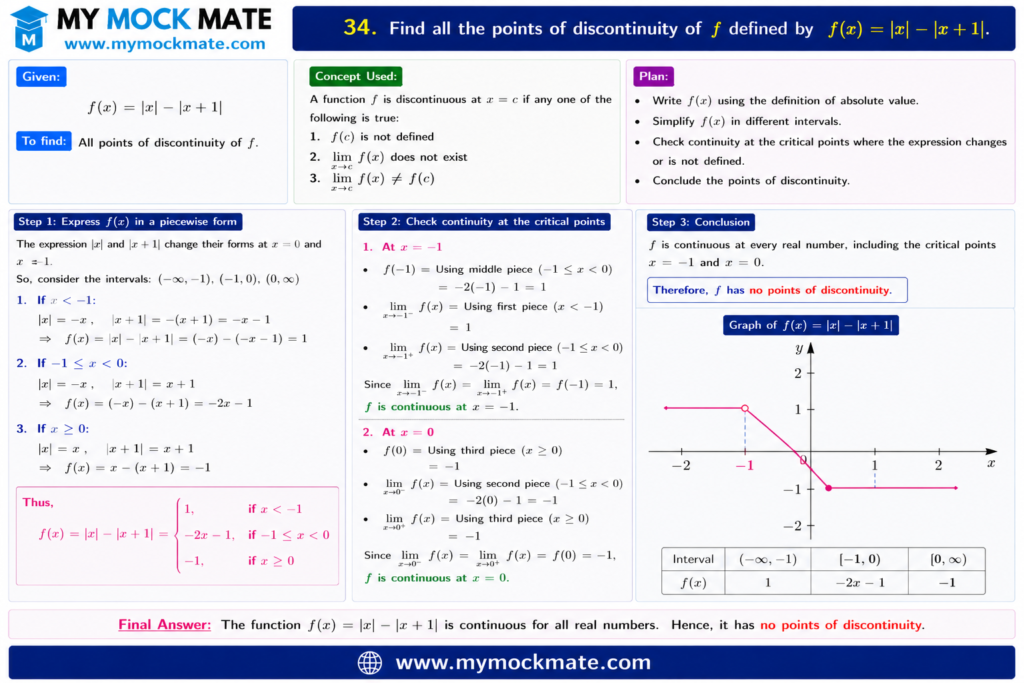
34. Find all the points of discontinuity of f defined by f(x) = |x| – |x + 1|.
The possible points are where the expressions inside the modulus become zero:
We examine these points.
For
Thus,
For
Therefore,
For
Hence,
Now check the critical points.
At
and
Also,
Therefore, is continuous at .
At
and
Also,
Therefore, is continuous at .
Final Answer
There are no points of discontinuity. f(x)=∣x∣−∣x+1∣ is continuous for every real x.
Quick Answer Key
| Q. | Answer |
|---|---|
| 1 | Continuous at |
| 2 | Continuous at |
| 3(a) | Continuous on |
| 3(b) | Continuous on |
| 3(c) | Continuous on |
| 3(d) | Continuous on |
| 4 | Continuous at |
| 5 | Discontinuous at |
| 6 | Discontinuous at |
| 7 | Discontinuous at |
| 8 | Discontinuous at |
| 9 | Continuous everywhere |
| 10 | Continuous everywhere |
| 11 | Continuous everywhere |
| 12 | Discontinuous at |
| 13 | Discontinuous at |
| 14 | Discontinuous at |
| 15 | Discontinuous at |
| 16 | Continuous everywhere |
| 17 | |
| 18 | for continuity at ; continuous at for every |
| 19 | Discontinuous at every integer |
| 20 | Continuous at |
| 21 | All three continuous on |
| 22 | Continuous on their respective domains |
| 23 | No point of discontinuity |
| 24 | Continuous everywhere |
| 25 | Continuous everywhere |
| 26 | |
| 27 | |
| 28 | |
| 29 | |
| 30 | |
| 31 | Continuous everywhere |
| 32 | Continuous everywhere |
| 33 | Continuous everywhere |
| 34 | No point of discontinuity |
Common Mistakes
❌ Forgetting to check whether the function is defined.
❌ Assuming every rational function is continuous everywhere.
❌ Not comparing LHL and RHL in piecewise functions.
❌ Ignoring denominator equal to zero.
❌ Missing modulus function properties.
Exam Tips
✅ Always write:
Function Value
↓
LHL
↓
RHL
↓
Conclusion
✅ Remember:
Polynomial → Continuous Everywhere
Rational → Continuous except denominator = 0
Modulus → Continuous Everywhere
Greatest Integer → Discontinuous at Integers
Practice MCQs
1.
Which function is continuous everywhere?
A. 1/x
B. |x|
C. 1/(x−2)
D. [x]
Answer: B
2.
The function 1/(x−3) is discontinuous at
A. 1
B. 2
C. 3
D. 4
Answer: C
3.
Every polynomial function is
A. Discontinuous
B. Continuous
C. Undefined
D. None
Answer: B
4.
The greatest integer function is discontinuous at
A. Rational numbers
B. Irrational numbers
C. Integers
D. Positive numbers
Answer: C
FAQ Section
Q1. What is continuity?
A function is continuous if
LHL = RHL = Function Value.
Q2. Are polynomial functions always continuous?
Yes. Every polynomial function is continuous for all real numbers.
Q3. Where are rational functions discontinuous?
At points where the denominator becomes zero.
Q4. Is modulus function continuous?
Yes, |x| is continuous everywhere.
Q5. Which questions are most important for CBSE Boards?
Piecewise functions, rational functions and greatest integer functions.
Prepare smarter with detailed NCERT solutions, chapter-wise mock tests, previous year questions and All India Rank based practice tests only at:
www.mymockmate.com
Mock Test Makes Preparation Easy!