



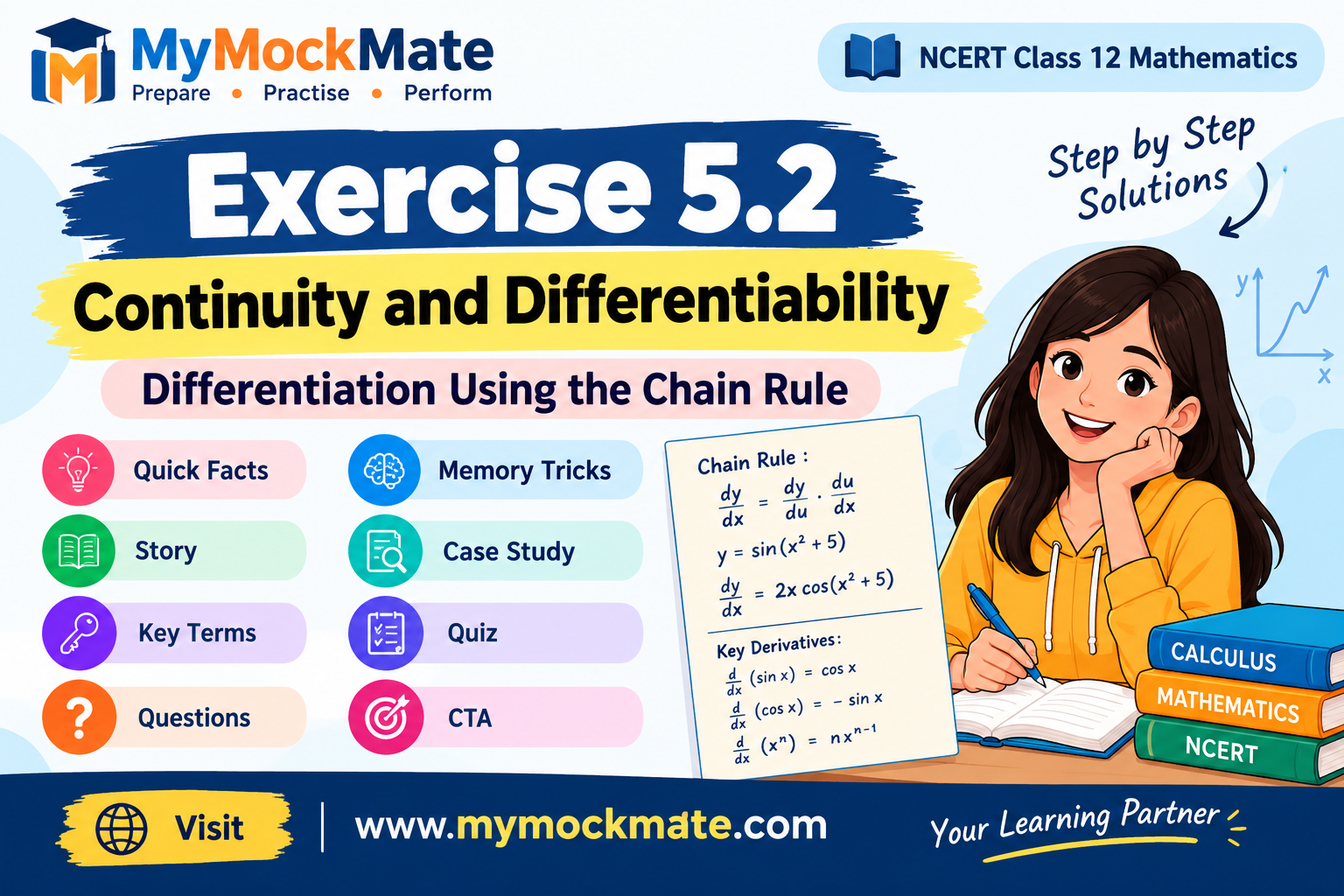

Differentiation Using the Chain Rule | NCERT Class 12 Mathematics
Quick Facts
- Exercise 5.2 focuses mainly on differentiation of composite functions and differentiability.
- The Chain Rule is used when one function is inside another function.
- If and , then:
- Standard derivatives frequently used in this exercise:
- A function can be continuous but not differentiable at a point, as illustrated by modulus and greatest integer functions in this exercise.
Story
Imagine a function as a machine. Sometimes goes directly into the machine:
But sometimes first enters one machine and its output enters another:
Here, the function is composite. To differentiate it, we need to follow the same journey in reverse.
For example,
First differentiate the outside function:
Then multiply by the derivative of the inside function:
Therefore,
This step-by-step process is the Chain Rule, which the textbook introduces for composite functions.
Key Terms
| Term | Meaning |
|---|---|
| Composite Function | A function formed by applying one function to another |
| Chain Rule | Rule used to differentiate composite functions |
| Inner Function | The function inside another function |
| Outer Function | The function acting on the inner function |
| Differentiability | Existence of a finite derivative at a point |
| Left-hand Derivative | Derivative obtained by approaching a point from the left |
| Right-hand Derivative | Derivative obtained by approaching a point from the right |
| Greatest Integer Function | , the greatest integer less than or equal to |
| Modulus Function | ( |
The textbook states that a function is differentiable at a point when the relevant left- and right-hand derivative limits are finite and equal.
Questions – Detailed Solutions
The PDF contains 10 questions in Exercise 5.2: Questions 1–8 ask for differentiation, while Questions 9–10 ask for proofs of non-differentiability.
Question 1
Differentiate:
Solution
Let
Then,

Using the Chain Rule,
Now,
Therefore,
Question 2
Differentiate:
Let
Then
Therefore,
Since
we get
Question 3
Differentiate:
Let
Then
Using the Chain Rule,
Since
we obtain
Question 4
Differentiate:
This contains three layers:
Let
Then
and
Now,
and
Therefore,
Substituting back,
Question 5
Differentiate:
Use the Quotient Rule:
Take
and
Then
and
Hence,
Therefore,
Question 6
Differentiate:
Using the Product Rule:
Let
and
First,
so
For ,
Therefore,
Using the Product Rule,
Hence,
Question 7
Differentiate:
Rewrite:
Using the Chain Rule,
Now,
Therefore,
Question 8
Differentiate:
Let
Then
Therefore,
Since
we get
Question 9
Prove that
is not differentiable at x=1x=1.
Solution
For ,
For ,
At ,
Left-hand derivative
For ,
Therefore,
Right-hand derivative
For ,
Hence,
Thus,
Therefore the derivative does not exist at .
This follows the textbook’s treatment of the modulus function: continuity does not necessarily imply differentiability.
Question 10
Prove that the greatest integer function
is not differentiable at and .
Solution
The greatest integer function gives the greatest integer less than or equal to .
Around :
For and sufficiently close to 1,
For and sufficiently close to 1,
Therefore,
and
cannot give the same finite value. Hence is not differentiable at .
Similarly, around :
For ,
while for ,
Thus the left-hand and right-hand derivatives at are not equal.
Therefore,
The textbook also explains that the greatest integer function has jumps at integral points, which is why it is discontinuous there.
Memory Tricks
Trick 1: “Outside × Inside”
For
remember:
Derivative of Outside × Derivative of Inside
Example:
Trick 2: Three-layer functions
For:
read from outside to inside:
SEC → TAN → √
Then differentiate from inside to outside:
√ → TAN → SEC
Trick 3: Modulus = Corner
A modulus graph often creates a sharp corner.
At a corner:
Therefore, the derivative does not exist.
Trick 4: Greatest Integer = Jump
Remember:
GI function jumps at integers.
At a jump, differentiability fails.
Case Study
Case Study: Modelling the Position of a Moving Object
Suppose the position of an object is represented by
where represents time.
To determine its instantaneous velocity, differentiate :
Using the Chain Rule,
Therefore,
Questions
1. Which differentiation rule is essential here?
Answer: Chain Rule.
2. What is the inner function?
3. What is the derivative of the inner function?
4. What is the final velocity function?
This case study demonstrates how the Chain Rule converts a nested mathematical expression into a manageable differentiation process. The textbook explicitly introduces this rule for composite functions.
Quiz
Test your understanding of Exercise 5.2 with this interactive quiz:
Differentiate y = sin(x² + 5) with respect to x.
1 of 5
A
2x sin(x² + 5)
B
x cos(x² + 5)
C
2x cos(x² + 5)
D
cos(x² + 5)Next
Give feedback
CTA
Master Differentiation with MyMockMate
Struggling with Chain Rule, Product Rule, Quotient Rule and Differentiability?
Learn → Practise → Test → Improve
👉 Visit www.mymockmate.com for more NCERT solutions, practice questions, quizzes and exam-focused learning resources.
Keep practising—every derivative becomes easier when you learn to identify the function layers first.